

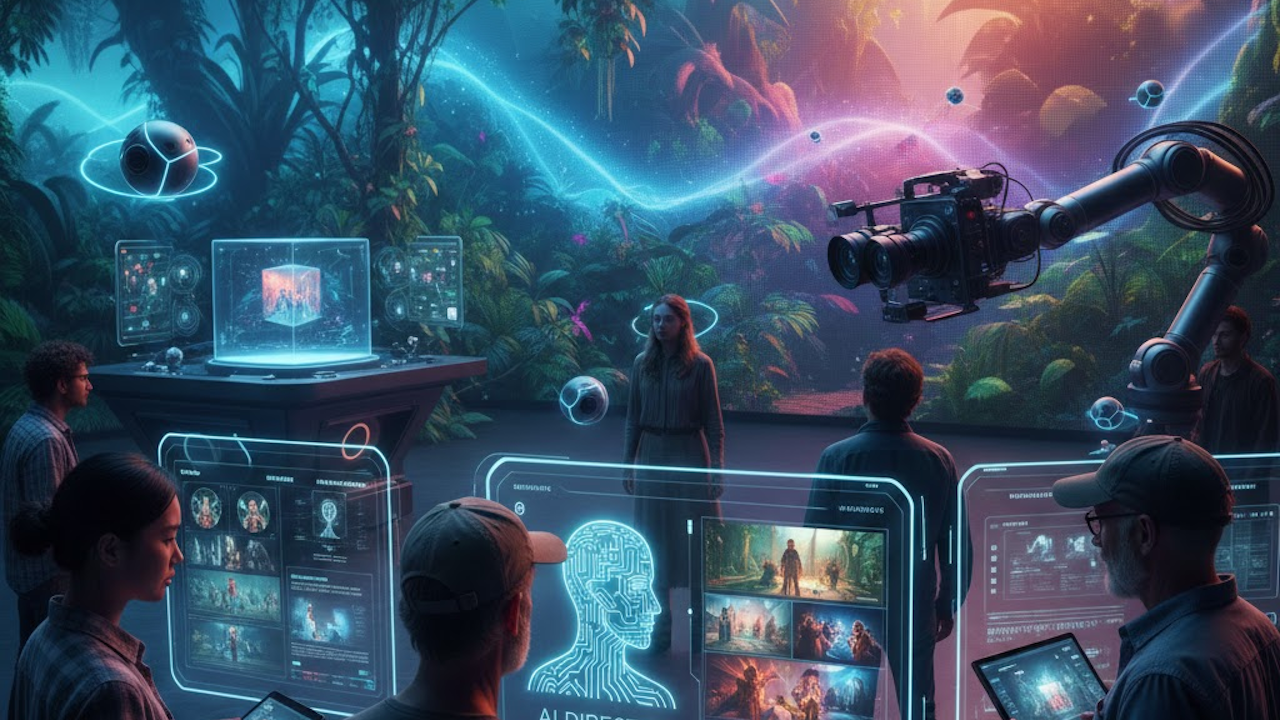
The film industry stands at a transformative crossroads. Artificial intelligence is no longer a distant concept confined to science fiction plots but a practical force reshaping every stage of filmmaking, from script development to final edits. What was once the domain of human directors, writers, and crews is increasingly augmented, and in some cases driven, by algorithms capable of generating visuals, dialogue, and even entire scenes. This evolution raises profound questions about creativity, authorship, and the very essence of cinema. As AI tools grow more sophisticated, they promise to democratize filmmaking while challenging traditional Hollywood structures.
The term “AI director” may sound futuristic, but it describes a growing reality where human creatives collaborate with intelligent systems that can interpret prompts, visualize concepts, and iterate on ideas at speeds unimaginable just a few years ago. This article explores how AI is influencing cinema, examining its applications, real-world examples, benefits, drawbacks, and potential long-term effects on the art form.
A Brief History of Technology in Film
Cinema has always embraced technological innovation. From the introduction of sound in the late 1920s to color film, digital cameras, and computer-generated imagery in the 1990s, each advancement expanded storytelling possibilities. AI represents the latest chapter in this progression, building on earlier computational tools like early visual effects software.
Generative AI gained prominence in the 2020s with models capable of creating images, text, and video from textual descriptions. Tools like OpenAI’s Sora, Google’s Veo, and various image generators such as Midjourney accelerated experimentation. Early experiments, such as the 2016 short film “Sunspring” written by an AI, highlighted both the potential and limitations of machine-generated content. Today, AI permeates pre-production, production, and post-production, moving beyond novelty to become an integral part of workflows.
AI Across the Filmmaking Pipeline
AI’s influence spans the entire production process, offering efficiency and new creative avenues.
In screenwriting and development, AI assists with brainstorming plots, generating dialogue, and analyzing scripts for market appeal. Tools can suggest revisions, predict audience reception based on historical data, or even co-write scenes. While human writers provide emotional depth and originality, AI handles repetitive tasks and offers rapid iterations, potentially reducing development time from months to weeks.
Pre-production benefits enormously from AI-driven storyboarding, casting suggestions, and location scouting. Generative models can produce detailed visual concepts, helping directors visualize complex sequences before filming begins. Predictive analytics optimize budgets by forecasting production needs, such as required props or set designs.
During production, AI supports virtual production techniques, real-time visual effects, and even performance enhancements. For instance, directors have used AI to refine accents or generate background elements on set. In post-production, AI excels at editing, color grading, sound design, and VFX. Automated tools can assemble rough cuts, remove unwanted objects, or generate missing footage, streamlining what traditionally required large teams.
Distribution and marketing also leverage AI for audience targeting, trailer generation, and personalized content recommendations on streaming platforms.
Notable Examples and Pioneers
Several projects illustrate AI’s growing role in cinema. Brady Corbet’s film “The Brutalist” employed AI subtly to refine a lead actor’s performance in a Hungarian dialect scene, sparking debates about authenticity versus enhancement.
Independent creators are pushing boundaries further. Director Dave Clark has pioneered AI-assisted filmmaking, using tools like Midjourney for visuals, Runway for text-to-video, and ElevenLabs for voice generation to produce shorts with intricate stories. His work demonstrates how a single filmmaker can achieve cinematic results that once required substantial crews.
Series like ReelForce’s “King of Mars: Markus’s Revenge” showcase coherent world-building with consistent characters and environments generated through AI, earning praise for immersive storytelling that feels dramatically grounded.
Other experiments include short films created frame-by-frame with tools like Midjourney, animated into narratives, and larger efforts such as AI-visual adaptations of epics. Festivals dedicated to AI filmmaking, such as those spotlighted at events like TIFF, highlight a burgeoning community of creators exploring these technologies.
Veteran filmmakers like Paul Schrader have also embraced generative AI, while younger directors experiment with hybrid approaches, blending traditional techniques with machine assistance.
Democratization and New Opportunities
One of the most significant impacts of AI is lowering barriers to entry. Aspiring filmmakers no longer need massive budgets or studio access to produce professional-looking content. Tools empower individuals to direct, design, and distribute their visions globally, fostering diversity in voices and stories that might otherwise remain untold.
This shift could loosen the grip of major studios, allowing independent producers greater creative freedom. Lower costs in VFX and post-production mean more resources for experimentation, potentially leading to a renaissance in innovative storytelling. Educational programs and online courses now teach AI filmmaking, preparing a new generation of hybrid creators skilled in both artistic direction and technical prompting.
Challenges and Ethical Considerations
Despite the excitement, AI introduces substantial challenges. Concerns about job displacement loom large, particularly for below-the-line workers in editing, VFX, and other technical roles. The 2023 Hollywood strikes underscored fears that AI could devalue human labor and creativity.
Questions of authorship arise when machines contribute significantly to a work. Who owns the copyright of an AI-generated scene? How do we credit contributions? There are also risks of homogenized content if algorithms trained on existing films reinforce tropes rather than innovate.
Deepfakes and unauthorized use of likenesses raise ethical red flags, as seen in experiments replacing actors in scenes. Quality control remains an issue; AI can produce inconsistencies in character appearance, physics, or narrative logic that require human oversight to correct.
Intellectual property debates intensify as models train on vast datasets of existing films, prompting calls for regulation and fair compensation for original creators.
The Hybrid Future: Collaboration Over Replacement
Experts largely agree that AI will not fully replace filmmakers but augment them. The future appears hybrid, where human directors provide vision, emotional insight, and leadership, while AI handles technical execution and rapid prototyping.
Directors of the future may act more like conductors, orchestrating teams of humans and AI systems. World models in AI could enable persistent story universes that evolve across formats, responding dynamically to audiences. This opens doors to interactive cinema, personalized narratives, and entirely new mediums.
As tools mature, the distinction between real and generated footage may blur, shifting audience expectations. Filmmakers who master AI alongside traditional skills will likely thrive, expanding human imagination rather than constraining it.
Looking Ahead
AI directors symbolize a broader technological shift in cinema. They offer tools to overcome production hurdles, foster inclusivity, and unlock ambitious visions once limited by resources. Yet they also demand careful navigation to preserve the human core of storytelling: empathy, surprise, and cultural resonance.
The industry must address ethical frameworks, worker protections, and training initiatives to ensure AI enhances rather than erodes cinema’s artistic integrity. Filmmakers, studios, and audiences alike will shape this future through their choices.
In the end, technology has always served the story. Whether directed by humans alone or in partnership with AI, cinema’s power lies in its ability to move, provoke, and connect us. As AI evolves, so too will the ways we tell our most enduring tales, promising a vibrant, if uncertain, cinematic horizon.