

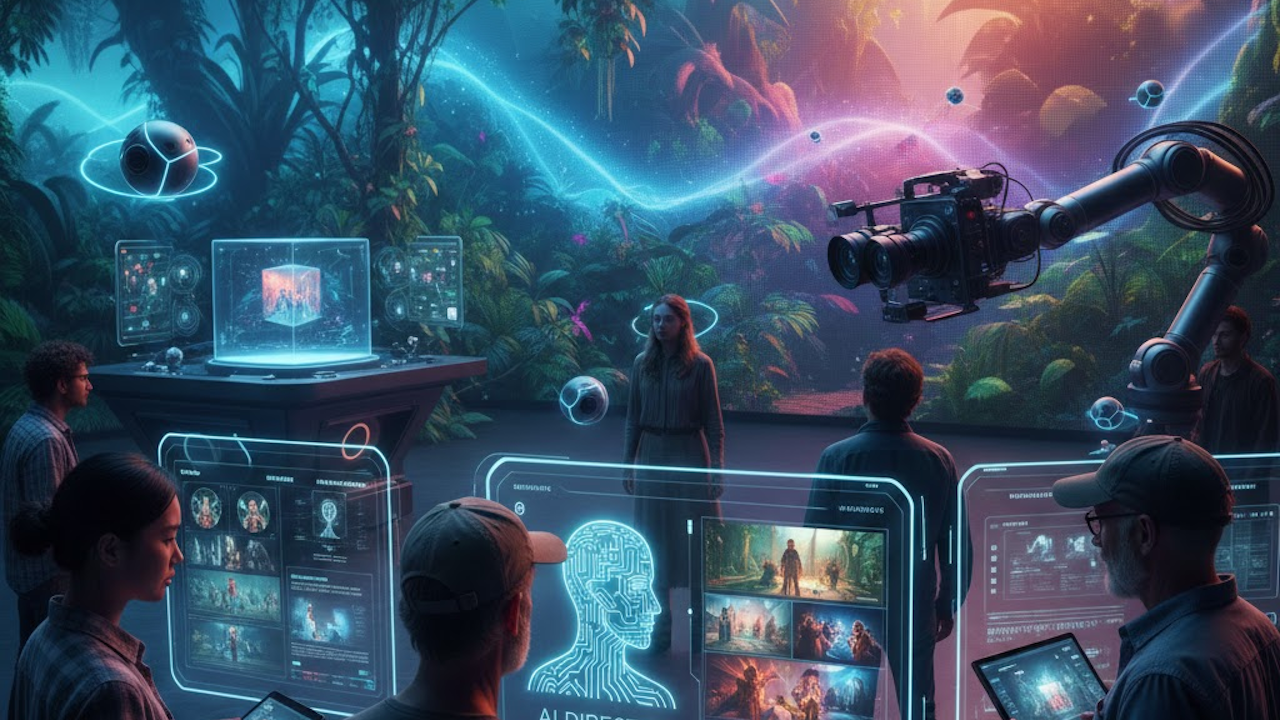
The traditional image of a film director involves a megaphone, a chaotic set, and a singular human vision. However, as we move through 2025, that image is being rewritten by silicon and algorithms. The rise of the AI Director is not merely a change in tools; it is a fundamental shift in how stories are conceived, visualized, and executed.
From generative video models like OpenAI’s Sora and Google’s Veo 3 to predictive analytics that can forecast a film’s success before a single frame is shot, technology is now an active participant in the director’s chair.
The Birth of the Digital Auteur
The concept of an AI Director began with simple automation, such as software that could suggest a basic edit or correct a lighting mistake. Today, it has evolved into a comprehensive creative partner. Modern directors use AI to bridge the gap between imagination and technical feasibility.
Pre-Visualization and Scripting
Before the cameras roll, AI is already at work. Tools like ChatGPT and Claude are no longer just for writing emails; they are being used to break down scripts, identify narrative pacing issues, and even suggest alternative dialogue.
In the realm of storyboarding, the change is even more dramatic. In the past, a director would wait weeks for a concept artist to turn a script into a visual plan. Now, platforms like Midjourney and Cuebric can generate photorealistic storyboards in seconds. A director can describe a mood, a lighting style, and a camera angle, and see it rendered instantly. This allows for rapid iteration, where a filmmaker can “test” ten different visual styles for a scene before committing to one.
Directing Without a Camera
Perhaps the most disruptive change is the ability to create cinematic content without a physical set. Generative video models have reached a level of fidelity where they can produce complex shots that previously required massive crews and millions of dollars.
- Virtual Production: Technologies like the “Volume” (massive LED walls used in The Mandalorian) now use AI to render 3D environments in real time. If a director wants to move the sun or change the color of the sky, they can do it with a click of a button.
- Digital Doubles: AI-generated digital actors and de-aging technology are becoming indistinguishable from reality. Directors can now film complex or dangerous stunts using digital doubles that perfectly match the lead actor’s performance and physical likeness.
- Prompt-to-Screen: We are entering an era where a director might “direct” an AI model rather than a human crew. By providing detailed prompts regarding lens choice, movement, and emotional tone, a filmmaker can generate entire sequences directly from a computer.
The Collaborative Engine: Humans and Algorithms
Despite the fears of job displacement, many industry leaders view AI as a creative lubricant. James Cameron, a pioneer of film technology, recently noted that while he is open to using generative AI to speed up the massive production cycles of films like Avatar, he maintains that it should never replace the soul of the work. The director’s role is shifting from a micromanager of technical details to a high-level curator of vision.
| Stage of Production | Traditional Method | AI-Enhanced Method |
| Casting | Months of auditions and chemistry reads | Data-driven matching based on audience trends and performance history |
| Cinematography | Manual focus pulling and dolly tracking | AI drones and LiDAR systems that track subjects automatically |
| Editing | Weeks of manual cutting and assembly | AI-assisted scene detection and automated rough cuts |
| VFX | Massive teams working on frame-by-frame rotoscoping | Generative fill and instant object removal |
Ethical and Creative Crossroads
The emergence of AI directors brings significant challenges. The most pressing is the question of authenticity. If a film is directed by an algorithm that has analyzed thousands of successful movies, does it risk becoming a “slop” of tropes? There is a danger that cinema could become homogenized, losing the eccentricities and “happy accidents” that make human-led films unique.
There are also legal and ethical hurdles. Who owns the copyright to a film generated by an AI? How do we protect the likeness of actors from being used without consent? These are the questions that will define the industry’s legal landscape over the next decade.
The Democratization of Cinema
The most exciting aspect of this technological revolution is the democratization of the medium. In 2025, the barrier to entry for filmmaking has never been lower. A young creator in a remote part of the world now has access to the same “digital crew” as a Hollywood studio. They can use AI to score their film, generate their backgrounds, and edit their footage.
The future of cinema is not about the replacement of the director, but the expansion of who gets to be one. As AI handles the labor of production, the industry is left with the one thing machines cannot yet replicate: the human need to tell a story that truly matters.