

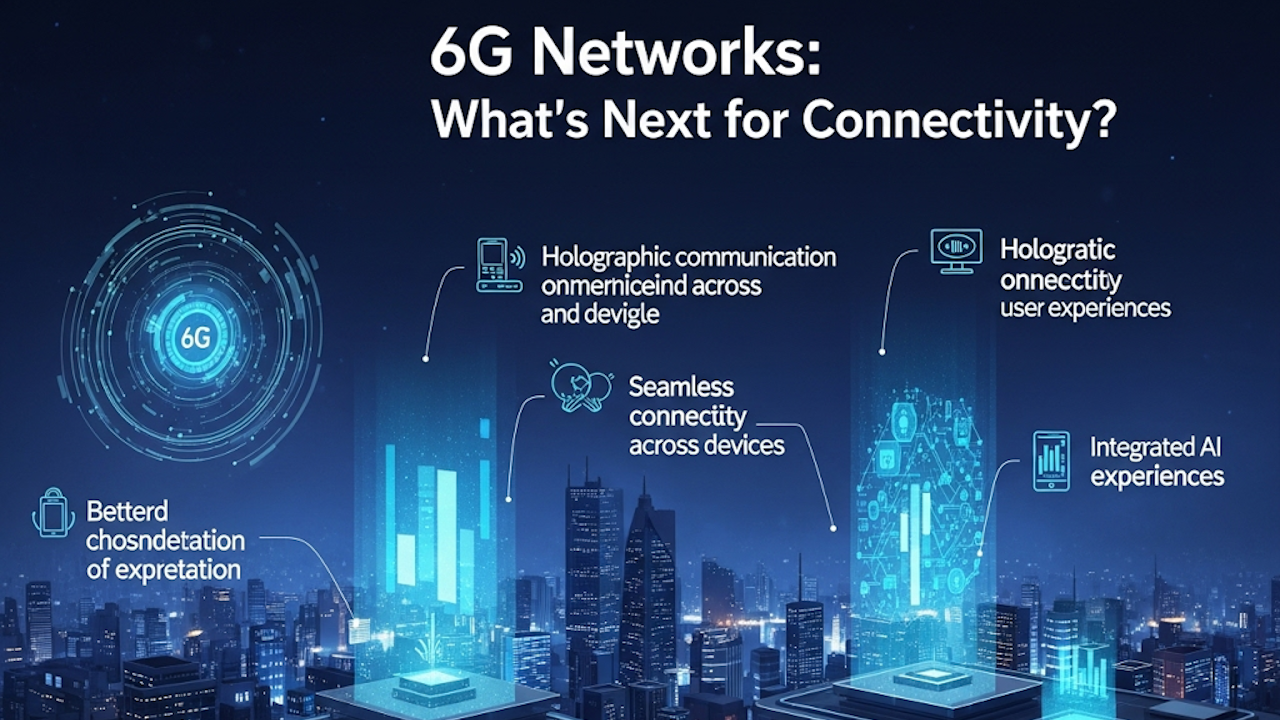
The world of wireless communication stands on the brink of another transformative leap. As 5G networks continue to expand and mature in 2026, attention has shifted firmly toward 6G, the sixth generation of mobile technology poised to redefine connectivity on a global scale. Unlike previous upgrades that primarily boosted speed and capacity, 6G aims to fuse the physical, digital, and biological realms into a seamless intelligent fabric. It will support applications that today seem futuristic, from real-time holographic interactions to networks that sense their environment and adapt autonomously. This article explores the vision for 6G, its technological foundations, expected timeline, global development efforts, potential applications, and the formidable challenges ahead. By examining these elements, we can glimpse how 6G will extend connectivity far beyond what 5G has achieved, unlocking new economic, societal, and industrial possibilities.
To understand 6G, it helps to trace the evolutionary path of wireless generations. Each decade has brought incremental yet profound improvements. 1G introduced analog voice calls in the 1980s. 2G added digital encryption and text messaging in the 1990s. 3G enabled basic mobile internet in the 2000s. 4G delivered high-speed broadband and app ecosystems in the 2010s. 5G, launched commercially around 2019, emphasized ultra-reliable low-latency communication, massive machine-type connections, and enhanced mobile broadband, achieving peak speeds of about 10 gigabits per second and latency as low as 1 millisecond. These advances powered innovations like autonomous vehicles in controlled settings, smart factories, and widespread augmented reality experiences.
6G builds directly on this foundation but pushes performance boundaries by orders of magnitude. Where 5G focused on connectivity for billions of devices, 6G envisions an AI-native system that treats intelligence as a core architectural element rather than an overlay. It will integrate communication with environmental sensing, computing, and control functions. Early visions from research initiatives highlight targets such as peak data rates approaching 1 terabit per second, connection densities exceeding 10 million devices per square kilometer, and latency dropping below 0.1 milliseconds. These metrics are not mere marketing hype; they address the exploding demands of emerging technologies like immersive extended reality, digital twins of entire cities, and brain-computer interfaces.
At the heart of 6G’s technical leap lies the exploitation of higher frequency spectrum, particularly the sub-terahertz and terahertz bands ranging from 100 gigahertz to 10 terahertz. These frequencies offer vast unused bandwidth compared to the millimeter-wave bands used in 5G. The result is the potential for dramatically higher throughput, enabling data transfers that could stream thousands of high-definition holographic videos simultaneously. However, researchers have tempered initial enthusiasm for full terahertz deployment. Recent industry discussions at events like MWC 2026 indicate a practical focus on sub-6 gigahertz bands for broad coverage, upper mid-bands (7-24 gigahertz) for capacity, and selective sub-terahertz use for high-density hotspots. This hybrid approach balances performance with real-world propagation challenges.
Complementing spectrum advances are several enabling technologies that will define 6G architecture. Artificial intelligence will be embedded natively across the air interface, radio access network, core, and user devices. AI-driven optimization will allow networks to self-configure, predict traffic patterns, and allocate resources dynamically in real time. Integrated sensing and communication (ISAC) represents another pillar. 6G base stations will not only transmit data but also use reflected signals to map surroundings, detect objects, and enable applications like precise environmental monitoring or gesture-based controls without additional sensors.
Reconfigurable intelligent surfaces (RIS) will further enhance signal propagation. These programmable metasurfaces, essentially smart walls or panels, can reflect and shape electromagnetic waves to overcome blockages and extend coverage in complex environments. Distributed massive multiple-input multiple-output (MIMO) systems will scale antenna arrays across buildings or vehicles, creating virtual beamforming that delivers focused signals with minimal interference. Edge computing will fuse with these elements to process data locally, reducing reliance on distant cloud servers and supporting time-sensitive tasks. Visible light communication and optical wireless technologies may supplement radio frequencies indoors, providing ultra-high-speed links where line-of-sight conditions allow.
Standardization and commercialization timelines have solidified in recent years. The International Telecommunication Union is expected to finalize its IMT-2030 framework around 2026, outlining the official vision and requirements for 6G. The 3rd Generation Partnership Project (3GPP) has begun work on Release 21, which will include the first 6G specifications, targeted for completion by late 2028. Initial commercial deployments could follow in late 2029 or early 2030, starting in leading markets and expanding globally through the early 2030s. This schedule aligns with the industry’s roughly decade-long cycle between generations, allowing time for prototyping, trials, and ecosystem alignment. By 2026, the focus has shifted from pure research to concept validation, with industry players collaborating on prototypes and early testbeds.
Global efforts reflect intense competition and collaboration. China has positioned 6G as a national priority through the IMT-2030 Promotion Group, established in 2019, with substantial government and industry investment in spectrum research, hardware, and pilot projects. The United States coordinates via the Next G Alliance under the Alliance for Telecommunications Industry Solutions, emphasizing private-sector innovation and partnerships across academia and vendors. Europe advances through projects like Hexa-X and Hexa-X-II under the Horizon Europe program, with companies such as Nokia and Ericsson playing central roles in sustainable and intelligent network design. South Korea aims for pre-6G demonstrations by 2026 via public-private investments, while Japan has launched funding initiatives focused on spectrum and international standards. These parallel tracks underscore a shared recognition that 6G leadership will confer strategic advantages in technology, economy, and security.
The applications enabled by 6G extend far beyond faster downloads. In healthcare, surgeons could perform remote procedures with haptic feedback indistinguishable from physical presence, supported by sub-millisecond latency and high-reliability links. Smart cities will deploy digital twins that mirror real-time traffic, energy usage, and environmental conditions, allowing predictive management of infrastructure. Industry 5.0 envisions human-machine collaboration at unprecedented scales, with factories using ISAC for seamless robot coordination and zero-downtime operations. Immersive extended reality will evolve into full holographic telepresence, transforming education, entertainment, and remote work. Large-scale AI systems will operate across physical environments, with networks feeding continuous data streams to train models on the edge. Even sustainability gains are anticipated through energy-efficient designs that could improve power consumption by 10 to 100 times compared to previous generations.
Despite the promise, significant challenges remain. Terahertz signals suffer from high propagation losses, molecular absorption by atmospheric gases, and sensitivity to obstacles like rain or foliage. Overcoming these will require dense infrastructure deployments, advanced beamforming, and innovative materials for antennas and transceivers. Energy efficiency poses another hurdle; while targets are ambitious, powering AI-native networks and massive sensor arrays without spiking consumption demands breakthroughs in hardware and algorithms. Security and privacy concerns intensify with denser connectivity and integrated sensing capabilities. Networks must incorporate robust encryption, zero-trust architectures, and resilient designs to counter cyber threats that could exploit the very intelligence meant to enhance them. Spectrum allocation requires global coordination to avoid fragmentation, and the high costs of rollout may widen digital divides unless addressed through policy and inclusive planning. Standardization itself remains complex, as competing regional priorities could delay interoperability.
Economic and societal impacts will be profound. Analysts project the 6G market to grow rapidly from modest experimental phases in the late 2020s to hundreds of billions in value by the mid-2030s, driven by new enterprise models in immersive applications and AI-enabled services. It could accelerate digital transformation across sectors, fostering innovation in areas like precision agriculture, climate monitoring, and personalized education. Yet equitable access will be critical. Policymakers must ensure that 6G benefits extend to rural and underserved regions, perhaps through non-terrestrial networks integrating satellites and high-altitude platforms for truly ubiquitous coverage.
In conclusion, 6G represents more than an incremental upgrade to wireless infrastructure. It heralds an era where connectivity becomes intelligent, pervasive, and context-aware, blending communication with sensing and computation to create experiences that feel intuitive and natural. As standardization progresses and prototypes mature through 2026 and beyond, the path to 2030 deployments will test the limits of engineering, collaboration, and imagination. The ultimate success of 6G will depend not only on technological prowess but on how societies harness it to address pressing challenges while fostering inclusive growth. What lies ahead is a future of connectivity that transcends speed alone, promising a world where distance, delay, and disconnection fade into memory. The next chapter in human progress through networks is just beginning to unfold.