

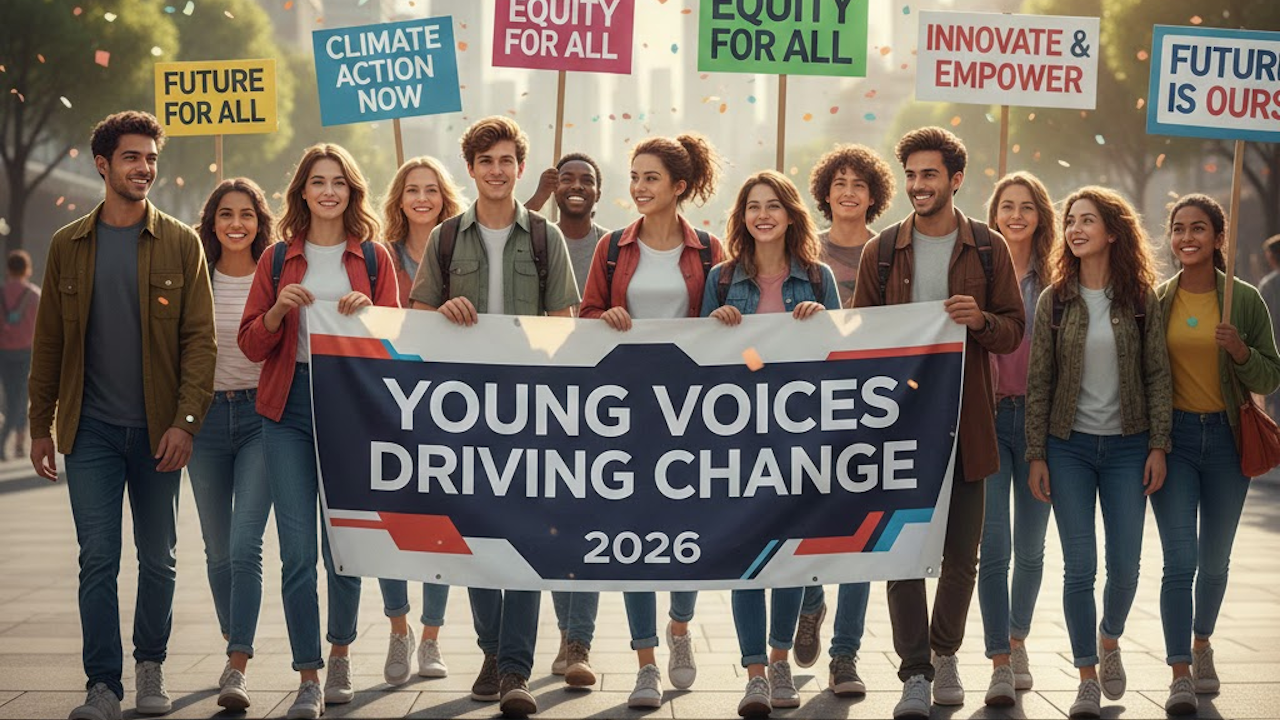
In 2026, a clear pattern has taken hold across continents. Young people, primarily those in Generation Z and the younger end of the millennials, are no longer waiting on the sidelines for older institutions to deliver results. They are organizing, innovating, protesting, and embedding themselves in decision-making processes that once excluded them. From climate action on the ground to political upheavals that have toppled governments, from education policy debates to community-level solutions powered by digital tools, youth voices are shaping outcomes in real time. This is not abstract idealism. It is practical, often decentralized work driven by lived experience with economic precarity, environmental stress, and institutional distrust.
The year has already produced measurable markers of this shift. Wind and solar power generated more electricity globally than gas for the first time, a milestone that youth climate groups have helped accelerate through advocacy and local projects. At the same time, UNESCO released its 2026 Youth Report titled “Lead with youth,” documenting both progress and persistent gaps in how governments include young people in education policy. Parallel to these formal efforts, street-level movements in Africa and Asia have forced accountability, while innovation prizes and leadership networks have scaled practical solutions in dozens of countries. What unites these efforts is a refusal to accept token consultation. Young people are demanding, and in many cases securing, genuine co-creation of the systems that will define their futures.
Climate Action Moving from Protest to Practice
Climate remains one of the most visible arenas where young voices have moved beyond awareness-raising into implementation. A decade after the Paris Agreement, progress is uneven but tangible. Youth-led initiatives are producing data, protecting land, and building alternatives rooted in local knowledge rather than waiting for top-down mandates.
In Mongolia, the Breathe Mongolia-Clean Air Coalition has combined air quality monitoring with policy advocacy to confront severe pollution. Their work has gathered tens of thousands of signatures, contributed to parliamentary discussions, and pushed for an end to certain coal stove subsidies. Similar energy appears in other regions. The Youth Climate Justice Fund has highlighted how young organizers are shifting from pure advocacy to on-the-ground systems change, including rapid response campaigns that secured the release of environmental defenders in early 2026.
Across Africa, partnerships such as those between EARTHDAY.ORG and the Climate Smart Agriculture Youth Network trained emerging leaders in Kenya, Nigeria, Cameroon, Gambia, and Ghana to design Earth Day projects focused on restoration, sustainable agriculture, and community education. These efforts treat young people as implementers rather than beneficiaries. In the Asia-Pacific, more than a thousand young leaders surveyed across 35 countries reported navigating climate governance structures, co-drafting policies, and forming strategic alignments that older institutions once monopolized.
Innovation prizes have further amplified this work. The 2026 Global Shapers Innovation Prize recognized youth-led projects addressing gaps in technology access for women, climate literacy programs that turn anxiety into civic letters and policy submissions, and other community solutions that have already reached thousands. These are not isolated experiments. They form part of a broader pattern in which digital fluency allows young people to collect localized data, share tactics across borders, and hold decision-makers to account with evidence rather than slogans alone.
Political Upheaval and the Demand for Accountability
Beyond environmental work, 2026 has seen sustained political pressure from young people frustrated by corruption, economic exclusion, and unresponsive elites. In Kenya, the second anniversary of the 2024 Gen Z protests brought thousands back into the streets of Nairobi and other cities. Demonstrators marked the more than 120 lives lost two years earlier and pressed for justice, compensation, and greater government accountability on living costs and governance. The movement remains decentralized, coordinated largely through social media, and distinct from traditional party structures.
Similar dynamics reshaped Nepal. Protests that intensified in 2025 against nepotism, unemployment, and entrenched party politics contributed to the resignation of the previous government and paved the way for elections in March 2026. Those elections elevated a 36-year-old former rapper and mayor, Balendra Shah, as the country’s youngest prime minister. Hashtags such as #NepoBabies spread rapidly, and social media bans only accelerated street mobilization. Young protesters framed their actions as a rejection of institutional failure rather than allegiance to any single ideology.
The pattern extends further. Analyses of recent years document Gen Z-led or heavily youth-influenced uprisings and policy reversals in Bangladesh, Indonesia, Madagascar, the Philippines, and other nations. Common triggers include economic hardship, police repression, and visible elite privileges. Organizers often operate horizontally, share tactics internationally, and use creative tools ranging from memes and graffiti to rapid mutual aid. Governments have been forced to reverse unpopular measures or, in some cases, step aside.
In the United States, the picture is different but related. Surveys ahead of the 2026 midterms show high levels of party alienation among Gen Z voters. Many express dissatisfaction with both major parties and focus on economic stability, skills, and well-being. At the same time, a visible cohort of Gen Z candidates is running for office, arguing that no one else will deliver the changes they need. Organizations on both the left and the right have emerged to support younger candidates, reflecting a pragmatic recognition that electoral pathways remain one route to influence.
Leadership, Education, and Institutional Openings
Formal institutions have begun to respond, albeit unevenly. UNESCO’s 2026 Youth Report mapped more than 500 nationwide youth and student organizations involved in education decision-making. It found that consultation mechanisms exist in many countries, yet genuine influence over policy remains limited. The report, produced in partnership with the United Nations Youth Office, argues that the final years of Sustainable Development Goal 4 and any successor agenda must be shaped with young people rather than merely for them.
Networks such as One Young World continue to connect tens of thousands of young leaders with corporations and governments that are experimenting with intergenerational collaboration. Companies including L’Oréal, BMW, EY, Siemens, and others have begun embedding younger perspectives into core decisions rather than treating youth input as a public-relations exercise. In Thailand, nearly 400 young leaders participated in a national dialogue marking 80 years of UN membership, pressing for inclusion in the implementation of the Pact for the Future and insisting that young people are stakeholders and equal partners, not future leaders alone.
In Africa, the Institute for Security Studies opened applications for its Young Changemakers 2026 program, inviting Africans aged 18 to 35 to present visions for the continent in 2050. Finalists will attend a conference focused on the choices that will shape Africa’s rapid demographic and employment transitions. Parallel UNESCO programs on intercultural leadership and peace have equipped dozens of young leaders from nearly 50 countries to run community projects reaching more than a million people.
Digital Tools and Practical Innovation
A defining feature of these efforts is technological fluency. Young people treat social media, messaging apps, and open data as infrastructure rather than novelties. They use them to coordinate across borders, circumvent restrictions with VPNs, and turn climate concern into concrete outputs such as policy submissions or local monitoring systems. In India, platforms that poll tens of thousands of young people daily on issues ranging from climate anxiety to mental health have begun feeding insights into city-level resilience frameworks.
Global dialogues, such as the Tsinghua Global Youth Dialogue held across Chinese cities in mid-2026, brought together students, entrepreneurs, and researchers focused on AI education, digital healthcare, women’s leadership, and sustainable development. Participants emphasized collaboration over national silos and highlighted how rapidly young people can prototype solutions once given access to tools and networks.
Challenges That Persist
None of this progress is automatic or uncontested. Many governments still treat youth engagement as symbolic. Economic barriers, including high youth unemployment in parts of Africa and Asia, limit the time and resources available for sustained organizing. Digital platforms that enable rapid mobilization can also amplify misinformation or expose activists to surveillance. In some countries, protest movements have faced violent responses, and the transition from street pressure to durable institutional reform remains incomplete.
Intergenerational tensions surface regularly. Older decision-makers sometimes dismiss youth demands as naive, while young organizers criticize established leaders for short-term thinking on issues whose consequences will fall most heavily on those now in their twenties and thirties. Bridging that gap requires more than invitations to panels. It requires shared power over budgets, legislation, and strategy.
Looking Ahead
The developments of 2026 suggest that young voices are becoming a structural feature of global problem-solving rather than a temporary wave. Climate projects are producing cleaner air and policy shifts. Political movements have altered governments and forced policy reversals. Leadership networks and education reports are creating baselines against which future inclusion can be measured. Innovation prizes and digital platforms are turning ideas into scaled solutions.
What remains essential is continuity. Token seats at the table are insufficient. Young people have demonstrated the capacity to generate data, organize at scale, and deliver results under difficult conditions. Institutions that treat them as equal partners stand a better chance of producing policies that endure. Those that continue to consult without sharing power risk further erosion of trust.
The story of 2026 is therefore not simply that young people are speaking. It is that many of them are already building the alternatives, enforcing accountability, and claiming space in the systems that will determine the quality of life for decades to come. The question for older generations and existing institutions is whether they will accelerate that work or continue to lag behind it.