

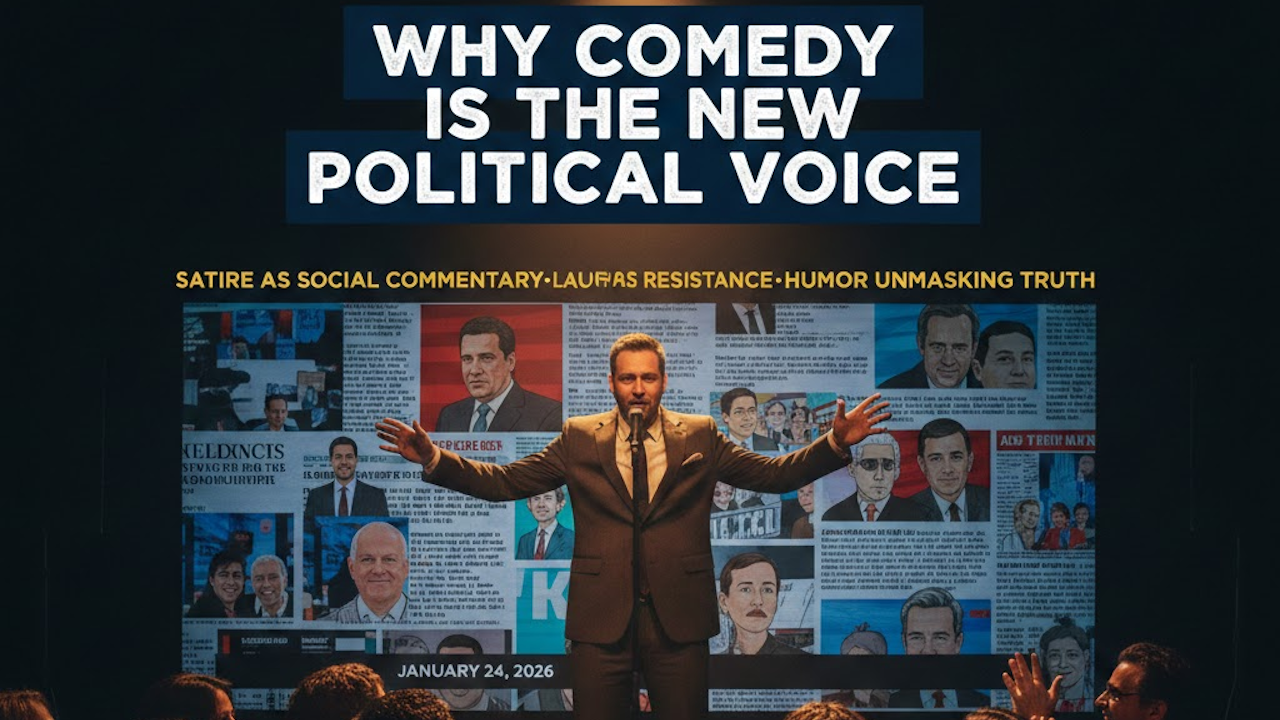
Comedy has always had a place in public life, but in recent decades it has moved from the margins of entertainment into the center of political conversation. Late-night monologues, stand-up specials, viral sketches, and meme accounts now shape how millions of people understand elections, policy debates, and cultural conflicts. What was once dismissed as mere diversion has become one of the primary ways citizens process power, hypocrisy, and institutional failure. Comedy is not simply commenting on politics. In many cases it has become the politics.
The shift did not happen overnight. For centuries rulers tolerated jesters precisely because humor could deliver uncomfortable truths without triggering the full weight of official retaliation. Shakespeare’s fools spoke more freely than his kings. Political cartoons in the nineteenth century regularly reduced presidents and prime ministers to objects of ridicule. Yet those forms remained secondary to speeches, newspapers, and formal debate. The difference today is scale, speed, and cultural authority. A single well-timed joke can reach more people in an afternoon than a carefully researched newspaper investigation reaches in a month. When traditional institutions lose trust, audiences turn to the voices that still feel human and unscripted. Comedians often fill that gap.
One reason comedy thrives as political speech is its ability to lower defenses. Direct accusation triggers tribal loyalty. A well-constructed joke invites the audience to laugh first and think second. The laughter creates a temporary suspension of partisan reflex. Once that guard is down, the underlying point can land with greater force. This is not a new insight. Satirists have long understood that mockery can make the powerful look smaller and the audience feel larger. What has changed is the delivery system. A joke that once required a ticket to a club or a subscription to a magazine now travels through smartphones at almost no cost. The same mechanism that spreads dance videos also spreads critiques of legislation, foreign policy, and elite behavior.
Social media accelerated the process. Platforms reward brevity, emotion, and shareability. Long-form policy analysis rarely competes with a thirty-second clip that captures an absurd contradiction. Comedians adapted faster than most journalists and politicians. They learned to package complex failures into digestible punch lines. The result is a feedback loop. Audiences hungry for clarity and catharsis reward the clearest, funniest frames. Those frames then shape how the same audiences interpret subsequent news. Over time the comedic interpretation can become the default interpretation.
This development carries democratic benefits. Comedy can expose hypocrisy that formal reporting sometimes softens in the name of access or neutrality. It can give voice to frustration that polite discourse suppresses. It can also create temporary coalitions across usual political lines when the target is sufficiently ridiculous. Shared laughter remains one of the few remaining experiences that can briefly unite people who otherwise regard each other with suspicion. In an era of fragmented attention and mutual incomprehension, that unifying effect is not trivial.
Yet the rise of comedy as political voice also introduces serious distortions. Humor selects for the ridiculous. Nuance, trade-offs, and incremental progress make poor material for punch lines. A policy that reduces harm by fifteen percent while creating new administrative burdens will rarely generate viral comedy, while a single tone-deaf statement by a public official can dominate the discourse for days. The incentive structure favors outrage and simplification. Comedians who want to remain relevant must continually find new targets and sharper edges. Over time this can produce a politics of permanent mockery in which every institution and every opposing faction appears primarily as a source of material rather than as a collection of people trying, however imperfectly, to solve problems.
Partisan capture presents another risk. Once comedy becomes a major channel of political information, it becomes a prize worth capturing. Networks, streaming platforms, and individual creators face pressure to align with the preferences of their core audiences. The result is often two parallel comedic universes that rarely overlap. Each side laughs at the excesses of the other while remaining largely blind to its own. The same tools that once punctured authority can harden into new forms of orthodoxy. When every joke carries an expected ideological payload, the original subversive power begins to erode.
There is also the question of responsibility. Traditional political actors can be held accountable through elections, legislative procedures, or professional codes. Comedians operate under different rules. They can claim the privilege of the court jester while simultaneously shaping the opinions of millions. The claim that “it’s just a joke” becomes harder to sustain when the joke functions as the primary frame through which large numbers of people understand reality. The more influence comedy gains, the less tenable the pure entertainment defense becomes.
Still, the underlying demand that elevated comedy is unlikely to disappear. Citizens continue to seek forms of political communication that feel authentic, emotionally resonant, and free from institutional jargon. As long as formal politics appears remote, scripted, or captured by narrow interests, audiences will keep turning to the voices that make them laugh while telling them something that feels true. The task for both creators and audiences is to recognize the power of the form without surrendering critical judgment to it.
Comedy will not replace careful analysis, institutional reform, or the hard work of persuasion across difference. It can, however, keep those efforts honest by refusing to let power take itself too seriously. The healthiest political culture may be one in which serious argument and sharp satire exist in productive tension rather than in competition for dominance. When laughter becomes the only remaining common language, the challenge is to ensure it remains a language of recognition rather than a weapon of permanent division.
In the end the rise of comedy as political voice reflects both the exhaustion of older forms and the enduring human preference for speech that entertains while it reveals. Whether that preference strengthens democratic life or merely accelerates its fragmentation will depend on how wisely societies learn to use the new voice they have chosen.