

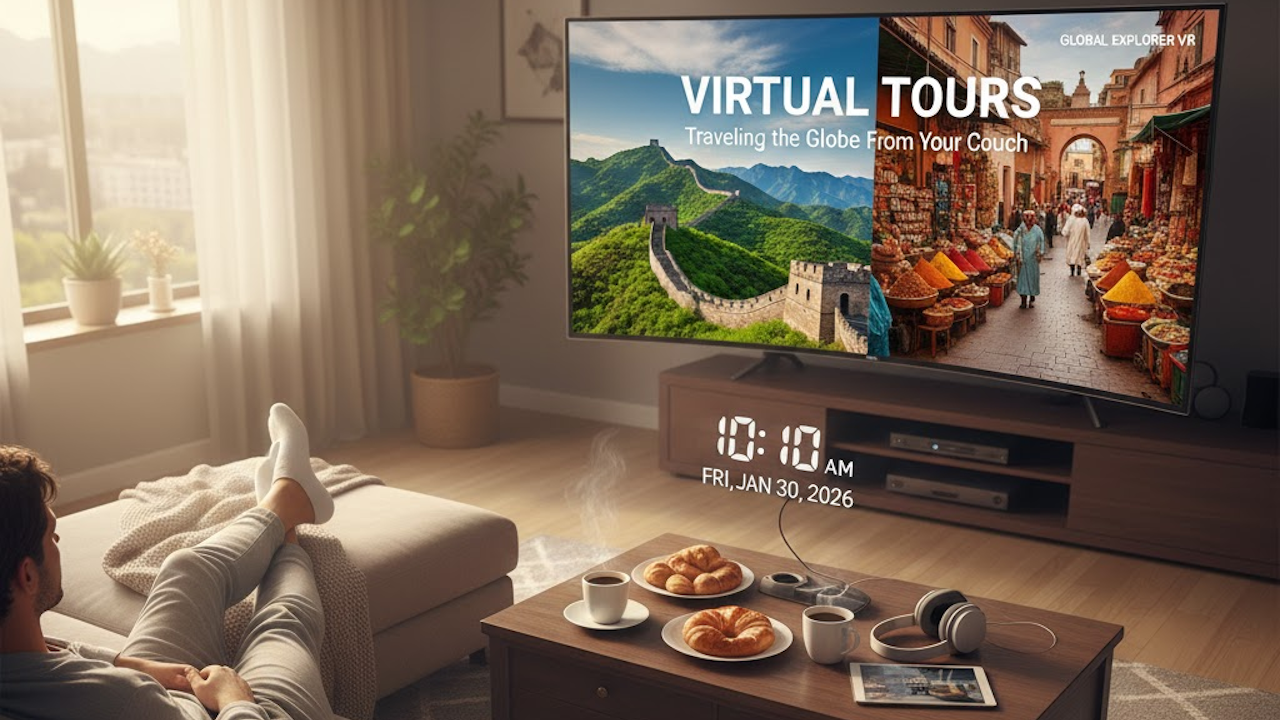
The world has always held a magnetic pull for the curious. For centuries, explorers crossed oceans, climbed mountains, and mapped uncharted territories in pursuit of discovery. Today, that same spirit of adventure no longer requires a passport, a plane ticket, or even leaving the living room. Virtual tours have transformed the way people experience distant places, offering immersive journeys through museums, ancient ruins, bustling cities, and remote natural wonders. From the comfort of a couch, anyone with an internet connection can stand before the pyramids of Giza, wander the halls of the Louvre, or hike the trails of Patagonia. This form of travel, once a novelty, has become a mainstream way to explore the planet.
The rise of virtual tourism did not happen overnight. Early versions appeared in the 1990s with rudimentary 360-degree photographs and basic computer simulations. Museums experimented with online galleries, while tourism boards offered simple slideshows of attractions. The real shift came with advances in photography, video, and internet speeds. Google Street View, launched in 2007, allowed users to navigate city streets as if walking them in person. High-resolution cameras mounted on cars, backpacks, and even boats captured continuous imagery that could be stitched into seamless panoramic views. Around the same time, museums began digitizing collections with professional-grade equipment, creating detailed virtual walkthroughs that let visitors examine brushstrokes on paintings or inscriptions on artifacts without glass barriers.
The COVID-19 pandemic accelerated adoption dramatically. When international travel halted and physical attractions closed, cultural institutions and tourism operators turned to digital alternatives to stay connected with audiences. Virtual tours that had existed quietly for years suddenly became essential. The Louvre reported millions of online visitors exploring its galleries. National parks offered guided video walks. Cruise lines streamed live views from empty decks. What began as a temporary solution revealed lasting demand. People discovered they could visit places previously inaccessible due to cost, distance, physical limitations, or time constraints. The habit stuck even after borders reopened.
One of the strongest advantages of virtual tours is accessibility. Travel has long been shaped by privilege. Expensive flights, visas, accommodations, and physical fitness requirements exclude large portions of the global population. Virtual experiences remove many of those barriers. A person with limited mobility can explore the steep streets of Santorini or the multi-level corridors of a medieval castle. Someone living far from major cultural centers can spend an afternoon in the British Museum or the Metropolitan Museum of Art. Families on tight budgets can take children on educational journeys without the stress and expense of actual travel. Schools use virtual tours to bring history and geography lessons to life, allowing students to “visit” the Roman Forum or the Great Barrier Reef during class time.
Cost savings form another clear benefit. Traditional travel involves transportation, lodging, food, entrance fees, and unexpected expenses. A virtual tour typically requires only an internet connection and perhaps a modest subscription or free access. Many of the highest-quality experiences are available at no charge. Google Arts and Culture hosts thousands of virtual exhibits from partner institutions worldwide. National Geographic, UNESCO, and various tourism boards offer free high-quality 360-degree videos and interactive maps. For those seeking more immersion, affordable virtual reality headsets unlock even deeper experiences without the price tag of an international trip.
Environmental considerations also favor virtual exploration. Aviation accounts for a significant share of global carbon emissions, and mass tourism places pressure on fragile ecosystems and historic sites. Overcrowding at popular destinations such as Venice, Machu Picchu, and certain national parks has led to restrictions and damage. Virtual visits generate almost no direct environmental impact beyond the electricity used by devices. They allow people to appreciate places without contributing to wear and tear, overcrowding, or the carbon footprint associated with long-distance travel. Some conservation organizations now promote virtual tours as a way to raise awareness and funding while protecting sensitive locations.
The range of available experiences has grown remarkably diverse. Art museums lead the way with sophisticated offerings. The Rijksmuseum in Amsterdam lets users zoom into Rembrandt paintings at resolutions impossible in person. The Vatican Museums provide detailed views of the Sistine Chapel ceiling. Beyond art, natural history museums offer virtual digs into fossil collections and interactive exhibits on evolution. Historical sites present reconstructions and guided narratives. Users can walk through the ruins of Pompeii with overlays showing how the city appeared before the eruption of Mount Vesuvius. Ancient Egyptian tombs reveal hieroglyphs and burial chambers that remain closed to the public for preservation reasons.
Cities themselves have become destinations for virtual exploration. Street View covers vast portions of the planet, from Tokyo’s neon-lit alleys to the quiet lanes of small European villages. Interactive maps allow users to navigate freely, pausing to examine architecture, read shop signs, or simply absorb the atmosphere. Some platforms add layers of historical photography, letting visitors compare modern streets with images from decades or centuries earlier. Live webcams in public squares, harbors, and mountain viewpoints provide real-time windows onto distant places, complete with changing weather and the movement of people going about their days.
Nature and adventure destinations thrive in virtual formats as well. National parks offer trail simulations and ranger-led virtual hikes. Underwater sites feature 360-degree videos of coral reefs and shipwrecks. Mountain ranges appear in drone footage that soars over peaks and valleys. Zoos and aquariums stream live animal cams and create virtual enclosures that educate while entertaining. Space exploration even enters the mix through NASA and other agencies that provide virtual tours of the International Space Station and planetary surfaces reconstructed from rover data.
Technology continues to improve the quality of these experiences. Early virtual tours often felt flat or limited by low resolution. Modern versions use high-dynamic-range imaging, precise spatial audio, and smooth navigation. Virtual reality headsets take immersion further by placing the user inside a three-dimensional space where head movements control the view. Some platforms incorporate interactive elements: clicking on objects reveals information, quizzes test knowledge, or guided audio narration provides context. Augmented reality applications overlay digital information onto real-world views through phone cameras, though pure virtual tours remain the primary couch-based option.
Live virtual tours add a social dimension. Guided sessions led by experts or local guides allow real-time questions and discussion. Participants from different countries can join the same tour, sharing reactions and insights. Some platforms host private group experiences for families, schools, or corporate teams. These shared moments recreate aspects of traditional travel companionship while removing logistical complications.
Preparing for a successful virtual tour involves a few practical considerations. A stable internet connection prevents buffering during high-resolution streams. A larger screen or tablet enhances detail compared with a small phone display. For maximum immersion, a virtual reality headset paired with comfortable seating creates a stronger sense of presence. Headphones improve audio quality, especially for guided tours with narration or ambient sounds. Setting aside dedicated time, free from distractions, helps maintain focus and engagement. Treating the experience like an actual outing rather than casual browsing yields greater satisfaction.
Certain virtual tours stand out for their quality and depth. Google Arts and Culture remains one of the most comprehensive free resources, partnering with hundreds of institutions. The Smithsonian offers extensive collections and virtual exhibits. The British Museum and Louvre maintain strong online presence with detailed gallery walkthroughs. For natural wonders, sites affiliated with national parks and conservation groups provide excellent guided content. Independent creators on video platforms produce carefully crafted 360-degree films of less-visited locations, expanding the range beyond major tourist attractions.
Limitations exist, of course. No virtual experience fully replicates the sensory richness of physical travel. The smell of ocean air, the feeling of stone underfoot, the taste of local cuisine, and the unpredictable encounters with people remain unique to being present. Temperature, humidity, and the physical effort of movement contribute to memory and understanding in ways screens cannot match. Some users report that virtual tours can feel isolating or incomplete after extended use. Technical issues such as motion discomfort in virtual reality or imperfect image stitching occasionally disrupt the experience.
Despite these gaps, virtual tourism serves purposes that physical travel cannot always fulfill. It functions as research and planning tool. Prospective travelers can preview destinations, compare hotels through virtual property tours, or familiarize themselves with layout and logistics before booking. It supports lifelong learning for those who may never visit certain places due to age, health, or other constraints. It preserves access to sites that face closure, reconstruction, or environmental threat. When a historic building undergoes restoration or a natural area restricts visitors for recovery, virtual versions keep the location available to the public.
Looking ahead, the technology shows no signs of slowing. Improvements in resolution, frame rates, and interactivity will make virtual environments more convincing. Artificial intelligence may personalize tours based on user interests, adjusting pacing, language, and focus areas. Haptic feedback devices could introduce limited tactile sensations. Integration with social platforms might create persistent virtual spaces where people return repeatedly to explore together. Hybrid models already appear, combining physical visits with digital enhancements through apps that provide layered information on site.
The cultural implications run deep. Virtual access democratizes knowledge of global heritage. Artifacts and sites once restricted by geography or politics become shared resources. At the same time, questions arise about authenticity and ownership. Digitization projects require careful ethical consideration regarding representation, consent from local communities, and the potential for commercial exploitation of cultural assets. Responsible platforms work with institutions and communities to ensure accurate, respectful presentation.
For many people, virtual tours have become a regular part of leisure and education. An evening might include a walk through a Japanese garden, followed by a visit to an Impressionist exhibition, then a quiet sit by a webcam overlooking a Norwegian fjord. These experiences accumulate into a personal atlas of places visited without suitcases or jet lag. They satisfy curiosity, spark new interests, and sometimes inspire future physical journeys. In other cases, they stand complete on their own as meaningful encounters with the wider world.
The couch has become an unexpected departure lounge. From that ordinary piece of furniture, the globe unfolds in high definition and interactive detail. Virtual tours do not replace the irreplaceable magic of standing in a place and breathing its air. They expand the definition of travel itself, making exploration possible for more people, more often, and with fewer barriers. As technology advances and content libraries grow, the distance between home and the farthest corners of the planet continues to shrink. The only requirement is the willingness to look, click, and begin the journey.