

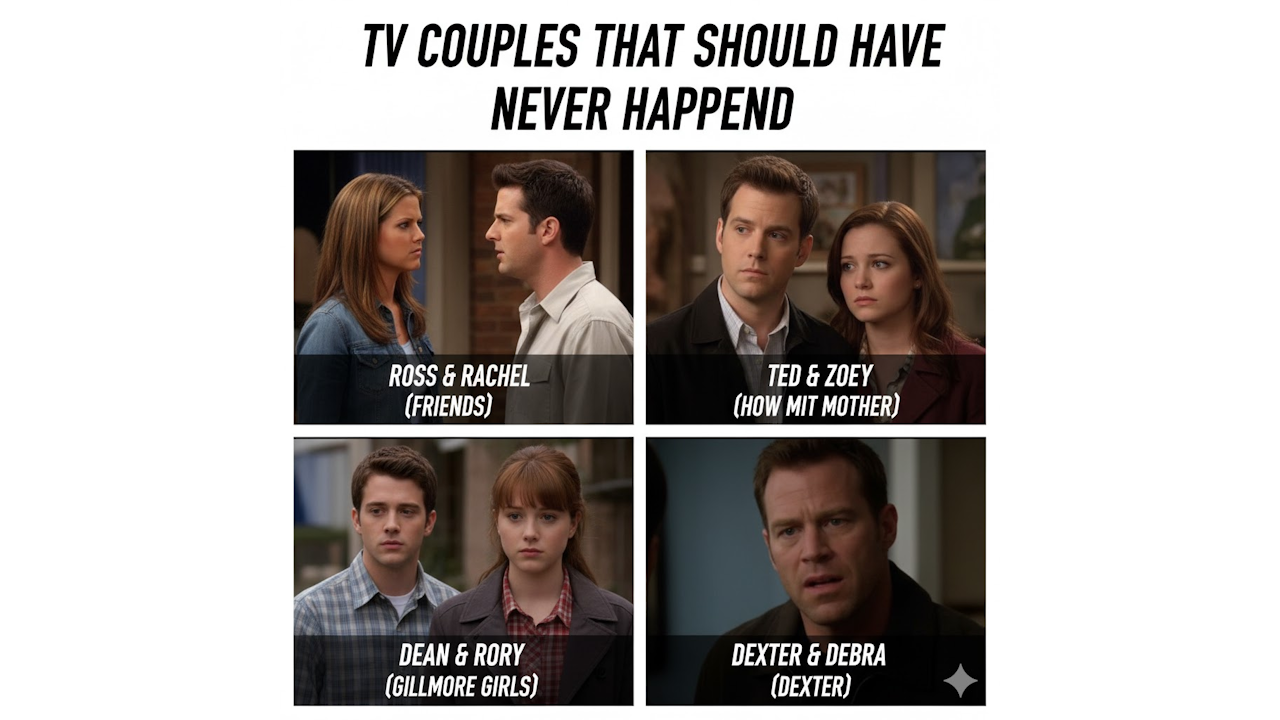
Television has given us some of the most memorable romances in pop culture history. From sweeping love stories to will-they-won’t-they tensions, couples often drive the emotional core of our favorite shows. Yet not every pairing lands well. Some feel forced by writers desperate for drama, others reveal deep incompatibilities or outright toxicity once the initial spark fades. These couples not only strained viewer patience but sometimes undermined the shows themselves. Here is a deep dive into some of the most regrettable TV romances that, in hindsight, should have never happened.
Ross and Rachel from Friends
Ross Geller and Rachel Green defined the on-again, off-again dynamic for a generation. Their relationship began with years of unrequited feelings, a pivotal “we were on a break” moment, and endless complications. While their chemistry provided laughs and heartfelt moments, the pairing highlighted fundamental issues. Ross’s jealousy and controlling tendencies clashed repeatedly with Rachel’s growth into an independent career woman. The constant breakups and makeups grew exhausting rather than romantic. Many fans argue the show would have benefited from letting them remain friends or finding better matches. Instead, their saga dragged on, often at the expense of character development for both.
Ted and Robin from How I Met Your Mother
The entire series of How I Met Your Mother built toward Ted Mosby’s search for the mother of his children. Yet the creators could not resist circling back to Robin Scherbatsky as a central love interest. Ted and Robin shared some sweet early episodes, but their core values never aligned. Ted wanted marriage and kids immediately while Robin prioritized her career and independence. Their repeated attempts at romance felt like the show forcing a square peg into a round hole. The finale’s decision to reunite them after revealing the mother’s fate only amplified the frustration for many viewers who had invested in Ted’s journey. A clean break earlier would have served both characters and the story better.
Aria and Ezra from Pretty Little Liars
Few TV relationships carry the ethical weight of Aria Montgomery and Ezra Fitz. Their romance started when Aria was a high school student and Ezra her English teacher. Even after the age gap and power imbalance were addressed in the plot, the foundation remained deeply problematic. The relationship normalized predatory dynamics under the guise of true love. Ezra’s initial interest in Aria while she was underage, combined with his later deceptions, made their eventual happy ending feel unearned and uncomfortable. Many critics and fans now view this pairing as one of television’s most glaring missteps in romantic storytelling.
Chuck and Blair from Gossip Girl
Chuck Bass and Blair Waldorf became icons of passionate, turbulent romance. Their ups and downs, schemes, and dramatic declarations captured hearts. Yet underneath the glamour lay a deeply toxic dynamic. Chuck’s early behavior included attempted assault, manipulation, and emotional abuse. Their relationship often glorified control and jealousy as signs of intense love. While the show tried redemption arcs, the core issues persisted. Fans who once shipped them hard have increasingly recognized how harmful this model of romance appeared, especially to younger audiences. A version of Gossip Girl where Blair found strength without Chuck might have delivered a stronger message.
Fez and Jackie from That 70s Show
Fez harbored a long-standing crush on Jackie Burkhart throughout much of That 70s Show. Their eventual coupling in later seasons felt like a lazy resolution rather than organic growth. Jackie had spent years pursuing status and popularity while Fez represented a different world. The pairing lacked the spark of her earlier relationships and often played as comedic relief instead of genuine romance. Many viewers felt it undermined both characters’ arcs and served more as a way to tie up loose ends than a satisfying love story.
Rachel and Joey from Friends
Before Ross and Rachel’s final reconciliation, the show tested Rachel with Joey Tribbiani. What started as a brief flirtation turned into an actual relationship that felt entirely out of place. Joey, the lovable ladies’ man, suddenly developed deep feelings, while Rachel’s vulnerability post-breakup made the timing questionable. Their romance lacked the foundational friendship chemistry that defined other pairings on the show. It alienated fans invested in the Ross-Rachel saga and created awkwardness among the group. Most agree this detour added little value and should have been avoided entirely.
Haley and Dylan from Modern Family
Modern Family followed Haley Dunphy’s growth from a ditzy teen to a capable young woman building her career. Pairing her back with high school boyfriend Dylan in the later seasons felt like a regression. Their relationship, complete with an unplanned pregnancy, mirrored her parents’ mistakes without the same charm. Dylan remained immature and directionless while Haley had shown real potential for independence. Fans widely preferred her with Andy, whose dynamic brought out better sides of her character. The Dylan reunion undermined Haley’s development and left many viewers disappointed.
Izzie and George from Grey’s Anatomy
Grey’s Anatomy thrived on messy hospital romances, but Izzie Stevens and George O’Malley’s pairing stands out as particularly ill-conceived. George was married to Callie at the time, and the affair felt rushed and out of character for the usually loyal George. Izzie’s motivations seemed unclear beyond filling screen time. The relationship damaged friendships within the group and contributed to fan frustration with the show’s handling of its core cast. It added unnecessary drama without meaningful payoff.
Tom and Ann from Parks and Recreation
Parks and Recreation excelled at workplace friendships and quirky dynamics. Tom Haverford and Ann Perkins’ brief romance came across as forced and mismatched. Tom’s flashy, entrepreneurial personality clashed with Ann’s more grounded nature. The pairing generated few memorable moments and felt like an experiment that the writers quickly abandoned. It distracted from stronger character connections and highlighted how not every duo needs a romantic subplot.
Dawson and Joey from Dawson’s Creek
Dawson Leery and Joey Potter were positioned as the central will-they-won’t-they couple of their era. Their friendship-based romance initially seemed pure, yet it quickly revealed codependency and stagnation. Dawson often projected his ideals onto Joey, holding her back from growth. Their repeated cycles prevented both from exploring healthier options, particularly with Pacey. Many fans believe the show improved dramatically when it moved away from prioritizing this pairing.
Other Notable Mentions
Television offers plenty more examples. Rory Gilmore and Dean Forrester from Gilmore Girls started innocently but turned controlling and unfulfilling. Kelly Kapoor and Ryan Howard from The Office embodied chaotic dysfunction. In teen dramas, several teacher-student relationships beyond Aria and Ezra raised similar red flags. Even established shows like Riverdale experimented with pairings that felt random or regressive.
Why These Pairings Fail
Several common threads run through these ill-fated couples. Many stem from writers prioritizing shock value or prolonged tension over logical character growth. Power imbalances, unresolved toxicity, or fundamental incompatibility often get glossed over in favor of dramatic reunions. In some cases, audience testing or network pressure pushed romances that the creative team never fully believed in. The result leaves viewers feeling manipulated rather than moved.
Hindsight allows us to see how these stories could have unfolded differently. Stronger platonic bonds, better-matched partners, or single-character arcs might have elevated the shows. Television evolves, and modern series increasingly prioritize healthier dynamics or at least acknowledge the flaws in past pairings.
The Enduring Appeal of Bad Romance
Despite the frustrations, these couples remain part of TV history. They spark debates, memes, and think pieces years later. They remind us that not every romance needs to be aspirational. Sometimes the most compelling stories come from watching characters learn what they do not want. As viewers, we keep hoping for better writing while secretly enjoying the mess. The key is recognizing when a pairing crosses from entertaining drama into regrettable territory.
In the end, the best TV couples enhance the world around them rather than diminish it. The ones that should have never happened often teach us the most about storytelling pitfalls and what makes relationships truly work on screen and off.