

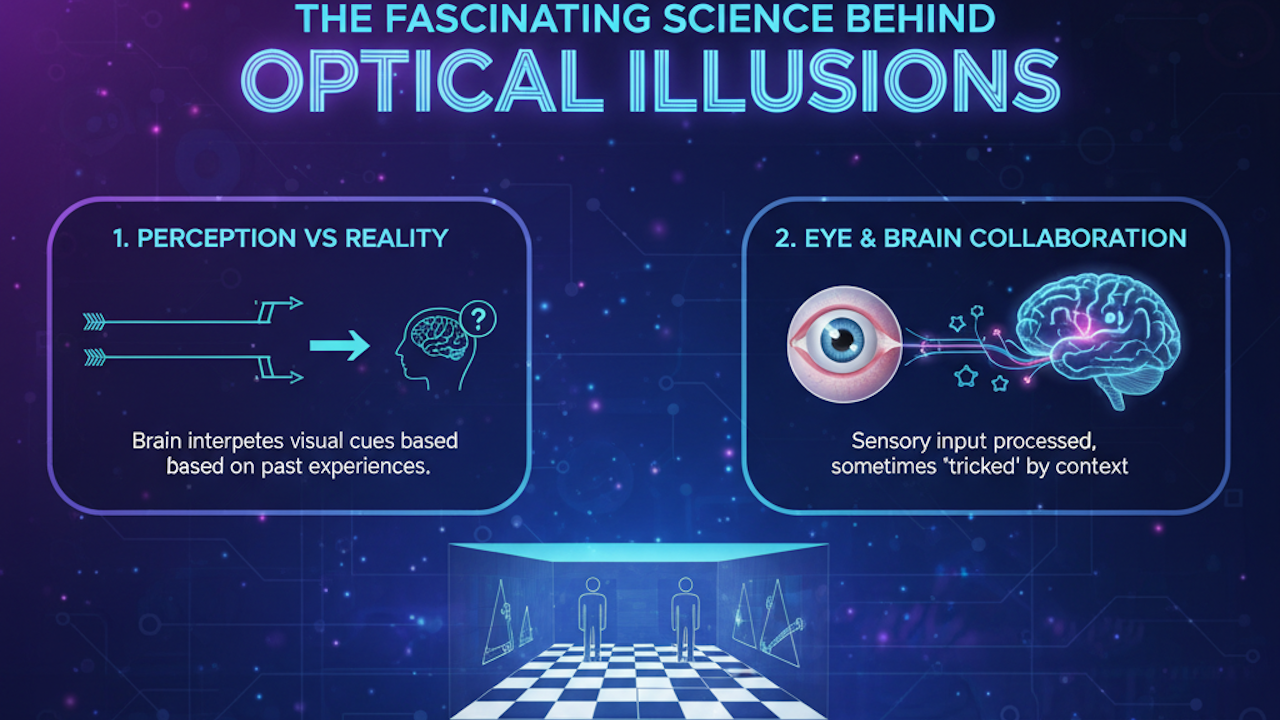
Optical illusions captivate people because they reveal a fundamental truth about human perception: what we see is not always an exact replica of reality. Instead, our visual experience results from complex interactions between our eyes and brain. The brain actively constructs our perception of the world by interpreting sensory data, filling in gaps, and making rapid assumptions based on past experiences. When these processes encounter specific visual stimuli, illusions emerge as mismatches between physical reality and subjective experience.
The Visual Pathway: From Eye to Brain
Vision begins when light enters the eye and strikes the retina, a layer of photoreceptor cells at the back of the eyeball. These cells convert light into electrical signals that travel via the optic nerve to the brain. The signals first reach the thalamus, a relay station, before arriving at the primary visual cortex in the occipital lobe. From there, information spreads to higher areas for further processing, including recognition of shapes, colors, motion, and depth.
This pathway is efficient but not flawless. The brain evolved to process information quickly for survival, prioritizing speed over perfect accuracy. It relies on heuristics, or mental shortcuts, drawn from evolutionary history and lifelong learning. In prehistoric environments, detecting motion or judging distance rapidly could mean the difference between life and death. Modern illusions often exploit these same mechanisms in artificial settings where the assumptions no longer hold.
Categories of Optical Illusions
Scientists generally classify optical illusions into three main types: literal, physiological, and cognitive. Each arises from different stages or aspects of visual processing.
Literal illusions occur when an image combines multiple elements that create a different overall perception. A classic example is an ambiguous figure where parts of the image can form two distinct scenes, such as the Rubin vase, which viewers interpret as either two facing profiles or a central vase. These illusions highlight how the brain organizes visual information into coherent wholes rather than isolated parts, a principle from Gestalt psychology.
Physiological illusions stem from the way the eyes and early visual system respond to stimuli. Overstimulation of retinal cells or neural pathways leads to effects like afterimages, where staring at a bright image leaves a lingering ghost version in complementary colors. The Hermann Grid illusion, with its grid of black squares on white, produces illusory dark spots at intersections due to lateral inhibition, where excited neurons suppress neighboring ones. Recent research suggests additional mechanisms, such as responses in simple cells of the visual cortex, may also contribute.
Cognitive illusions involve higher-level brain processes and expectations. The brain uses context, prior knowledge, and assumptions about the world to interpret ambiguous or incomplete data. These are among the most studied because they demonstrate top-down processing, where higher brain areas influence lower-level perception.
Key Mechanisms: How the Brain Gets Tricked
Several core principles explain most illusions.
Context and contrast: The brain judges properties like brightness, size, or color relative to surroundings rather than in absolute terms. In the Checker Shadow illusion by Edward Adelson, two squares on a checkerboard appear different shades despite identical luminance. The brain accounts for an apparent shadow, assuming the square in shade must be lighter to match its perceived color. This shows sophisticated color constancy mechanisms that normally help us perceive stable objects under varying light but fail here.
Perspective and depth cues: The brain interprets two-dimensional images as three-dimensional scenes using cues like converging lines or relative size. The Ponzo illusion features two identical bars placed between converging lines that suggest depth, like railroad tracks. The brain perceives the upper bar as farther away and thus larger. Similarly, the Muller-Lyer illusion makes equal-length lines appear different due to arrow-like fins that mimic perspective cues for near or distant corners.
Motion perception: The visual system is highly sensitive to movement. Illusions like the peripheral drift or rotating snakes create perceived motion in static images through interactions between color contrasts and eye movements. Neurons tuned to specific directions of motion can be differentially stimulated, leading the brain to infer movement where none exists. The autokinetic effect, where a stationary point of light in darkness appears to drift, arises from small eye movements and the lack of a reference frame.
Filling in and completion: The brain excels at pattern completion. In the Kanizsa triangle, pac-man-like shapes create the illusion of a bright white triangle with sharp edges, even though no triangle exists. Neurons called illusory contour encoders in the primary visual cortex respond to these configurations. Feedback from higher brain areas helps “fill in” missing information, a process known as recurrent processing.
Ambiguity and multistable perception: Some images support multiple valid interpretations, leading to perceptual flipping. The Necker Cube, a wireframe drawing, can appear to orient in two ways. The brain alternates between interpretations because no single view dominates. The Spinning Dancer silhouette is another example, where viewers may see clockwise or counterclockwise rotation depending on initial assumptions about depth and lighting.
Historical Context and Scientific Study
Interest in optical illusions dates back centuries. Ancient Greeks discussed them in philosophy and architecture. In the 19th century, psychologists like Johannes Mueller and researchers studying phenomena such as the Muller-Lyer illusion formalized their scientific investigation. Gestalt psychologists in the early 20th century emphasized holistic perception. Modern neuroscience uses tools like functional magnetic resonance imaging (fMRI) to observe brain activity during illusions, revealing where perception diverges from raw sensory input.
Recent studies highlight specialized neurons and feedback loops. For instance, work on illusory contours shows how lower visual areas receive top-down signals to construct perceptions not present in the stimulus. Other research links illusions to small timing differences in neural processing, on the order of milliseconds, that create motion effects.
Why Illusions Matter
Beyond entertainment, optical illusions serve as powerful tools for understanding the mind. They expose the constructive nature of perception: the brain does not passively record the world but actively builds it. This has implications for fields ranging from psychology and neuroscience to art, design, marketing, and even legal testimony, where eyewitness accounts can be unreliable due to perceptual biases.
Illusions also underscore humility in how we view reality. If the brain can be so easily fooled in controlled settings, it suggests caution in assuming our perceptions are always accurate, especially in complex social or political contexts where biases shape interpretation.
Moreover, studying illusions aids in diagnosing and understanding neurological conditions. Variations in susceptibility to certain illusions can reflect differences in brain wiring or processing. Some illusions help researchers probe consciousness itself by separating bottom-up sensory data from top-down expectations.
Limitations and Ongoing Mysteries
Despite advances, many illusions lack complete explanations. Lateral inhibition accounts for some grid effects but not all variations. Higher cognitive influences interact with low-level mechanisms in ways still under investigation. Individual differences, cultural factors, and even fatigue can alter susceptibility, indicating perception is not uniform across people.
Future research with advanced imaging, computational modeling, and perhaps virtual reality will continue unraveling these phenomena. Models simulating neural responses already help test theories about why certain patterns trigger illusions.
In everyday life, awareness of optical illusions encourages closer examination of assumptions. The next time a visual trick fools you, remember it is not a flaw but a window into the remarkable, adaptive machinery of the human brain. Our perception, though imperfect, allows us to navigate a complex world efficiently most of the time. Optical illusions remind us that seeing is interpreting, and the science behind them illuminates the intricate dance between eyes, brain, and environment.