

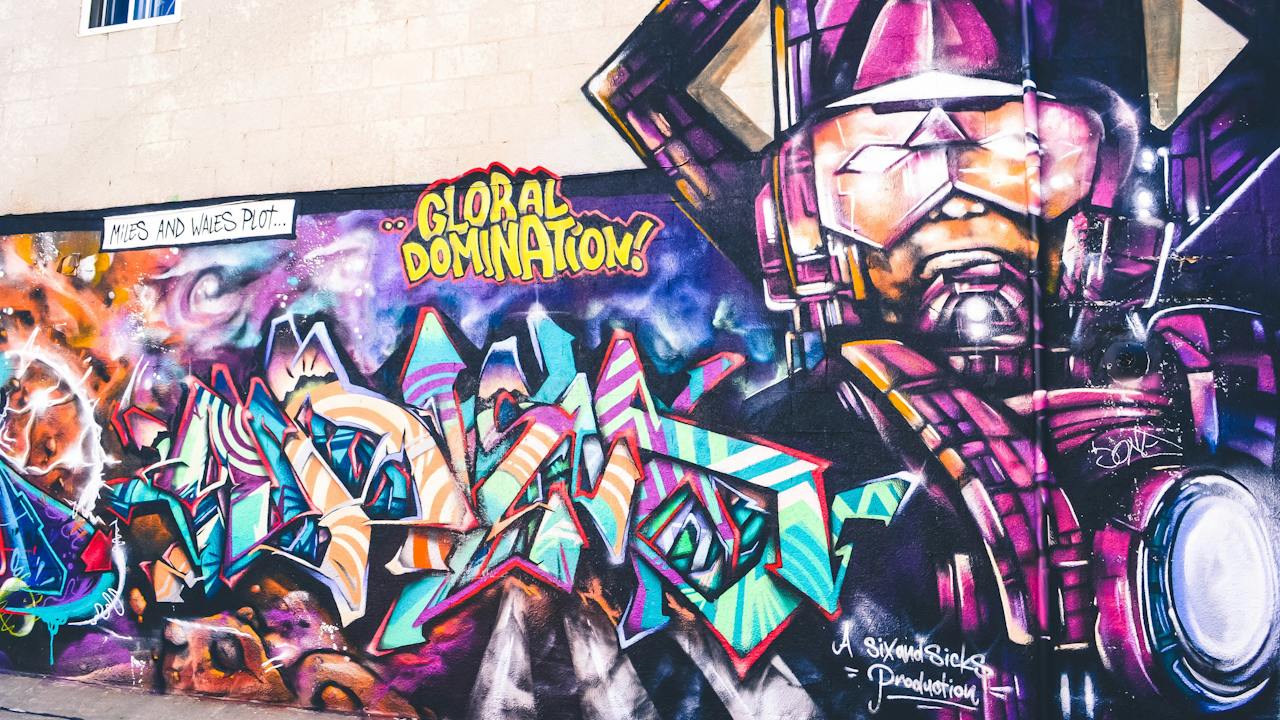
In the heart of cities from New York to New Delhi, blank walls transform into loudspeakers for ideas that might otherwise go unheard. Street art, particularly large scale murals, has grown from underground graffiti into a global language of protest, hope, and reflection. These painted surfaces do not hang in quiet galleries. They stand in public view where thousands pass daily, forcing viewers to confront messages about inequality, climate crisis, political freedom, and human dignity. What began as rebellious tags on subway cars has become a worldwide movement that blends raw creativity with urgent social commentary. This article examines the roots of message driven street art, its recurring themes, its distinct expressions across continents, and the complex ways it shapes communities and sparks debate.
The roots of modern street art reach back to the 1970s in New York City. Young people from working class neighborhoods began tagging trains and walls with stylized signatures. Names like TAKI 183 turned simple markers into a cultural phenomenon that spread rapidly through the boroughs. By the early 1980s the scene exploded with artists who moved beyond letters into full blown murals. Keith Haring covered subway stations with dancing figures that warned about the AIDS epidemic and apartheid in South Africa. His work showed that street art could combine bold lines and bright colors with clear calls for justice. At the same time the Mexican muralist tradition, established decades earlier by Diego Rivera, David Alfaro Siqueiros, and Jose Clemente Orozco, offered a historical model. Those government commissioned frescoes had promoted revolutionary ideals after the Mexican Revolution, proving that large public paintings could educate and mobilize entire populations. Contemporary street artists drew on this legacy while rejecting official sponsorship, preferring the freedom of unsanctioned walls. By the 1990s and 2000s the movement had circled the globe, carried by travelers, photographs in magazines, and later by the internet. What once looked like vandalism now appeared in major museums and auction houses, yet its power still lived on the street.
Certain themes appear again and again in murals regardless of location. Environmental destruction tops many lists. Artists paint cracked earth, rising seas, or animals trapped in plastic waste to demand immediate action on climate change. Social justice forms another pillar. Murals honor victims of police violence, celebrate LGBTQ rights, or protest gender based discrimination. Political critique targets war, corruption, and authoritarian control. Some works focus inward on cultural identity, reclaiming indigenous symbols or immigrant stories that official narratives often erase. A single mural might combine several messages, layering portraits of local heroes over backdrops of polluted rivers or border fences. The best examples avoid simple slogans. They use visual metaphors that invite viewers to linger and interpret. A child releasing a balloon might symbolize lost innocence in a war zone. A giant eye staring from a wall might remind passersby that surveillance is constant. These murals do not preach; they provoke conversation in spaces where people live, work, and commute.
Across the Americas the tradition thrives with particular energy. In the United States Shepard Fairey launched the Obey Giant campaign in the late 1980s, pasting stylized portraits that questioned authority and consumer culture. His 2008 Hope poster for Barack Obama became a defining image of political optimism, later adapted into countless street versions. During the 2020 racial justice protests following the murder of George Floyd, neighborhoods in Minneapolis, Portland, and Washington DC filled with murals showing raised fists, portraits of victims, and demands to defund the police. These works appeared overnight, created by local artists and volunteers who treated walls as temporary memorials and organizing tools. Further south, Mexico maintains one of the strongest links to its muralist past. In Oaxaca the ASARO collective paints vivid scenes that denounce government corruption and defend indigenous land rights. Their murals often feature masked figures, corn stalks, and protest signs, blending folk traditions with contemporary resistance. Brazil contributes dreamlike imagery through the twin brothers known as Os Gemeos. Their yellow skinned characters populate walls in Sao Paulo and Rio de Janeiro, commenting on urban poverty, police brutality, and the daily struggles of favela residents. Even in quieter moments their murals convey a quiet defiance against systems that marginalize the poor.
Europe offers a different flavor shaped by dense history and shifting borders. In the United Kingdom the artist Banksy has defined an era with stenciled works that mix dark humor and sharp politics. A girl reaching for a heart shaped balloon appears on walls from London to Gaza, suggesting fleeting hope in troubled times. Other pieces mock consumerism, critique war, or highlight refugee crises with a single image that travels the world through photographs. Banksy’s anonymity adds to the legend, yet the messages remain unmistakably clear. In France the photographer turned artist JR pastes enormous black and white portraits onto buildings and barriers. His project on the Israel Palestine separation wall featured Palestinians and Israelis standing side by side, humanizing people often reduced to statistics. Across the continent Berlin’s remaining sections of the former Wall carry murals that celebrate the fall of division and warn against new ones. In Spain artists responded to economic austerity after the 2008 financial crisis with murals that portrayed evicted families and corrupt bankers. Eastern Europe has seen a surge since the end of communism, with murals in Warsaw and Budapest reclaiming public space from state propaganda and addressing migration and minority rights.
Asia presents a rapidly expanding scene that navigates strict regulations and cultural expectations. In India the St+Art India Foundation has organized festivals that turn entire neighborhoods into open air galleries. Mumbai’s streets now host murals on women’s safety and sustainable living, created by artists such as Daku who combine calligraphy with bold figures. The Aravani Art Project focuses specifically on transgender rights, painting walls with vibrant portraits that challenge long standing stigmas. Delhi’s underpasses and building sides carry works that celebrate farmers’ protests or demand clean air. Japan maintains a more controlled environment, yet pockets in Tokyo and Osaka allow artists to blend traditional woodblock influences with modern concerns about overwork and nuclear safety. In China underground creators in Shanghai and Beijing have painted fleeting pieces on rapid urbanization, environmental smog, and the loss of historic neighborhoods. Many works last only days before authorities cover them, yet digital sharing ensures the messages reach far beyond the physical wall. Southeast Asia adds its voice through scenes in Bangkok and Manila where murals address political upheaval, labor rights, and the aftermath of natural disasters.
Africa and the Middle East bring stories of resilience forged through struggle. South Africa’s townships feature murals that continue the visual fight against apartheid’s legacy. Artists such as Faith47 create intricate compositions that weave portraits of activists with symbols of healing and renewal. Cape Town walls carry messages about HIV awareness, land redistribution, and economic inequality. Further north, Egypt’s streets exploded with revolutionary art during the 2011 Arab Spring. Cairo’s walls filled with portraits of fallen protesters and calls for democracy, though many were painted over after the political tide turned. In Palestine the separation barrier has become one of the world’s most photographed canvases. Local and visiting artists, including Banksy, have covered concrete slabs with images of ladders to freedom, children flying kites, and doves breaking through bars. These murals turn a symbol of restriction into a platform for hope. In Iran and Lebanon street artists risk arrest to paint critiques of censorship and economic hardship, often using symbolic animals or veiled figures to evade direct confrontation with authorities.
Oceania adds unique perspectives rooted in indigenous knowledge and island isolation. Melbourne, Australia, boasts one of the most photographed street art districts in the world. Laneways feature murals that confront the country’s colonial past, advocate for Aboriginal land rights, and highlight the impacts of climate change on the Great Barrier Reef. Artists like Rone paint large scale portraits of women that seem to fade into decaying buildings, evoking melancholy over lost histories. New Zealand incorporates Maori designs and stories into urban murals that assert cultural survival and environmental guardianship. Pacific island nations, though smaller in scale, have seen community murals addressing rising sea levels and the need for global solidarity on climate action.
The impact of these murals extends far beyond aesthetics. They build community pride in neglected neighborhoods, reduce feelings of alienation, and sometimes lower local crime rates by giving residents ownership of shared spaces. Cultural tourism follows successful projects, bringing economic benefits to areas once overlooked. At the same time murals can accelerate gentrification, raising rents and pushing out the very people whose stories the art celebrates. Legal tensions remain constant. Many cities treat unsanctioned work as criminal damage, leading to arrests and fines. Other municipalities commission murals to channel the energy of street artists into approved channels, raising questions about whether the rebellious spirit survives official approval. Preservation poses another challenge. Weather, pollution, and overpainting erase works that historians now recognize as important cultural artifacts. Digital documentation helps, yet nothing replaces the experience of standing before a mural that towers overhead in its original context.
Despite obstacles the movement shows no signs of slowing. New generations of artists train in public spaces, learning from predecessors while inventing fresh techniques and messages. Collaborative projects cross borders, with artists from different continents painting together during festivals. Social media amplifies each mural’s reach, allowing a piece created in a remote favela to inspire activists halfway around the globe within hours. Street art has proven that public walls belong to everyone, not just property owners or governments. They serve as democratic forums where ideas compete without gatekeepers.
In the end these global murals with a message remind us that art and activism can occupy the same space. They turn ordinary streets into sites of reflection and resistance. Whether celebrating identity, mourning loss, or demanding justice, each painted wall adds a sentence to an ongoing global conversation. As long as cities have blank surfaces and people have something to say, street art will continue to speak loudly where it matters most: right in the middle of daily life. The walls are listening, and so are the people walking past them.