

The COVID-19 pandemic accelerated a transformation in how people work that had been simmering for decades. What began as a temporary necessity in early 2020 evolved into one of the most significant shifts in labor practices since the Industrial Revolution. By 2026, remote work arrangements have stabilized at levels far above pre-pandemic norms, yet the debate persists. Is this a permanent, full-scale departure from office-centric models, or does the evidence point toward a hybrid future that combines remote flexibility with structured in-office collaboration? Current data, employee preferences, and corporate strategies suggest the latter, though the balance continues to evolve amid economic pressures, technological advancements, and cultural adjustments.
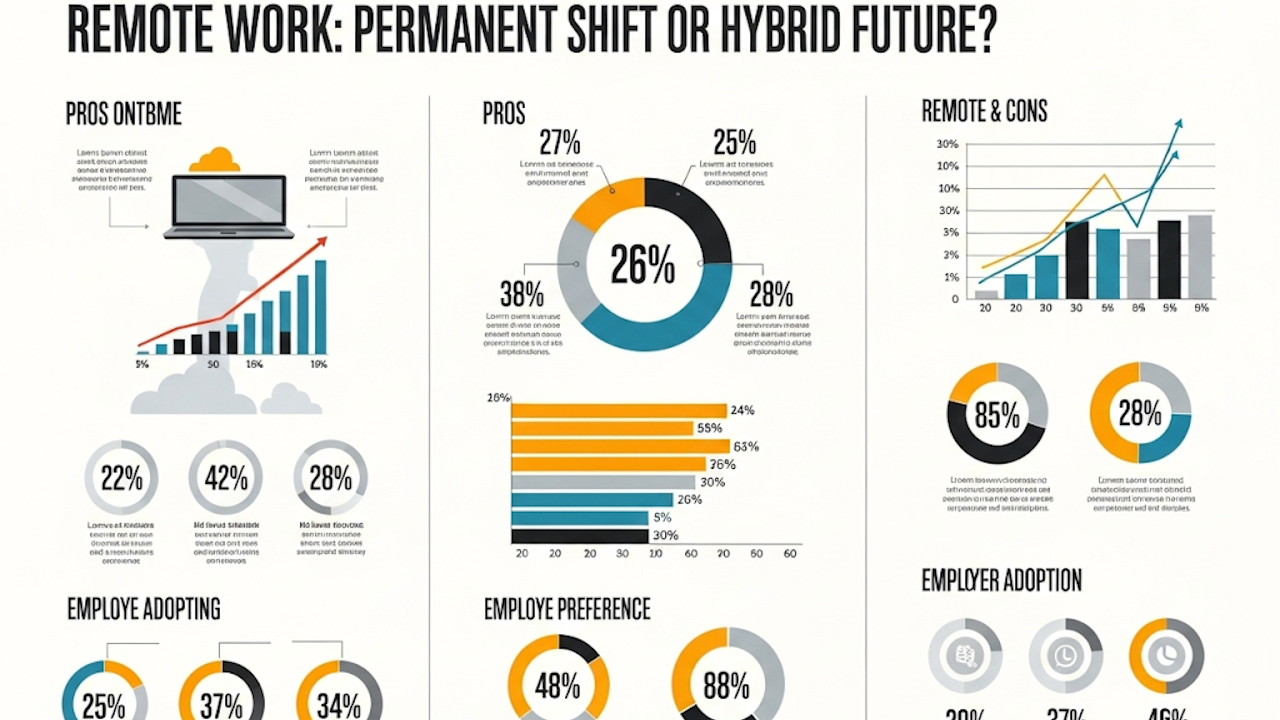
To understand the current landscape, it is essential to trace the trajectory. Before 2020, fewer than 6 percent of the U.S. workforce worked remotely on a regular basis. The pandemic forced an abrupt experiment, with over 60 percent of employees shifting to remote setups at its peak. Post-pandemic surveys and labor statistics reveal that remote work did not vanish as offices reopened. Instead, it became embedded in the fabric of knowledge-based industries. As of early 2026, approximately 22.8 percent of U.S. employees, or more than 36 million people, work remotely at least part of the time. Among workers in roles that allow remote capability, the breakdown is telling: 52 percent operate on hybrid schedules, 27 percent are fully remote, and only 21 percent remain fully on-site. These figures have remained remarkably stable since late 2022, indicating that remote work has achieved a degree of permanence, even as some companies pursue return-to-office initiatives.
The appeal of fully remote work lies in its tangible advantages for both employees and employers. Workers report significant improvements in work-life balance, largely because they eliminate lengthy commutes that once consumed hours each week. This time savings translates into greater autonomy over daily schedules, allowing individuals to align work with personal responsibilities such as family care, health appointments, or even pursuing side interests. Productivity metrics from multiple studies support this view. Many remote employees log more hours overall and experience fewer distractions than in traditional open-plan offices, leading to higher output in focused tasks. Employers benefit from reduced overhead costs on office space, utilities, and amenities. Broader talent pools become accessible without geographic constraints, enabling companies to hire skilled professionals from lower-cost regions or diverse backgrounds. Environmentally, the reduction in commuting has contributed to lower carbon emissions, aligning with corporate sustainability goals. In sectors like technology, finance, and professional services, fully remote setups have demonstrated resilience, with some firms reporting sustained or even elevated employee satisfaction and retention rates.
Yet fully remote work is not without its limitations, which have become more apparent over time. Isolation emerges as a primary concern. Without regular face-to-face interactions, employees can feel disconnected from colleagues, leading to diminished team cohesion and a sense of loneliness that affects mental health. Collaboration suffers in subtle ways; spontaneous brainstorming sessions and informal knowledge sharing, which often spark innovation in physical settings, become rarer when interactions are scheduled via video calls. Management challenges intensify as well. Supervisors report difficulties in mentoring junior staff, monitoring performance without micromanagement, and fostering company culture remotely. Burnout risks rise when boundaries between work and home blur, with many remote workers admitting they check emails outside regular hours or struggle to disconnect. Equity issues also surface. Not all employees have access to quiet, ergonomic home setups, high-speed internet, or supportive family environments, creating disparities based on socioeconomic status, location, or household composition. These drawbacks have prompted a reevaluation, particularly in organizations where innovation and cross-functional teamwork are critical.
In response to these realities, hybrid models have emerged as the dominant compromise. Hybrid arrangements typically involve a mix of remote and in-office days, often structured around two to three days per week in the office for collaboration and the remainder at home for individual work. This approach aims to capture the productivity gains of remote setups while preserving the social and creative benefits of in-person presence. Proponents argue that hybrid schedules strike an optimal balance: employees maintain flexibility for deep-focus tasks at home, yet they benefit from structured office time for meetings, training, and relationship-building. Data from 2026 reinforces this appeal. Hybrid job postings have grown substantially since 2023, accounting for nearly a quarter of new listings in some analyses, while fully on-site roles have declined from 83 percent to around 66 percent in the same period. Employee surveys consistently show strong preference for hybrid over pure extremes. Six in ten remote-capable workers express a desire for hybrid arrangements, with about one-third favoring fully remote and fewer than 10 percent preferring full on-site. This preference holds across demographics, though younger workers and those in urban areas often value the social aspects of office days more than anticipated.
Adoption rates underscore hybrid’s entrenchment. In the United States, 88 percent of employers offer some form of hybrid or flexible options, with 25 percent extending hybrid to all employees. Globally, patterns vary by region and industry, but the trend is clear: technology and finance lead with higher remote and hybrid shares, while sectors requiring physical presence, such as manufacturing or healthcare, lag. Structured policies have increased, with many companies formalizing specific in-office requirements to reduce ambiguity. For instance, hybrid workers often spend about 46 percent of their week in the office, equating to roughly 2.3 days. This stability reflects a maturation of the model rather than a retreat. Companies that implement hybrid effectively report gains in retention and engagement, attributing these to the autonomy granted without sacrificing organizational glue.
Despite these positives, hybrid implementations face hurdles. Some organizations experience “hybrid creep,” where required office days gradually increase due to managerial preferences or perceived needs for oversight. Return-to-office mandates by prominent firms in finance and retail have garnered attention, signaling that not all leaders view remote work as equally viable long-term. Job posting data from the first quarter of 2026 shows a shift: 77 percent of analyzed roles are now fully on-site, compared to 19 percent hybrid and just 4 percent fully remote. This decline from prior years suggests many companies have solidified their post-pandemic policies, prioritizing in-person culture in certain contexts. Critics of full remote argue that sustained productivity requires accountability mechanisms that are harder to maintain virtually, and that younger employees miss out on organic learning opportunities. Economic factors play a role too; in tighter labor markets or during inflationary periods, firms may favor cost controls through consolidated office use.
The broader impacts of these shifts extend beyond individual workplaces. Economically, remote and hybrid options have redistributed opportunities, boosting rural and suburban areas while challenging traditional urban office ecosystems. Cities with high commercial real estate values have adapted by repurposing spaces for collaborative hubs rather than daily occupancy. Socially, the models influence diversity and inclusion efforts. Remote work can reduce barriers for parents, caregivers, and people with disabilities, yet it risks widening gaps if digital divides persist. Environmentally, fewer commutes and smaller office footprints yield measurable reductions in energy consumption and pollution. However, these gains depend on thoughtful implementation; poorly managed hybrid setups can lead to duplicated resources or inefficient travel patterns.
Expert predictions for the years ahead lean toward refinement rather than reversal. Stanford researchers and labor economists forecast that 35 to 40 percent of the workforce will continue remote work one or more days per week, with hybrid as the prevailing structure for knowledge workers. Organizations that redesign offices as collaboration centers, invest in technology for seamless virtual integration, and emphasize outcome-based performance over presence metrics are positioned to thrive. Artificial intelligence tools may further support this evolution by automating routine tasks and enhancing remote collaboration, though they do not resolve core human needs for connection. Employee expectations have permanently shifted; flexibility now ranks as a top job perk, sometimes surpassing salary in attractiveness for talent acquisition.
In weighing the evidence, remote work has proven itself more than a fleeting pandemic response. It offers enduring benefits in autonomy, efficiency, and inclusivity that pre-2020 workplaces rarely matched. Full-scale remote adoption, however, has not displaced the value of in-person elements for most roles and organizations. The hybrid future appears not as a reluctant compromise but as the pragmatic evolution that reconciles competing priorities. Companies and workers who embrace this balance, investing in clear policies, training, and infrastructure, will likely reap the greatest rewards. As 2026 unfolds, the question is less about choosing one model over the other and more about optimizing the blend. The permanent shift is not away from offices entirely but toward a more flexible, human-centered approach that values results over rigid routines. This hybrid reality represents the most sustainable path forward, one that honors both the lessons of the past six years and the enduring need for connection in professional life.