

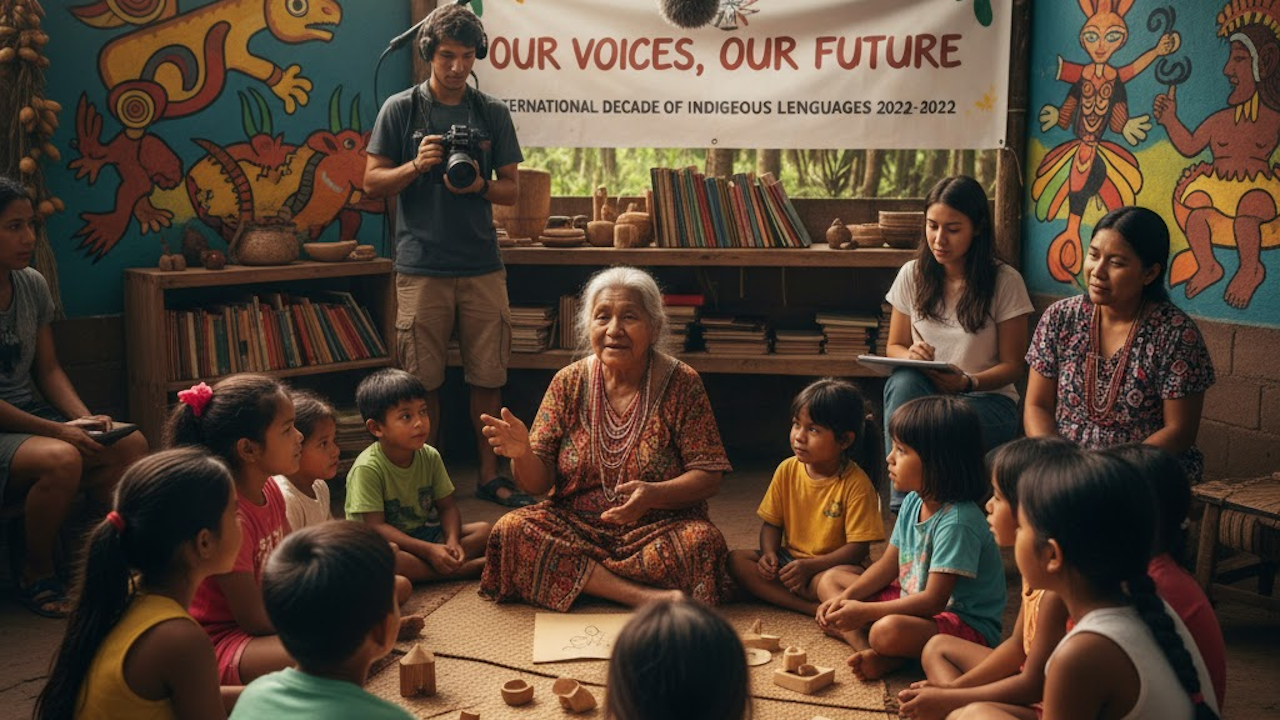
Languages are more than tools for communication. They carry the history, knowledge, identity, and worldview of the communities that speak them. When a language disappears, a unique way of understanding the world vanishes with it. Today, the preservation of endangered languages stands as one of the most pressing cultural challenges of our time. With thousands of languages at risk, global initiatives, local communities, and new technologies are working to document, revitalize, and sustain linguistic diversity.
The Scale of the Crisis
Estimates suggest that around 7,000 languages are spoken worldwide. Of these, a significant portion faces endangerment. According to recent data from Ethnologue and UNESCO, approximately 3,000 to 3,200 languages are classified as endangered, representing roughly 40 to 44 percent of all living languages. Many have fewer than 10,000 speakers, and some are down to just a handful of elderly individuals. Experts warn that, without intervention, up to 90 percent of languages could disappear by the end of the century, with one language fading every few weeks on average.
Regions with high linguistic diversity, such as New Guinea, parts of Central America, the Himalayas, and Africa, are particularly affected. In Africa, for instance, up to 10 percent of languages spoken by small communities could vanish within a century. In Mexico, several indigenous languages have fewer than 100 speakers based on recent census data. Globally, the loss is not uniform but concentrated among indigenous and minority groups.
A language is considered endangered when it is no longer being learned by children as a first language or when its use is declining in daily life. Categories range from vulnerable to critically endangered, with some languages already “sleeping” or dormant, meaning they have no fluent speakers but retain documentation or community interest in revival.
Causes of Language Endangerment
Several interconnected factors drive language loss. Globalization and the dominance of major languages like English, Spanish, Mandarin, and Arabic play a central role. Economic opportunities often require proficiency in these dominant tongues, leading parents to prioritize them for their children. Urbanization draws people away from traditional communities, breaking intergenerational transmission.
Historical pressures, including colonization, forced assimilation policies, and residential or boarding schools, have suppressed indigenous languages for generations. In many cases, children were punished for speaking their native tongues, creating stigma that persists. Climate change, migration due to conflict or environmental degradation, and the spread of mass media further accelerate the shift toward majority languages.
The consequences extend beyond words. Languages encode traditional ecological knowledge, medicinal practices, oral histories, and cultural nuances that are difficult to translate fully. Their disappearance represents a loss of intellectual and cultural heritage, weakening community resilience and identity.
Global and Institutional Efforts
International organizations have taken significant steps to address this crisis. UNESCO has been at the forefront, launching the International Year of Indigenous Languages in 2019 and proclaiming the International Decade of Indigenous Languages (2022-2032). This decade aims to mobilize resources, raise awareness, and integrate language preservation into education, policy, and sustainable development goals. UNESCO’s Atlas of the World’s Languages in Danger serves as a key resource for tracking and prioritizing efforts.
The United Nations Permanent Forum on Indigenous Issues and various regional bodies support these initiatives. National governments in countries with high indigenous populations, such as Mexico, New Zealand, Australia, and Canada, have established institutes and funding programs. Mexico, for example, has undertaken extensive activities through its National Institute of Indigenous Languages.
Non-governmental organizations and community-led groups also drive much of the work. The Endangered Languages Project, supported by institutions like Google, documents over 3,000 languages and provides resources for revitalization. The Language Conservancy focuses on North American indigenous languages, offering training and materials. Similar efforts exist worldwide, emphasizing community ownership rather than top-down imposition.
Successful Examples of Revitalization
Despite the challenges, there are inspiring success stories that demonstrate revitalization is possible.
One of the most prominent is the revival of Hawaiian. In the late 20th century, only a few thousand native speakers remained, mostly elders. Through immersion schools known as “language nests,” community radio programs, and widespread educational integration, the number of fluent speakers has grown substantially. Today, tens of thousands of people in Hawaii speak Hawaiian, and it is used in schools, media, and daily life.
Maori in New Zealand offers another model. Language nests (kohanga reo) started in the 1980s helped reverse decline. Combined with political recognition and integration into the education system, Maori has seen increased speakers and cultural pride.
In North America, the Tunica language in Louisiana, once dormant after the death of its last fluent speaker, is being revived through community classes, children’s books, and summer camps. The Salish School of Spokane has doubled the number of advanced speakers of n̓səl̓xčin̓ through innovative immersion techniques. Hebrew’s revival from a primarily liturgical language to a vibrant modern tongue spoken by millions remains a powerful, though unique, precedent.
Smaller efforts, such as the Cornish language in England or various Native American master-apprentice programs, show that even languages with very few speakers can gain new life through dedicated community action.
The Role of Technology and Innovation
Modern technology is transforming language preservation. Digital tools allow for efficient documentation, archiving, and dissemination. Smartphones, audio recorders, and online platforms enable communities to capture elders’ stories, create dictionaries, and develop learning apps.
Artificial intelligence (AI) and machine learning are opening new frontiers. AI can assist in transcription, speech recognition, and even generating educational content for low-resource languages. Projects like Google’s Woolaroo use image recognition to teach vocabulary in endangered languages. Meta’s No Language Left Behind initiative works on machine translation for hundreds of low-resource languages. In Mali, AI helped produce over 140 children’s books in Bambara in under a year.
Generative AI models can create practice dialogues, stories, or even virtual tutors from limited data. Initiatives like NüshuRescue explore adapting large language models for rare scripts. However, experts emphasize that technology must complement, not replace, human connection and community leadership. AI trained on biased or insufficient data risks inaccuracies, and cultural context is irreplaceable.
Other innovations include online language nests, augmented reality apps for storytelling, and social media campaigns that normalize language use among youth. FirstVoices and similar platforms host community-managed resources for dozens of languages.
Challenges and Ethical Considerations
Preservation efforts face numerous obstacles. Funding is often limited and inconsistent. Political will varies, and dominant language policies can undermine minority ones. Finding fluent speakers for teaching is difficult when only elders remain. Balancing preservation with the practical needs of communities, who may require dominant languages for economic success, requires careful approaches.
Ethical issues arise around ownership of data, cultural appropriation, and ensuring communities control their own linguistic futures. Revitalization must respect evolving identities and avoid freezing languages in time. Climate change and displacement add urgency, as traditional territories where languages thrive are threatened.
Looking Forward: A Call to Action
Preserving endangered languages requires a multifaceted strategy. Governments must enact supportive policies, including multilingual education and official recognition. Schools should incorporate indigenous languages, not as electives but as vital parts of curricula. Communities need resources for immersion programs, teacher training, and materials development.
Individuals can contribute by learning endangered languages, supporting relevant organizations, advocating for policy changes, or simply valuing linguistic diversity in their own lives. Media and technology companies have a role in promoting inclusive content and tools.
The International Decade of Indigenous Languages provides a framework, but success depends on sustained, localized action. Every effort counts, from recording a single elder’s story to building comprehensive digital archives or establishing new speakers in homes.
Languages connect us to our ancestors and shape our futures. By investing in their preservation today, we safeguard not only words but the rich tapestry of human experience they represent. The work is challenging, yet the rewards, in strengthened communities, preserved knowledge, and greater cultural understanding, are profound. The momentum building through global cooperation, technological innovation, and grassroots determination offers hope that many languages can thrive for generations to come.