

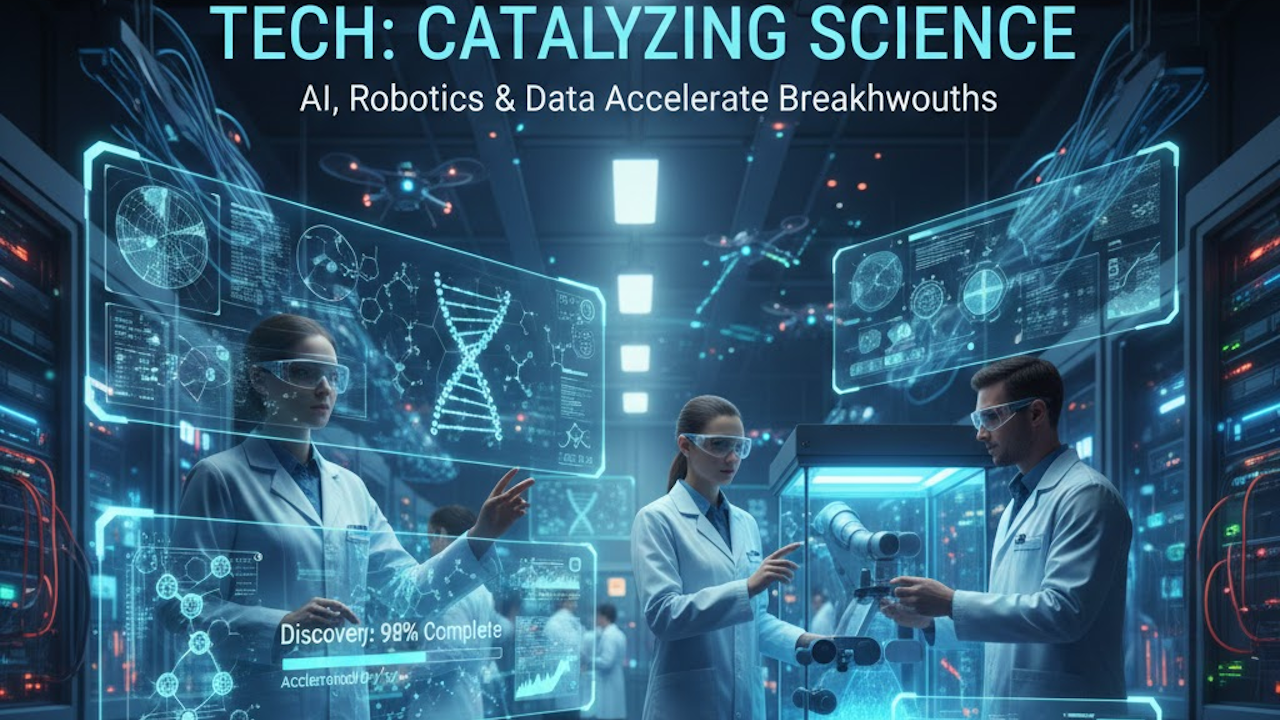
Technology has always been intertwined with scientific progress, but in recent years, the pace of acceleration has become extraordinary. From artificial intelligence analyzing vast datasets in minutes to supercomputers simulating complex phenomena that once took years, modern tools are compressing timelines that historically spanned decades. This transformation is reshaping fields like biology, physics, materials science, and medicine, enabling discoveries that were previously unimaginable. Researchers can now tackle problems of greater complexity, iterate faster, and collaborate more effectively across disciplines.
The impact is measurable. Tasks that required months or years of manual effort are now completed in hours or days. Protein structure prediction, once a bottleneck taking years per protein, can now be handled rapidly for millions of proteins. Drug discovery pipelines are shortening, and simulations of astrophysical events or climate systems achieve unprecedented scale and resolution. This article explores the key technologies driving this revolution, with real-world examples of their contributions to scientific breakthroughs.
Artificial Intelligence and Machine Learning: The New Research Partner
Artificial intelligence stands out as one of the most transformative forces in contemporary science. AI systems excel at pattern recognition in massive datasets, hypothesis generation, literature synthesis, and even code writing for simulations. Large language models and specialized neural networks are acting as co-investigators, compressing timelines dramatically.
A landmark example is AlphaFold from Google DeepMind. For decades, determining the three-dimensional structure of a protein from its amino acid sequence was a grand challenge in biology, often requiring years of experimental work per protein. AlphaFold changed this paradigm. In 2020, it achieved near-experimental accuracy in the Critical Assessment of protein Structure Prediction (CASP) competition. By 2021, it had predicted structures for over 200 million proteins, a feat that would have taken hundreds of millions of years with traditional methods. This database is freely available and has been used by millions of researchers, boosting novel experimental structure submissions by over 40 percent in some analyses. The work earned a Nobel Prize in Chemistry, underscoring its significance for drug design, enzyme engineering, and understanding diseases.
AI is extending beyond proteins. In materials science, tools like GNoME have discovered hundreds of thousands of stable materials, including potential new conductors for batteries and solar cells. Generative models are designing entirely new molecules and optimizing processes such as carbon capture. In mathematics and physics, AI has helped solve long-standing problems, including those posed decades ago, by searching obscure literature and performing complex calculations.
Biomedical research benefits immensely. AI agents analyze immune cell data, propose testable hypotheses, and even accelerate coding for models in nuclear fusion or gravitational wave studies. Virtual cell models and foundation models trained on genomic data promise to further personalize medicine and speed up drug repurposing.
While AI requires human oversight to avoid errors or hallucinations, its ability to reduce routine tasks frees scientists to focus on creative, high-level thinking. Capabilities are doubling rapidly, suggesting even greater impacts ahead.
High-Performance Computing and Simulations: Modeling Reality at Scale
Supercomputers and accelerated computing platforms allow scientists to run detailed simulations that mirror real-world complexity. Modern systems perform quadrillions of operations per second, enabling predictions in areas like earthquake risks, brain tumor growth, space weather, and universe-scale astrophysics.
Exascale computers, such as those from the U.S. Department of Energy, represent a leap forward. These machines handle simulations with trillions of grid points or degrees of freedom in hours rather than weeks. GPU acceleration has flipped traditional computing landscapes, with most top systems now leveraging this technology for both traditional simulations and AI workloads.
In biomolecular science, packages like GROMACS, LAMMPS, and NAMD run on GPUs to simulate molecular dynamics for drug binding, protein interactions, and material properties. Quantum chemistry simulations and climate models achieve higher fidelity, incorporating more variables and longer timescales. Recent runs on systems like El Capitan have pushed fluid dynamics to new extremes, aiding aerospace and energy research.
These tools do not just speed up existing work; they expand what questions can be asked. Gravitational wave detections, for instance, relied on massive computing resources to confirm signals and earn Nobel recognition.
Genomics, CRISPR, and Biotech Tools: Precision at Unprecedented Speed
Next-generation sequencing and gene editing technologies have revolutionized biology. The first human genome took 13 years and billions of dollars; today, sequencing is faster and cheaper by orders of magnitude. AI tools enhance annotation, variant detection, and multi-omics analysis, turning raw data into actionable insights.
CRISPR-Cas9, introduced around 2012-2013, democratized genome editing. What once required laborious protein engineering for each target now uses simple RNA guides. This has accelerated functional genomics, disease modeling, and therapeutic development. Base and prime editing offer even more precise corrections without double-strand breaks, opening paths to treat genetic diseases like progeria or sickle cell. Clinical approvals and trials are expanding rapidly, with the first CRISPR therapy approved in 2023.
Combined with AI, these tools enable virtual screening of genetic variants and design of synthetic genomes. The result is a surge in publications and applications across medicine and agriculture.
Laboratory Automation and Robotics: From Manual to Autonomous
Repetitive lab tasks consume enormous time and introduce variability. Robotics and automation address this by handling liquid dispensing, sample preparation, high-throughput screening, and even full experimental cycles with high precision and reproducibility.
Systems from companies like Tecan, Hamilton, and custom cobot setups achieve sub-microliter accuracy and run 24/7. Self-driving labs integrate AI to hypothesize, execute, and iterate experiments with minimal human input. In materials discovery and synthetic biology, robots synthesize compounds, test properties, and optimize conditions far faster than manual methods.
This shift turns labs into efficient factories of discovery, reducing errors and scaling output dramatically. Early examples show robots identifying superior photocatalysts or screening thousands of compounds daily.
Big Data, Collaboration, and Open Science Platforms
Cloud computing, shared databases, and collaborative platforms amplify individual efforts. The AlphaFold Protein Database exemplifies how open access multiplies impact. AI tools for literature review and data integration help researchers navigate exponential growth in publications.
Multidisciplinary projects, such as those combining genomics with climate modeling or astrophysics with AI, benefit from standardized formats and real-time data sharing. This ecosystem reduces duplication and accelerates validation.
Challenges and the Road Ahead
Despite the gains, hurdles remain. AI models need high-quality data and expert validation. Compute resources are energy-intensive, raising sustainability questions. Ethical issues around data privacy, bias, and equitable access persist. Integration of new tools into traditional workflows requires training and cultural shifts.
Future developments may include more advanced AI agents, quantum computing for certain simulations, and hybrid human-robot-AI laboratories. Foundation models tailored to specific sciences could further lower barriers.
Conclusion
Technology is not merely assisting science; it is fundamentally changing its tempo and scope. AI, computing power, precise editing tools, automation, and data infrastructure are enabling discoveries at a rate that promises solutions to pressing challenges in health, energy, climate, and beyond. As these tools mature and integrate, the scientific community stands on the cusp of even greater leaps. The key will be balancing innovation with responsible stewardship to ensure benefits reach all of humanity. The era of accelerated discovery is here, driven by the synergy of human ingenuity and technological capability.