

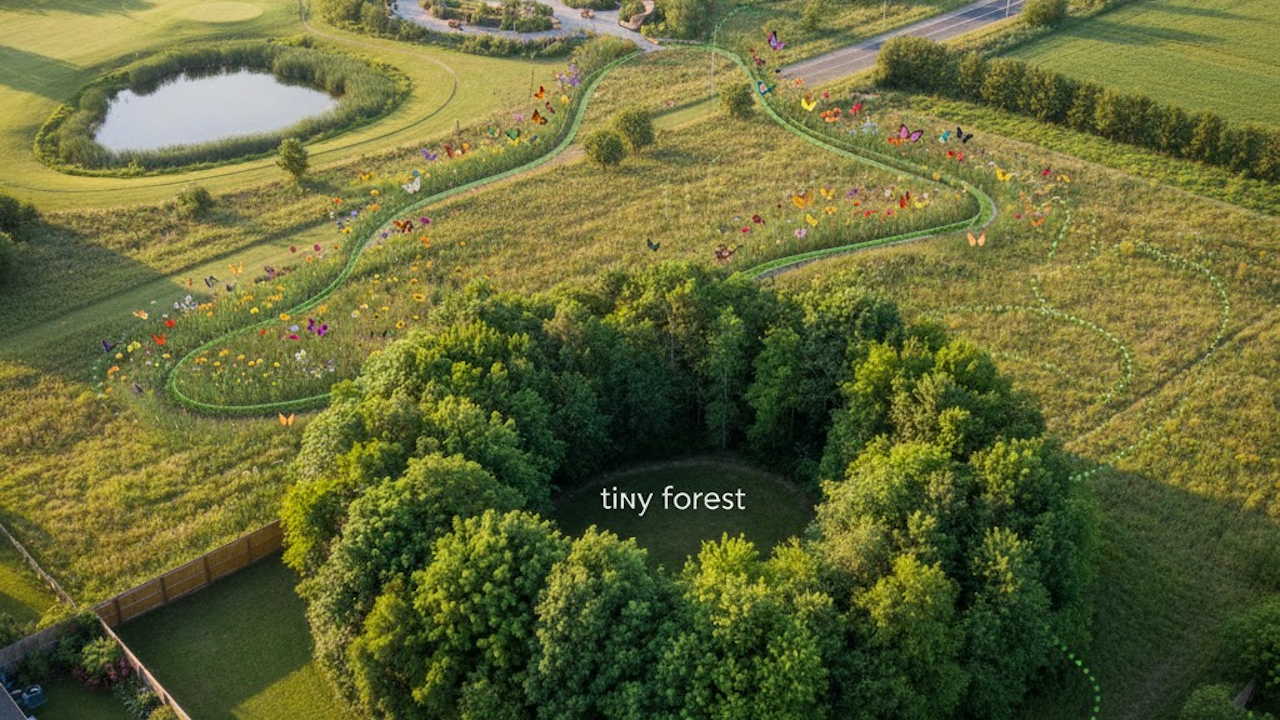
Small spaces are quietly rewriting the rules of conservation. While headlines often focus on vast national parks, rainforest reserves, and ocean sanctuaries, a growing body of evidence shows that the modest patches of green tucked into cities, suburbs, and even individual properties are performing outsized work. Pocket parks, balcony gardens, green roofs, roadside verges, schoolyards, and backyard wildlife habitats are not merely decorative. They function as critical nodes in larger ecological networks, supporting biodiversity, buffering climate impacts, and helping entire ecosystems remain resilient in the face of habitat loss and fragmentation.
The idea that small can save big runs counter to older conservation models that prioritized large, continuous tracts of land. Those large areas remain essential. Yet in a world where human development has carved landscapes into isolated fragments, the spaces between the fragments matter more than ever. Small habitats act as stepping stones, refuges, and genetic bridges. They keep populations connected, allow species to move in response to changing conditions, and sustain the ecological processes that larger systems depend on.
Habitat Fragmentation and the Power of Connectivity
Modern landscapes are heavily fragmented. Roads, buildings, agriculture, and infrastructure divide once-continuous habitats into smaller and smaller pieces. When populations become isolated, they face higher risks of local extinction from disease, inbreeding, or simple bad luck. Conservation biologists have long recognized that connectivity, the ability of individuals and genes to move between patches, is often as important as the size of any single protected area.
Small green spaces provide that connectivity. A series of backyard gardens planted with native shrubs can form a corridor for insects and birds moving between larger parks. A green roof on an office building can offer a stopover for migratory songbirds navigating urban skylines. Roadside wildflower strips can link remnant meadows that would otherwise be completely cut off. These modest interventions do not replace large reserves, but they reduce the isolation that makes those reserves more vulnerable.
Research in landscape ecology consistently shows that even tiny habitat patches can support surprisingly high levels of biodiversity when they are strategically placed and thoughtfully managed. The key is not size alone but configuration, plant composition, and the absence of certain threats such as heavy pesticide use or constant disturbance. A 50-square-meter native plant garden in a dense neighborhood can host dozens of insect species, provide nesting sites for birds, and contribute pollen and nectar that sustain wider pollinator populations.
Urban Green Spaces as Biodiversity Reservoirs
Cities are often viewed as ecological deserts, yet they contain some of the most dynamic small habitats on the planet. Vacant lots that have been allowed to grow into meadows, community gardens managed with wildlife in mind, and even cemetery grounds can become unexpected strongholds for native species.
In many metropolitan areas, these spaces now support higher densities of certain pollinators and birds than surrounding agricultural land, which is often dominated by monocultures and chemical inputs. Urban trees and shrubs offer structural complexity. Flowering plants provide sequential blooms across seasons. Water features, whether intentional ponds or temporary rain-filled depressions, create microhabitats for amphibians and aquatic insects.
One of the most valuable functions of these urban patches is their role as genetic reservoirs. Populations of plants and animals that persist in cities can carry unique adaptations to heat, pollution, or novel food sources. When conditions change in larger surrounding ecosystems, these urban populations may supply the genetic diversity needed for adaptation. In this sense, small urban spaces are not just recipients of ecological benefits from the countryside; they can export resilience outward.
Pollinators, Food Webs, and Cascading Effects
Perhaps the clearest example of small spaces supporting large systems involves pollinators. Bees, butterflies, moths, flies, and other insects that move pollen between flowers are essential to both wild plant communities and human agriculture. Many of these species have declined sharply due to habitat loss, pesticide exposure, and disease. Large-scale conservation efforts help, but the daily survival of pollinators often depends on the availability of forage and nesting sites at a fine scale.
A single residential garden planted with a diversity of native flowering plants can provide nectar and pollen across critical weeks when larger wildflower meadows are scarce. When thousands of such gardens exist across a region, they collectively create a continuous resource landscape. The same principle applies to other elements of the food web. Insect-rich gardens support insectivorous birds. Those birds, in turn, help control pest populations in nearby farms and forests. Small mammal habitats in suburban yards can sustain predators that regulate rodent numbers over wider areas.
These cascading effects mean that decisions made on a single property can influence ecological dynamics far beyond its boundaries. A homeowner who chooses native plants over lawn, reduces outdoor lighting, and avoids broad-spectrum insecticides is not simply improving their own backyard. They are contributing to the stability of regional insect populations that underpin plant reproduction and food production on a much larger scale.
Water, Soil, and Microclimate Regulation
Small green spaces also perform critical physical functions that support broader ecosystems. Vegetation intercepts rainfall, slowing runoff and reducing the volume of polluted stormwater that reaches rivers and streams. Rain gardens and bioswales, deliberately designed small depressions planted with water-tolerant species, filter contaminants and recharge groundwater. When implemented across a watershed, these micro-interventions can measurably improve water quality and reduce flooding downstream.
Soil health follows a similar pattern. Healthy soil communities of microbes, fungi, and invertebrates process organic matter, cycle nutrients, and store carbon. Even small patches of undisturbed or lightly managed soil contribute to these processes. In cities, where soils are often compacted and sealed under pavement, every unpaved green space becomes disproportionately valuable.
Microclimate effects matter as well. Trees and vegetation cool surrounding air through shade and evapotranspiration. In heat-stressed urban environments, a network of small green spaces can lower ambient temperatures enough to reduce heat stress on both people and wildlife. Cooler local conditions can also slow the evaporation of water bodies and reduce thermal stress on aquatic ecosystems downstream.
Climate Adaptation Through Distributed Habitats
As climate change accelerates, the ability of species to shift their ranges becomes increasingly important. Large protected areas alone cannot accommodate rapid shifts if the surrounding matrix is hostile. Small, well-distributed habitats improve the odds that plants and animals can track suitable conditions.
For migratory species, stopover sites are often more limiting than breeding or wintering grounds. A green roof or park that offers food and shelter for a few days can determine whether a bird successfully completes its journey. For less mobile organisms such as amphibians or flightless insects, a chain of small wetlands or moist microhabitats can enable gradual range shifts that would otherwise be impossible.
Distributed small habitats also provide insurance against extreme events. When a large fire, flood, or drought devastates a major reserve, nearby smaller patches can serve as sources for recolonization. This redundancy is a classic principle of resilience: systems with multiple, somewhat independent components recover more readily than those dependent on a single large unit.
The Role of Everyday People and Everyday Places
One of the most significant advantages of small-space conservation is its accessibility. Protecting a million-acre wilderness requires complex political and financial resources. Creating a wildlife-friendly garden, advocating for a schoolyard habitat, or converting a strip of lawn into a native plant border is within the reach of individuals, neighborhoods, and local organizations.
This democratization of conservation has practical consequences. Citizen science programs that track birds, butterflies, or plants in private gardens generate data that professional researchers could never collect alone. Community groups that restore vacant lots or plant pollinator corridors build social capital alongside ecological value. Municipal policies that encourage green roofs, reduce mowing on road verges, or protect mature street trees multiply these efforts at scale.
Success stories are accumulating. Cities that have systematically increased the amount and quality of small green spaces report measurable gains in native insect diversity, bird populations, and even certain rare plants that reappear once suitable microhabitats are restored. Agricultural landscapes that incorporate hedgerows, field margins, and small wetland features show improved pest control and higher yields of pollinator-dependent crops. These outcomes demonstrate that small interventions, when coordinated, produce large cumulative effects.
Challenges and Realistic Limits
Small spaces are not a panacea. They cannot fully compensate for the loss of large, intact ecosystems. Some species require extensive territories or specialized conditions that simply cannot be met in fragmented urban or agricultural settings. Pollution, invasive species, and human disturbance remain persistent threats even in well-intentioned gardens.
Quality matters more than quantity. A green space dominated by invasive plants or managed with frequent chemical treatments may provide little ecological value and can even act as a population sink. Effective small-space conservation requires attention to native species, structural diversity, seasonal resource continuity, and connectivity to other habitats.
There is also a risk of greenwashing. Planting a few flowers around a parking lot does not offset the destruction of a mature forest. Small spaces work best when they complement, rather than substitute for, strong protection of larger natural areas.
A Practical Path Forward
The evidence points toward a dual strategy. Societies must continue to safeguard large wildlands and restore degraded landscapes at scale. At the same time, they should deliberately cultivate a dense network of small, high-quality habitats across the human-dominated matrix. This approach treats the entire landscape as a functional whole rather than a collection of isolated reserves.
Practical steps are straightforward. Prioritize native plants that support local insects and birds. Reduce or eliminate pesticide use in residential and municipal settings. Design new developments with green roofs, living walls, and connected open spaces from the outset. Protect existing mature trees and understory vegetation wherever possible. Support policies that reward landowners for maintaining wildlife-friendly features.
Individuals can begin immediately. Replacing even a portion of lawn with native vegetation, adding a water source, or leaving leaf litter and dead wood in a corner of the yard creates usable habitat. Scaling these actions across neighborhoods produces measurable ecological benefits.
Small spaces succeed because ecosystems operate at multiple scales simultaneously. Processes that unfold across continents, such as bird migration or climate-driven range shifts, still depend on the availability of suitable conditions at the scale of a single tree, a patch of flowers, or a damp depression in the ground. By attending to these fine-grained elements, people are not merely decorating their surroundings. They are reinforcing the structural integrity of the larger systems on which all life depends.
The quiet work happening in backyards, on rooftops, and along city streets is therefore not peripheral to conservation. It is becoming one of its most essential components. In an era of rapid environmental change, the modest spaces closest to human lives are proving capable of helping the biggest ecosystems endure.