

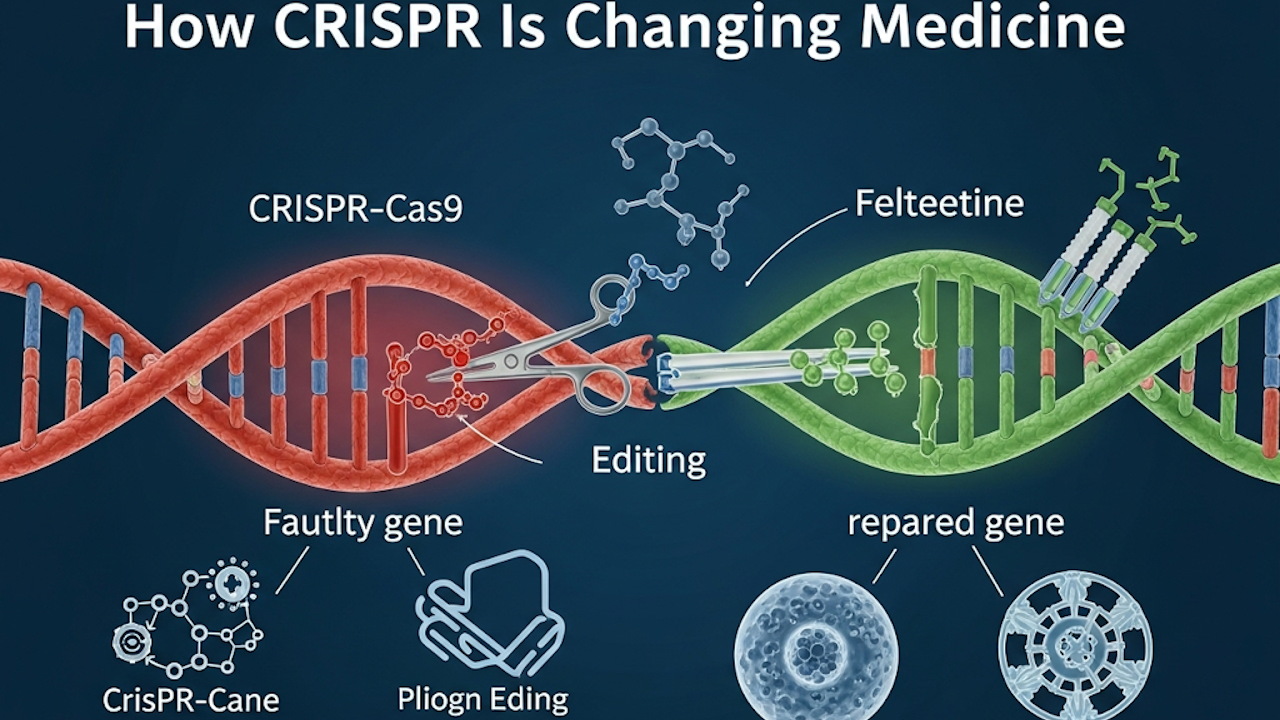
CRISPR technology has emerged as one of the most revolutionary advancements in biomedical science. Short for Clustered Regularly Interspaced Short Palindromic Repeats, CRISPR is a natural defense mechanism found in bacteria and archaea that protects them from viruses. Scientists have harnessed this system to create precise tools for editing DNA, opening new frontiers in the treatment of genetic diseases, cancer, infectious illnesses, and more. As of 2026, CRISPR-based therapies are transitioning from laboratory promise to clinical reality, with approved treatments and numerous ongoing trials reshaping modern medicine.
The Discovery and Mechanism of CRISPR
The story of CRISPR begins with observations in the late 1980s, when researchers noticed unusual repeating DNA sequences in bacteria. It was not until the early 2000s that scientists understood these sequences as part of an adaptive immune system. Key breakthroughs came around 2012 when Jennifer Doudna and Emmanuelle Charpentier demonstrated how CRISPR-Cas9 could be programmed to target specific DNA sequences. Their work earned them the Nobel Prize in Chemistry in 2020.
At its core, the CRISPR-Cas9 system functions like molecular scissors. It consists of two main components: a guide RNA (gRNA) that matches a target DNA sequence and the Cas9 enzyme that cuts the DNA. The guide RNA directs Cas9 to the precise location in the genome, where it creates a double-strand break. Cells then repair this break, often leading to gene disruption or, with additional templates, precise corrections through homology-directed repair.
Over time, variants and improvements have expanded the toolkit. Base editors allow single-letter DNA changes without cuts. Prime editing offers even greater precision for insertions, deletions, or corrections. Newer Cas proteins, such as Cas12a, provide additional targeting options and reduced off-target risks. These innovations have made gene editing safer and more versatile.
Early Applications and Proof of Concept
Initial uses of CRISPR focused on basic research. Scientists created animal and cellular models of diseases much faster than before, accelerating drug discovery. For instance, CRISPR enabled rapid generation of mouse models to study cancer genetics or neurodegenerative disorders.
The leap to therapeutic applications began with ex vivo editing, where cells are removed from the body, edited in the lab, and reinfused. This approach minimizes systemic risks. One landmark case involved editing immune cells to enhance their cancer-fighting abilities. In early trials, researchers used CRISPR to knock out genes like PD-1 in T cells, making them more effective against tumors.
Breakthrough in Blood Disorders: The Approval of Casgevy
The most prominent milestone came in late 2023 with the approval of Casgevy (exagamglogene autotemcel), developed by CRISPR Therapeutics and Vertex Pharmaceuticals. This became the first CRISPR-based therapy approved by regulatory agencies in the United States, United Kingdom, and other regions. It treats sickle cell disease (SCD) and transfusion-dependent beta-thalassemia (TDT).
In these conditions, mutations affect hemoglobin production, leading to misshapen red blood cells, pain crises, organ damage, and frequent transfusions. Casgevy uses CRISPR to edit a patient’s hematopoietic stem cells outside the body. The edit reactivates fetal hemoglobin production, which compensates for the defective adult hemoglobin. Clinical data showed remarkable results: most SCD patients became free of vaso-occlusive crises, and many TDT patients no longer needed transfusions, with benefits lasting years.
By 2026, Casgevy has gained approvals in multiple countries, and real-world use continues to expand, though challenges like high costs and complex manufacturing limit access.
In Vivo Editing and Personalized Therapies
While ex vivo editing dominates early successes, in vivo approaches, where editing occurs directly inside the body, represent the next frontier. Lipid nanoparticles deliver CRISPR components to target organs like the liver.
A notable 2025 case involved an infant named KJ with carbamoyl phosphate synthetase I (CPS1) deficiency, a rare urea cycle disorder. Researchers developed and delivered a personalized CRISPR therapy in just six months using lipid nanoparticles. The treatment reduced symptoms without serious side effects, marking a historic “on-demand” approach for ultra-rare diseases.
Another example is VERVE-102, a base-editing therapy targeting the PCSK9 gene in the liver to lower LDL cholesterol. In Phase 1b trials, a single dose reduced LDL by up to 62 percent, with effects lasting months. This mimics natural protective mutations and could transform cardiovascular disease prevention.
Prime editing has shown promise in conditions like chronic granulomatous disease (CGD), restoring immune function and reducing infections in early patients.
Expanding Horizons: Cancer, Infectious Diseases, and Beyond
CRISPR is advancing cancer immunotherapy. Engineered CAR-T cells with CRISPR edits remove inhibitory genes or enhance tumor recognition. Trials target B-cell cancers, multiple myeloma, and solid tumors.
For infectious diseases, researchers explore CRISPR to disrupt viral genomes, such as HIV by targeting CCR5 or excising viral DNA from hepatitis B. While still preclinical or early-stage, these approaches could complement existing antivirals.
Neurological and muscular disorders are also in focus. Trials address Duchenne muscular dystrophy by correcting dystrophin mutations. Eye diseases, including certain forms of inherited blindness, benefit from localized delivery to retinal cells.
As of early 2025, over 250 clinical trials involve gene-editing candidates, with more than 150 active. Blood disorders lead, but Phase 3 trials now cover amyloidosis, immunodeficiencies, and other areas.
Challenges in Delivery, Safety, and Scalability
Despite progress, hurdles remain. Delivery systems must reach the right cells efficiently without triggering immune responses. Viral vectors like AAV work well for some tissues but have size limits. Lipid nanoparticles suit liver targets but need optimization for others. Electroporation aids ex vivo work but is impractical for whole-body applications.
Safety concerns include off-target edits that could cause unintended mutations or cancer. On-target effects, mosaicism (where not all cells are edited uniformly), and immune reactions to Cas9 proteins also pose risks. Improved tools like controllable Cas9 systems and high-fidelity variants help mitigate these.
Manufacturing complexity drives high costs. Casgevy’s price tag limits accessibility, raising equity issues. Scaling personalized therapies for rare diseases demands new regulatory pathways, such as FDA’s platform trial concepts for similar conditions.
Ethical Considerations
CRISPR raises profound ethical questions. Somatic editing (affecting only the patient) garners broad support for treating severe diseases. Germline editing, which alters sperm, eggs, or embryos and passes changes to future generations, sparks debate due to risks of unintended consequences and potential for enhancement rather than therapy.
Issues of access, consent, and justice are critical. Who benefits from these expensive therapies? How do we prevent misuse for non-medical traits? International guidelines emphasize safety, transparency, and public engagement. Many countries restrict germline editing, prioritizing continued research over premature clinical use.
The Future of CRISPR in Medicine
Looking ahead, CRISPR could enable cures for thousands of genetic conditions. Integration with AI may accelerate guide RNA design and predict outcomes. Epigenetic editing, which modulates gene expression without altering DNA sequence, offers reversible options for complex diseases like cancer or inflammation.
Platform technologies for rapid personalized editing, as demonstrated in the KJ case, could address ultra-rare diseases that traditional drug development ignores. Combination therapies pairing CRISPR with small molecules or other modalities may enhance efficacy.
Broader applications might include engineering immune cells for autoimmune diseases, editing gut microbiomes, or even preventive edits for high-risk populations. Yet success depends on addressing technical, economic, and societal barriers.
CRISPR stands as a powerful example of how understanding fundamental biology can transform human health. From its bacterial origins to bedside therapies, it exemplifies the potential of precise genetic intervention. As research advances and more therapies reach patients, CRISPR promises not just to treat but to potentially cure diseases once considered intractable, ushering in a new era of precision medicine. Continued rigorous science, ethical vigilance, and equitable access will determine how fully this potential is realized.