

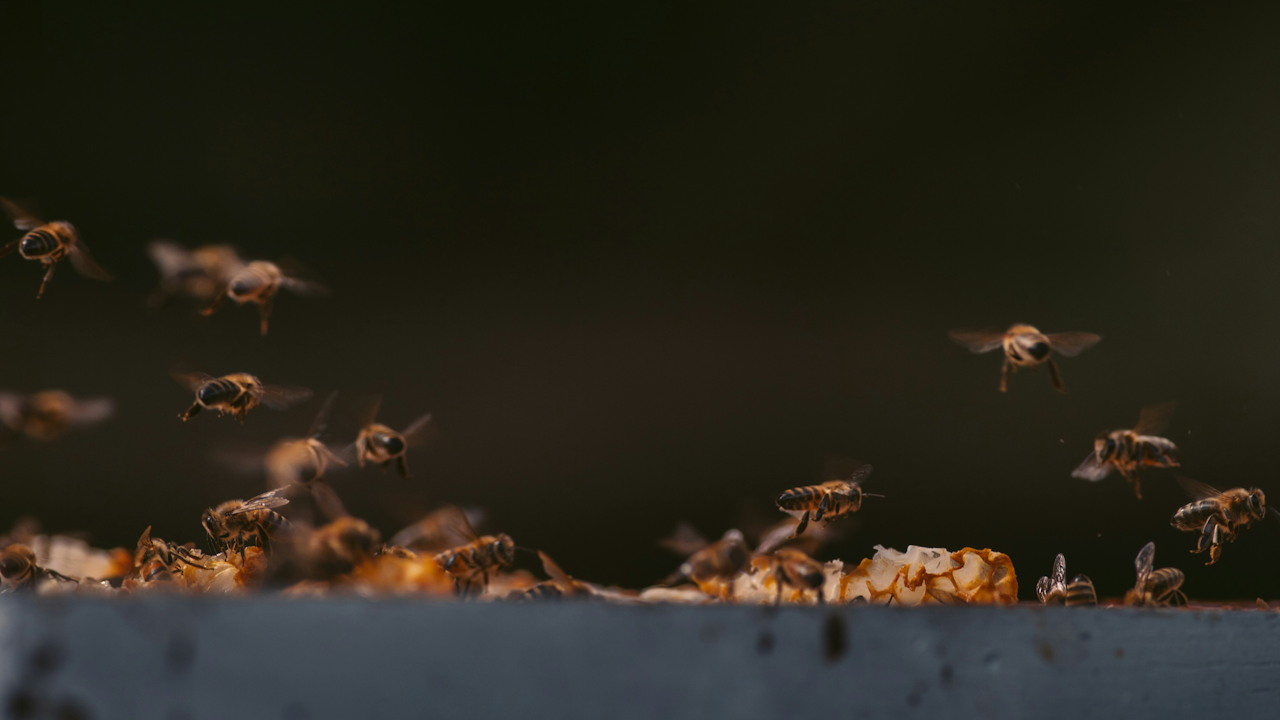
Honeybees stand among the most socially complex insects on Earth. Their colonies function as superorganisms where thousands of individuals coordinate tasks essential for survival. Foraging represents one of the most demanding challenges. Worker bees must locate scattered patches of nectar and pollen, often several kilometers from the hive, then share that information rapidly so the colony can exploit resources before competitors or changing weather intervene. While many social insects rely on chemical trails or simple signals, honeybees have evolved a remarkably precise system of movement based communication known as the dance language. This system allows a successful forager to convey the direction, distance, and relative quality of a food source to nest mates who have never visited the site themselves. The dances occur in complete darkness inside the hive on vertical wax combs, yet they encode spatial information with accuracy that rivals many vertebrate navigation systems.
The story of scientific discovery begins in the early twentieth century with Austrian ethologist Karl von Frisch. Earlier naturalists had observed bees performing curious movements after returning from foraging trips, but no one had decoded their meaning. Von Frisch began systematic experiments in the 1920s using observation hives with glass walls and marked individual bees with paint dots. He trained foragers to visit artificial feeders containing sugar water placed at controlled distances and directions from the hive. By timing the dances and recording the angles of the movements relative to the vertical surface of the comb, he demonstrated that the dances contained coded information. His initial findings faced skepticism from some contemporaries who believed insects lacked the cognitive capacity for symbolic communication. Decades of further experiments, including those that displaced bees or altered perceived sun positions with mirrors, confirmed the system. In 1973 von Frisch shared the Nobel Prize in Physiology or Medicine with Konrad Lorenz and Nikolaas Tinbergen for discoveries concerning organization and elicitation of individual and social behavior patterns. Subsequent researchers refined the picture using high speed video, harmonic radar tracking of flying bees, and even robotic models that simulated dances to recruit real bees.
Two primary dance forms exist for food sources. The round dance appears when a forager discovers nectar or pollen within roughly fifty to one hundred meters of the hive. The returning bee performs tight circular movements on the comb, alternating clockwise and counterclockwise directions several times. During these circuits the dancer frequently stops to offer small samples of nectar or to allow followers to touch her body. The round dance excites nearby workers and prompts them to search in the immediate vicinity of the hive. It carries little directional information because close sources lie within the range where bees can easily detect floral odors on the wind or from the dancer herself. The round dance therefore functions more as a general alert combined with olfactory cues that guide recruits to the correct flowers once they leave the hive.
For sources farther away the waggle dance takes over. This is the famous figure eight pattern that has become the textbook example of animal symbolic communication. The dancer moves forward in a straight line while vigorously shaking her abdomen from side to side. This straight segment is called the waggle run. At the end of the waggle run she turns to one side, performs a semicircular return path without waggling, then repeats the waggle run followed by a semicircle in the opposite direction. The overall path traces a flattened figure eight. The critical information resides in three variables of the waggle run itself.
Direction is encoded by the orientation of the waggle run relative to gravity. Inside the dark hive the vertical upward direction on the comb stands for the current azimuth of the sun outside. If a food source lies directly in line with the sun, the bee waggles straight upward. If the source lies forty five degrees to the right of the sun from the hive perspective, the waggle run tilts forty five degrees to the right of vertical. The angle updates continuously because bees possess an internal clock and compensate for the sun movement across the sky during the day. Recruits decode this angle using their own gravity sensing organs and translate it into a flight bearing once they exit the hive and see the sun or polarized light patterns in the sky.
Distance information comes from the duration of the waggle run. Longer waggle runs indicate greater distances. The relationship is roughly linear within the typical foraging range of a colony. A run lasting about one second might correspond to a source roughly one kilometer away, though exact calibration varies slightly among colonies and subspecies. Recruits measure the length of the waggle phase by following the dancer closely and sensing the rhythmic vibrations produced by her wing muscles and body movements. Some researchers suggest that the number of individual waggles or the total time spent performing circuits also contributes to the distance signal. Because the dance occurs on a vertical surface, followers must maintain physical contact or stay within millimeters to extract these temporal cues accurately.
The third element is the quality or profitability of the source. A forager that has found an exceptionally rich nectar flow or a dense pollen source performs more vigorous and rapid dances. The tempo of the entire dance increases, circuits complete more quickly, and the dancer may perform more repetitions before pausing to unload her load or rest. Followers appear to assess this liveliness and show greater persistence in following high quality dances. In addition, the dancer often carries floral scents on her body or regurgitates a small amount of nectar that recruits sample. These odors help pinpoint the exact plant species once the recruits reach the general area indicated by the dance.
Following a dance requires sophisticated sensory integration. A potential recruit approaches the dancer from behind or the side and aligns her body with the dancer orientation. Antennae make repeated contact with the dancer abdomen during the waggle phase, picking up both tactile and vibrational information. Air movements generated by the dancer wings may also transmit signals through the Johnston organs in the antennae. At the same time the follower detects any floral odors clinging to the dancer. After one or more circuits the recruit may leave the hive and fly in the indicated direction for approximately the indicated distance. She then begins searching in expanding arcs until she encounters the correct odor plume or visual target. Not every follower succeeds on the first attempt. Many bees follow several different dancers before committing to a particular site, effectively averaging information or selecting the most attractive option.
The waggle dance also serves another vital colony function during reproductive swarming. When a colony prepares to divide, scout bees search for new nest cavities. Successful scouts return and perform waggle dances on the surface of the swarm cluster to advertise cavity locations. These dances use the same directional and distance coding, though the reference point may shift because the swarm is outside the original hive. Other scouts follow the dances, inspect the advertised sites, and may dance in support or perform stop signals to inhibit dances for inferior cavities. Over hours or days the colony reaches consensus on the best new home through this democratic process of competing dances. The mechanism demonstrates that the dance language extends beyond food to collective decision making.
Honeybees employ additional movement based signals that complement the main dances. The tremble dance appears when a forager returns with nectar but finds the colony already processing large volumes. The bee performs irregular trembling movements while walking across the comb. This signal recruits more receiver bees to unload nectar and process it into honey, preventing a backlog at the entrance. The vibration signal or shaking signal involves one bee grasping another and vibrating her body. It occurs in multiple contexts, including stimulation of foraging activity, preparation for swarming, and regulation of task allocation. Short piping sounds produced by wing vibration serve to initiate swarming or to signal the presence of a new queen. These acoustic and vibrational signals often combine with the spatial dances to fine tune colony responses.
The evolutionary origins of the dance language remain a subject of study. Most other bee species do not perform comparable spatial dances. Stingless bees, close relatives, rely more heavily on pheromone trails and sound signals. The honeybee system likely evolved in tandem with large, perennial colonies that store substantial honey reserves and forage over wide areas in seasonal environments. The ability to recruit many workers quickly to a rich but ephemeral patch of flowers provides a decisive advantage over solitary foraging or simple chemical recruitment. Genetic analyses have identified specific genes influencing dance performance and following behavior, suggesting heritable components shaped by natural selection. Comparative studies across honeybee subspecies reveal variations in dance dialect. For example, some tropical subspecies perform shorter waggle runs for the same distance than temperate subspecies, possibly reflecting differences in typical foraging ranges or energy costs.
Modern research continues to reveal subtleties. Experiments with miniature robotic bees that waggle mechanically have successfully recruited live followers, proving that the key stimuli are the movements and vibrations rather than any chemical or visual cue unique to living dancers. Tracking studies using radar or RFID tags show that recruits do not fly in perfectly straight lines to the advertised location. Instead they use the dance information as a vector that brings them into the correct region, after which local cues take over. Brain imaging and neurophysiological recordings indicate that bees process the dance information in regions analogous to those handling spatial memory in other insects. Some evidence suggests that experienced foragers may weigh dance information against their own prior knowledge of the landscape, ignoring dances that point to known depleted sites.
The dance language carries broader implications for understanding animal cognition. It represents one of the clearest examples of symbolic communication in a non vertebrate. The dancer abstracts spatial relationships into a standardized motor pattern that unrelated individuals can interpret without ever having seen the location. This capacity challenges earlier assumptions that symbolic reference requires large brains or language like syntax found in primates or cetaceans. At the same time the system remains limited compared with human language. It lacks recursion, displacement to arbitrary times, or discussion of abstract concepts. It is tightly tied to immediate survival needs of the colony.
Human applications have emerged from studying bee foraging strategies. Algorithms inspired by the waggle dance and collective decision making appear in optimization software, robotics swarm coordination, and even certain machine learning approaches to resource allocation. Engineers have built models in which virtual agents perform dances to recruit others toward promising solutions in complex search spaces. Conservation biologists note that understanding communication helps assess colony health. Colonies exposed to pesticides or habitat fragmentation may show disrupted dance performance or reduced recruitment efficiency, contributing to declines in pollination services.
Climate change poses potential challenges to the system. Shifts in flowering times may desynchronize the internal clocks bees use to compensate for sun position. Changes in landscape structure could alter typical foraging distances and the profitability signals encoded in dance vigor. Research into these interactions remains active because pollinator declines threaten both wild ecosystems and agricultural productivity.
In essence the dances of honeybees illustrate how evolution can produce sophisticated information transfer through simple, repeatable movements performed in a social context. A worker bee returning from a distant meadow performs a short sequence of abdominal shakes on a dark wax wall. Within minutes dozens of her sisters interpret that sequence, exit the hive, and fly unerringly toward a patch of flowers they have never visited. The outcome is coordinated exploitation of resources that sustains the colony and, through pollination, supports flowering plants across continents. This elegant solution to the problem of collective foraging stands as one of the most remarkable achievements in the natural world, reminding observers that complexity and intelligence can emerge in forms very different from our own. Continued study of these tiny dancers promises further insights into navigation, social coordination, and the diverse ways life solves the challenge of living together.