

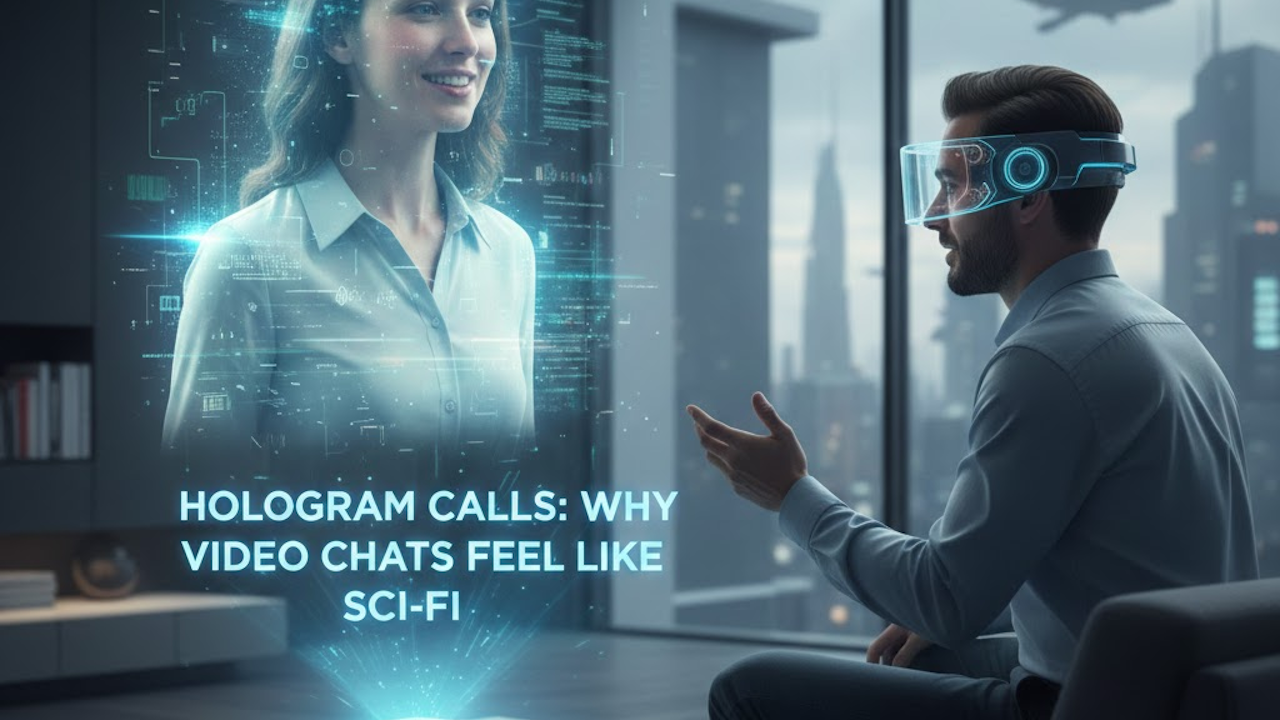
Video calls have transformed how people connect across distances. What began as pixelated images on early webcams has evolved into high-definition conversations that feel almost natural. Yet many users sense something deeper at work. Modern video chats evoke the futuristic holograms of science fiction films and television shows. Characters in Star Wars project life-sized, three-dimensional images of themselves to communicate instantly with distant allies. Similar concepts appear in Star Trek and other stories. Today those imagined technologies seem closer than ever. This article explores the journey from basic video communication to holographic experiences and explains why current tools already blur the line between reality and fiction.
The Roots of Holographic Dreams
Holography as a concept dates back to 1947 when physicist Dennis Gabor developed the underlying theory. He earned the Nobel Prize in Physics in 1971 for work that showed how light could be recorded and reconstructed to create three-dimensional images. Practical applications required lasers, invented in 1960, which provided the coherent light needed for clear interference patterns. Early holograms were static and required controlled conditions. They captivated scientists and the public alike with their depth and realism.
Science fiction quickly embraced the idea. In Star Wars, Princess Leia appears as a small, flickering hologram delivered by R2-D2. Jedi Council members project full-body images during meetings. These scenes portrayed holograms as practical tools for real-time interaction with depth, gesture, and spatial awareness. Other films and shows, including 2001: A Space Odyssey, featured video phones that foreshadowed today’s video calls. The emotional resonance came from the sense of presence. A flat screen limits interaction. A hologram feels like the person stands in the room.
For decades these depictions remained fantasy. Bandwidth limitations, processing power, and display technology lagged far behind imagination. Early video calls in the 1990s and 2000s suffered from low resolution, lag, and awkward framing. They improved dramatically with smartphones, high-speed internet, and apps like FaceTime and Zoom, especially during the global shift to remote work. Yet even advanced 2D video often leaves users feeling disconnected. Eye contact proves difficult because cameras sit above screens. Body language appears flattened. Participants talk over each other due to audio delays. These shortcomings make the sci-fi promise of immersive communication more appealing.
From 2D Video to 3D Presence
Today’s video chats represent a significant step toward holographic ideals, but true holograms add depth and parallax. Viewers can move around the projection and see different angles naturally. Modern systems use depth-sensing cameras, AI reconstruction, volumetric capture, and advanced displays to approximate this effect.
Several companies and research efforts have made notable progress. Microsoft developed Holoportation, which captures a person in 3D using depth cameras and transmits a lifelike avatar viewable through mixed-reality headsets like HoloLens. Users appear as realistic 3D figures that others can interact with as if sharing the same space. Google explored Project Starline, a “magic window” system with multiple cameras and light-field displays. Testers reported strong feelings of eye contact and physical presence, with gestures extending naturally toward the viewer.
Proto offers commercial holographic displays that project life-sized figures into rooms for events, education, and business. These systems have appeared at major venues like the U.S. Open and in university lectures. HYPERVSN created immersive booths that turn participants into shareable holographic content. In telecom, collaborations between Telefónica, Ericsson, and MATSUKO demonstrated holographic calls integrated directly into smartphone dialers using 5G and IMS data channels. A presenter’s face and torso appear as a real-time hologram on compatible devices, with two-way audio.
Apple Vision Pro introduces spatial personas that create 3D avatars for FaceTime-like experiences. Meta and other XR platforms pursue similar paths. These technologies rely on AI to process volumetric data, compress it efficiently, and render it with low latency. 5G networks provide the necessary speed and reliability, while edge computing reduces delays by processing data closer to users.
Why Video Chats Already Feel Like Science Fiction
Even standard video calls carry a sci-fi quality because they compress time and space in ways once reserved for speculative stories. A parent in one country can watch a child take first steps on another continent in real time. Surgeons consult remotely during procedures. Students attend lectures from experts thousands of miles away. This instant connection once required expensive satellite links or seemed impossible. Now it fits in a pocket.
The feeling intensifies with emerging 3D features. Depth and proper eye contact restore non-verbal cues lost in flat video. Gestures gain meaning when they occupy shared space. Participants report higher engagement and reduced fatigue compared to traditional grids of faces. In professional settings, holographic telepresence supports better collaboration on complex tasks like design reviews or medical training. Educators project guest speakers into classrooms as life-sized figures. Healthcare providers explore remote mentoring with spatial accuracy.
Cultural familiarity amplifies the effect. Decades of sci-fi exposure primed people to recognize and desire these experiences. When a video call achieves even partial realism, it triggers associations with Star Wars or futuristic visions. The technology fulfills a long-held narrative promise, making the present feel advanced. Yet imperfections, such as occasional glitches or limited fields of view, echo the dramatic static and blue-tinted holograms in films, adding another layer of familiarity.
Technical and Practical Challenges
Holographic communication still faces hurdles. High-quality volumetric capture demands significant bandwidth and computational resources. Real-time transmission over long distances requires robust networks to maintain low latency, ideally under 50 milliseconds for natural interaction. Current 5G helps, but widespread 6G will likely unlock smoother experiences.
Hardware remains a barrier. Many systems need specialized cameras, headsets, or dedicated displays like Proto units, which cost tens of thousands of dollars. Consumer adoption will accelerate when lightweight AR glasses or affordable light-field screens become common. Privacy concerns arise with detailed 3D scanning. Data security and consent must be addressed carefully. Standardization across platforms and devices is incomplete, though efforts like IMS data channels point toward integration with existing phone infrastructure.
Energy consumption and accessibility matter too. Not everyone has high-end devices or fast connections. Early applications therefore focus on enterprise, education, and specialized fields like medicine rather than everyday consumer calls. Costs will decrease over time as manufacturing scales and algorithms improve efficiency.
The Road Ahead
Projections suggest steady progress. Early spatial video and basic holographic pilots appear between 2024 and 2026. 6G specifications around 2028 will formalize support for immersive services. Broader commercial availability could arrive in the early 2030s as networks mature and devices shrink. By then, switching from a 2D video call to a holographic one may feel as routine as upgrading from voice calls to video.
Applications will expand beyond conversations. Remote work could include shared virtual workspaces where colleagues appear as holograms around a digital table. Entertainment, retail, and social experiences will incorporate 3D presence. Medical training and remote surgery guidance stand to benefit enormously from accurate spatial interaction. Cultural and family connections may deepen when loved ones feel truly present despite physical separation.
Artificial intelligence will play a growing role. AI can enhance reconstructions, generate realistic avatars, translate gestures across cultures, or fill in data during network hiccups. Combined with advancing display technologies, these improvements will close the gap between current approximations and the seamless sci-fi ideal.
A Future That Feels Familiar
Hologram calls represent more than technical achievement. They fulfill a human desire for connection that transcends flat screens. Video chats already feel like science fiction because they deliver presence at a distance in ways storytellers dreamed about for generations. As holographic elements become mainstream, the boundary between remote and in-person interaction will blur further.
The transition will not happen overnight. Practical, affordable, and high-fidelity systems require continued innovation in networks, hardware, and software. Yet the trajectory is clear. What once required suspension of disbelief in a movie theater is moving into living rooms, offices, and hospitals. Video communication has always carried a touch of wonder. With holograms, that wonder becomes everyday reality, turning long-distance conversations into shared spaces where people truly meet again. The future of calls is not just clearer or faster. It is more human.