

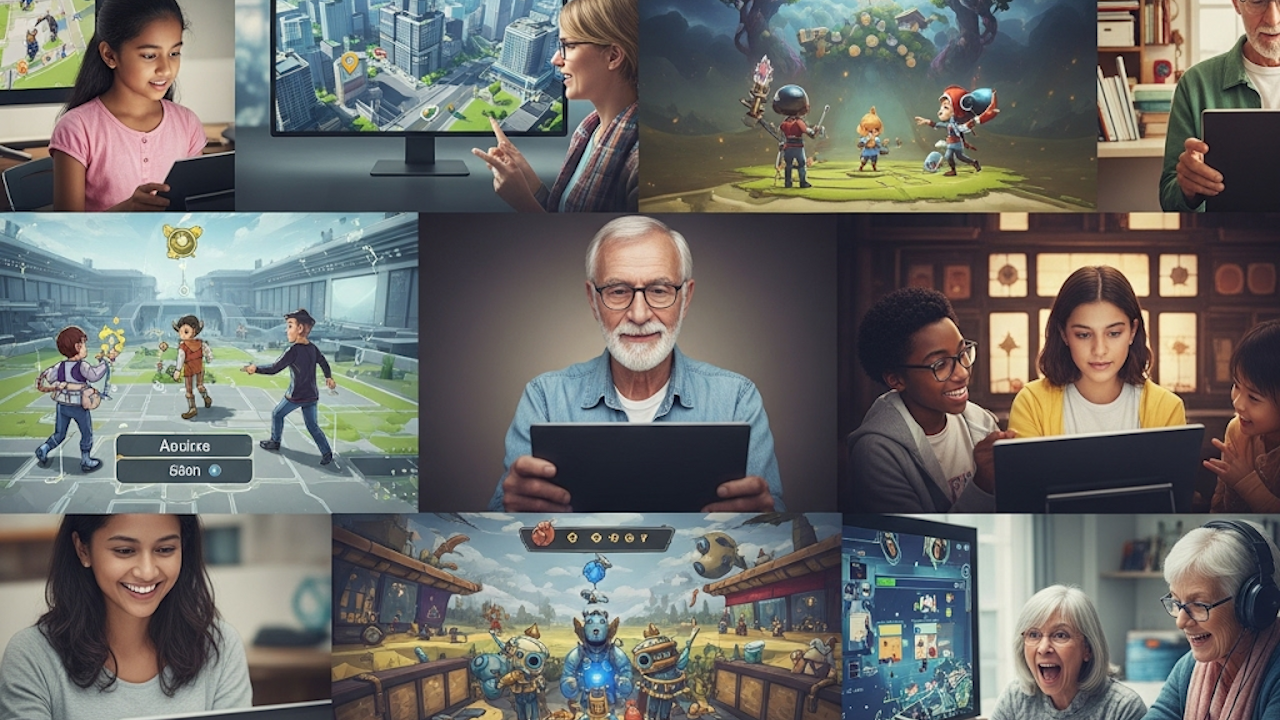
In an age where screens dominate our free time and entertainment options multiply by the day, many people dismiss video games, board games, and mobile apps as mere distractions. Yet beneath the surface of colorful pixels, strategic dice rolls, and addictive loops lies a powerful form of education that operates in stealth mode. These games embed real-world skills into experiences designed first and foremost for fun. Players chase high scores, build empires, or survive apocalyptic scenarios without ever opening a textbook or attending a lecture. The learning happens incidentally, through trial and error, immediate feedback, and the sheer joy of play. Psychologists call this incidental learning or stealth education, and it works because the brain absorbs patterns and principles more effectively when motivation comes from curiosity rather than obligation. This article dives deep into the games that quietly sharpen abilities ranging from financial literacy to ethical decision-making, spatial reasoning to crisis management, all while you think you are simply passing the time.
Simulation games stand out as masters of this subtle teaching approach because they mirror everyday complexities without announcing their intent. Consider The Sims series, which has captivated millions since its debut in the early 2000s. Players create digital households, guide characters through careers, relationships, and daily routines, and watch as needs like hunger, hygiene, and social interaction fluctuate in real time. On the surface, it feels like playing dollhouse with adults. Beneath that, however, the game trains players in time management and prioritization. You quickly learn that skipping work to party leads to bills piling up and job loss, just as neglecting friendships erodes social capital. Financial decisions appear in the form of furniture purchases, home upgrades, and career promotions that affect income. Many players report carrying these lessons into adulthood, becoming more mindful of budgeting or recognizing the trade-offs between short-term fun and long-term stability. The game never lectures about economics; it simply shows consequences unfolding naturally, making the principles stick through emotional investment rather than rote memorization.
City-building simulators like SimCity take this further by scaling the simulation to entire metropolitan areas. You zone residential, commercial, and industrial districts, lay down roads, power lines, and water systems, then balance budgets against citizen demands for schools, hospitals, and parks. Traffic jams emerge organically if you ignore public transit, pollution spikes when factories outpace green space, and economic booms or busts follow from tax policies. Players absorb lessons in systems thinking, infrastructure planning, and environmental trade-offs without realizing they are internalizing concepts taught in urban planning degrees or business management courses. The satisfaction comes from watching a thriving city grow under your watch, yet the real skill gained is understanding how interconnected decisions ripple outward. In real life, that translates to better handling of workplace logistics, community involvement, or even personal project management where one overlooked detail can cascade into larger problems.
Resource-management titles such as Factorio push these ideas into industrial territory. You crash-land on an alien planet and must automate massive factories to launch a rocket home. The gameplay revolves around designing conveyor belts, assembling machines, and optimizing production lines to avoid bottlenecks. What begins as a simple task of mining ore spirals into complex supply chains that demand efficiency, foresight, and creative problem-solving. Players learn logistics and process optimization through experimentation rather than theory. Trial and error teaches that overproducing one item wastes resources while underproducing another halts progress entirely. These same principles apply directly to careers in manufacturing, software development, or operations management. Many engineers credit Factorio with honing their ability to visualize workflows and eliminate waste, skills that feel intuitive after hours spent tweaking virtual assembly lines.
Puzzle games deliver another stealth curriculum, focusing on logic, spatial awareness, and creative thinking that transfer seamlessly to professional and daily challenges. Portal, developed by Valve, remains a landmark example. Trapped in a testing facility, you wield a portal gun that creates connected doorways through space and must navigate increasingly elaborate chambers using momentum, gravity, and physics. The game never explains Newtonian mechanics in textbooks; instead, it lets players discover conservation of momentum by launching themselves across chasms or redirecting energy beams. Spatial reasoning sharpens as you rotate perspectives and plan multi-step solutions. Studies have shown that regular play improves mental rotation abilities, which prove useful in fields like architecture, surgery, and even navigation in unfamiliar cities. The core loop feels like pure entertainment, yet each solved chamber reinforces analytical thinking and resilience in the face of repeated failure.
Tetris, the timeless block-stacking classic, operates on a simpler but equally effective level. Falling tetrominoes demand rapid pattern recognition and quick decisions under pressure. Players develop an intuitive grasp of spatial fitting that enhances hand-eye coordination and working memory. Research links prolonged Tetris play to better performance in tasks requiring visual processing, such as driving or assembling furniture. The game’s addictive nature ensures practice without fatigue, turning abstract geometry into muscle memory that aids real-world activities from packing suitcases efficiently to visualizing furniture arrangements in a new apartment.
Strategy games embed historical, diplomatic, and economic lessons within grand-scale conflicts or empire-building. The Civilization series lets players guide a civilization from ancient times to the space age, researching technologies, negotiating with rival leaders, and balancing culture, science, and military power. You might choose to pursue diplomacy one game and conquest the next, discovering how trade routes boost economies or how cultural dominance wins without bloodshed. The tech tree quietly teaches chronological cause-and-effect in history, from discovering bronze working to unlocking nuclear fission. Long-term planning becomes second nature as you weigh immediate gains against future advantages. Players often emerge with sharper strategic foresight applicable to business negotiations, career planning, or even personal finance, where delayed gratification yields greater rewards. The game’s depth encourages replayability, reinforcing adaptability and big-picture thinking each time.
Adventure and open-world games excel at fostering creativity, exploration, and adaptability, skills essential for innovation and resilience. Minecraft, the block-based phenomenon, drops players into a procedurally generated world where survival depends on gathering resources, crafting tools, and constructing shelters. Early hours focus on punching trees for wood and mining stone, yet these actions build foundational understanding of material properties and sequencing. Building elaborate structures later requires architectural intuition and engineering basics, especially when redstone circuits introduce logic gates akin to basic programming. In multiplayer servers, collaboration teaches teamwork and communication as players divide labor on massive projects. The game’s survival mode adds pressure from hunger, mobs, and environmental hazards, mirroring real-world preparedness concepts like resource scarcity and risk assessment. Countless architects and engineers have cited Minecraft as the spark for their spatial creativity, while educators note improved problem-solving confidence in students who play regularly.
Stardew Valley offers a gentler but equally profound take on life skills through its pixel-art farming simulation. You inherit a rundown farm, restore it to productivity, befriend townsfolk, and navigate seasonal cycles. Time management emerges as you balance planting, watering, fishing, mining, and social events within limited daylight hours. Relationship-building mechanics reward consistent interaction and thoughtful gift-giving, teaching emotional intelligence and empathy without ever using those terms. Community events highlight the value of participation and reciprocity. Players frequently report that the game prompted real-life changes, such as starting actual gardens, prioritizing family time, or reevaluating stressful careers. The subtle message is that steady effort and meaningful connections create fulfillment, lessons absorbed through peaceful afternoons tending virtual crops rather than self-help books.
Narrative-driven games tackle moral complexity and emotional intelligence with remarkable nuance. Papers, Please places you in the role of an immigration inspector in a fictional authoritarian state. Each day brings a line of applicants whose documents you must scrutinize against ever-changing rules. Deny entry to the wrong person and your family goes hungry; bend rules to help a desperate refugee and risk punishment. The game forces constant ethical calculus under time pressure, honing attention to detail and moral reasoning. Players confront bureaucracy’s absurdities and the human cost of policy decisions, gaining empathy for real-world immigration officers and a deeper appreciation for rule-following versus compassion. Many describe it as quietly transformative, improving their ability to weigh competing priorities in professional or personal dilemmas.
This War of Mine shifts perspective to civilians trapped in a besieged city. You control a group scavenging by night and surviving by day, making choices about stealing from neighbors, sharing limited food, or risking injury for medicine. The mechanics emphasize scarcity and consequence: one night’s bold raid might save a sick child but leave another character traumatized. Emotional weight accumulates through simple diary entries and character interactions, fostering empathy for war victims and an understanding of psychological tolls that traditional history lessons rarely convey. Players emerge with heightened awareness of ethical gray areas and the fragility of societal norms, skills that enhance conflict resolution and leadership in high-stakes environments.
Board games and tabletop experiences deliver parallel benefits in analog form, proving that screens are not required for stealth learning. Settlers of Catan requires players to trade resources, negotiate deals, and adapt to random dice rolls while building settlements. The haggling phase teaches persuasion, reading social cues, and compromise, abilities vital for sales, management, or everyday interpersonal dynamics. Resource scarcity forces strategic allocation, mirroring supply-chain realities in business. Similarly, cooperative titles like Pandemic task groups with containing global outbreaks through coordinated actions. Players learn collective problem-solving, role specialization, and calm decision-making under simulated pressure, lessons that translate to team projects or emergency response training.
Even mobile games can impart subtle growth when designed with depth. Journey, a minimalist exploration title, guides a robed figure across deserts and mountains toward a distant peak. Without dialogue or instructions, it cultivates patience, wonder, and occasional cooperation with strangers who appear briefly to assist. The experience reinforces mindfulness and the value of shared journeys, countering modern distraction culture. Other apps blend puzzle elements with pattern recognition in ways that sharpen cognitive flexibility for daily multitasking.
The underlying mechanism that makes all these games effective teachers is their alignment with how humans learn best: through active engagement, immediate feedback, and intrinsic motivation. Traditional classrooms often separate knowledge from context, but games integrate skills into meaningful challenges. Failure feels low-stakes yet instructive, encouraging experimentation that builds confidence. Repetition in varied scenarios strengthens neural pathways, turning abstract concepts into intuitive habits. As technology advances, virtual reality titles like those simulating surgery or flight further blur the line between play and preparation, allowing muscle memory and decision-making to develop safely.
Critics sometimes worry that time spent gaming detracts from productive pursuits, yet evidence suggests the opposite when games are chosen thoughtfully. They can supplement formal education by making dry subjects approachable and by developing soft skills that employers increasingly value, such as adaptability, collaboration, and creative problem-solving. Parents and educators have begun incorporating these titles into learning strategies, recognizing that a child mastering complex factory layouts in Factorio may approach math or science with greater enthusiasm.
Ultimately, the beauty of these games lies in their invisibility. You load them expecting entertainment, laughter, or competition, never suspecting that each session quietly upgrades your real-world toolkit. Whether negotiating trades in a virtual marketplace, engineering a rocket through orbital physics, or simply learning to balance a simulated life’s demands, players walk away sharper, more empathetic, and better equipped for life’s uncertainties. In a world that prizes lifelong learning, these experiences remind us that education need not feel like work. Sometimes the most profound lessons arrive wrapped in the language of fun, waiting for us to press start and discover them on our own terms. Next time you settle in for a gaming session, consider the hidden curriculum unfolding with every decision. You might just level up skills that matter long after the credits roll.