Category: Cryptocurrency

The Psychology Behind Crypto Market Cycles
Cryptocurrency markets are renowned for their extreme volatility, with prices capable of surging hundreds of percent in months only to plummet equally dramatically shortly after. While factors like technological developments, regulatory news, and macroeconomic trends play roles, the primary driver of these boom-and-bust patterns is human psychology. Collective emotions such as fear, greed, hope, and… Read More
Can Crypto Really Replace Traditional Banking
The question of whether cryptocurrency can fully replace traditional banking has been debated since Bitcoin’s inception in 2009. As of late 2025, cryptocurrency has achieved significant mainstream adoption, with global ownership rates reaching around 9.9% to 12.4% of the population, equating to hundreds of millions of users. In the United States alone, approximately 28% of… Read More
The Environmental Impact of Cryptocurrency Mining
Cryptocurrency mining, particularly for Bitcoin, has emerged as one of the most energy-intensive processes in the digital economy. The process involves using specialized computers to solve complex mathematical problems, validating transactions and securing the blockchain network through a mechanism known as proof-of-work (PoW). While this ensures decentralization and security, it comes at a significant environmental… Read More
How Blockchain Technology Prevents Fraud
Blockchain technology has emerged as one of the most promising tools in the fight against fraud across various industries. Originally developed to support cryptocurrencies like Bitcoin, blockchain is a distributed ledger system that records transactions in a secure, transparent, and tamper-resistant manner. Its core features make it particularly effective at preventing fraudulent activities, which cost… Read More
Why Bitcoin Has a Fixed Supply of 21 Million
Bitcoin, the world’s first decentralized cryptocurrency, was introduced in 2008 by its pseudonymous creator, Satoshi Nakamoto, through a whitepaper titled “Bitcoin: A Peer-to-Peer Electronic Cash System.” One of its most defining features is the hard-coded limit on its total supply, capped at approximately 21 million coins. This fixed supply stands in stark contrast to traditional… Read More
Proof of Work vs Proof of Stake Explained Simply
In the world of cryptocurrencies, blockchains need a way to agree on which transactions are valid and to add new blocks to the chain without relying on a central authority like a bank. This agreement process is called a consensus mechanism. The two most common ones are Proof of Work (PoW) and Proof of Stake… Read More
The History of Money and How Crypto Fits In
Money is one of humanity’s most profound inventions, serving as a medium of exchange, a unit of account, and a store of value. Its evolution reflects the growing complexity of human societies, from simple trade in ancient times to sophisticated digital systems today. Understanding this history reveals patterns of innovation driven by the need for… Read More
How Bitcoin Actually Works Under the Hood
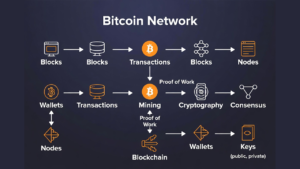
Bitcoin, introduced in 2008 by the pseudonymous Satoshi Nakamoto in the whitepaper “Bitcoin: A Peer-to-Peer Electronic Cash System,” is a decentralized digital currency that operates without a central authority. It achieves this through a combination of cryptography, distributed consensus, and economic incentives. At its core, Bitcoin is a protocol that enables peer-to-peer transfers of value… Read More
What Is Cryptocurrency and Why It Matters
Introduction to Cryptocurrency Cryptocurrency is a digital or virtual form of currency that uses cryptography for security and operates on decentralized networks, typically based on blockchain technology. Unlike traditional currencies issued by governments and managed by central banks, cryptocurrencies function independently of any central authority. This decentralization allows peer-to-peer transactions without intermediaries like banks. The… Read More