Category: Cryptocurrency

Privacy Coins and the Debate Over Financial Privacy
In the rapidly evolving world of cryptocurrencies, privacy coins stand out as a specialized subset designed to enhance user anonymity and protect transaction details from public scrutiny. Unlike mainstream cryptocurrencies such as Bitcoin or Ethereum, where transactions are recorded on transparent public ledgers, privacy coins employ advanced cryptographic techniques to obscure sender identities, recipient addresses,… Read More
The Role of Crypto in Sanctions and Politics
Cryptocurrency has emerged as a transformative force in the global financial landscape. It challenges traditional monetary systems and influences international relations. At the intersection of technology, economics, and geopolitics, crypto plays a dual role. On one hand, it offers financial inclusion and innovation. On the other, it serves as a tool for evading economic sanctions… Read More
Can Crypto Help the Unbanked
In an increasingly digital world, access to financial services remains a distant dream for billions of people. The unbanked, those without a bank account or access to traditional financial institutions, face significant barriers to economic participation. According to the World Bank’s Global Findex Database 2025, approximately 1.3 billion adults worldwide still lack access to formal… Read More
How Crypto Is Used in Inflation Hit Economies
In economies plagued by high inflation, where the value of local currency erodes rapidly, people and businesses often seek alternatives to preserve wealth and conduct transactions. Inflation-hit economies, such as those in Venezuela, Argentina, Turkey, and Zimbabwe, face annual inflation rates that can exceed 50 percent or even reach hyperinflation levels, leading to diminished purchasing… Read More
Crypto and Financial Freedom Myths vs Reality
In the world of finance, few topics have sparked as much excitement, debate, and controversy as cryptocurrency. Since Bitcoin’s inception in 2009, crypto has been hailed as a revolutionary force that could democratize money, empower individuals, and pave the way to true financial freedom. Financial freedom, in this context, often refers to the ability to… Read More
Taxation Challenges in Cryptocurrency
Cryptocurrency has revolutionized the financial landscape since the inception of Bitcoin in 2009. What began as a niche digital experiment has evolved into a global asset class worth trillions of dollars. However, with this growth comes a myriad of complexities, particularly in the realm of taxation. Governments worldwide are grappling with how to tax these… Read More
Is Crypto a Threat to the Global Financial System
Cryptocurrency has evolved from a niche experiment in digital money to a trillion-dollar asset class that captivates investors, regulators, and policymakers worldwide. Born out of the 2008 financial crisis with the creation of Bitcoin, crypto promises decentralization, transparency, and financial autonomy. Yet, as its adoption grows, a pressing question emerges: Does cryptocurrency pose a genuine… Read More
Why Some Countries Ban Crypto and Others Embrace It
Cryptocurrencies, digital assets like Bitcoin and Ethereum that operate on decentralized blockchain technology, have transformed the global financial landscape since their inception in 2009. These assets promise borderless transactions, financial inclusion for the unbanked, and a hedge against traditional economic instability. However, the response from governments worldwide has been far from uniform. While some nations… Read More
How Governments Regulate Crypto Around the World
Cryptocurrencies have transformed from niche digital assets to a global financial phenomenon, prompting governments worldwide to develop regulatory frameworks to address risks like money laundering, consumer protection, and financial stability while fostering innovation. As of early 2026, the regulatory landscape varies significantly by region, with some countries embracing crypto as a tool for economic growth… Read More
Central Bank Digital Currencies vs Cryptocurrencies
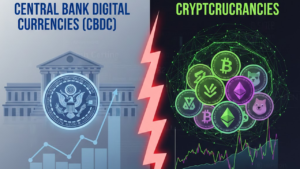
In the rapidly evolving landscape of digital finance, two prominent forms of digital money have captured global attention: Central Bank Digital Currencies (CBDCs) and cryptocurrencies. As of January 2026, with over 100 countries exploring or piloting CBDCs and cryptocurrencies like Bitcoin and Ethereum continuing to influence markets, the debate over their roles in the future… Read More
Why Scalability Is Crypto’s Biggest Challenge
In the rapidly evolving world of cryptocurrency, few issues loom as large as scalability. At its core, scalability refers to a blockchain network’s ability to handle an increasing number of transactions, users, and data without compromising its performance, security, or decentralized nature. As cryptocurrencies aim to disrupt traditional financial systems, scalability stands out as the… Read More
How Oracles Connect Blockchains to the Real World
Blockchains have revolutionized the way we think about trust, data integrity, and decentralized systems. At their core, blockchains are distributed ledgers that record transactions in a secure, immutable manner across a network of computers. However, one fundamental limitation of blockchains is their isolation from the external world. Smart contracts, which are self-executing programs on blockchains,… Read More
What Is Web3 and Is It the Future of the Internet
The internet has transformed society over the past few decades, evolving from a simple network of static pages to a dynamic platform for social interaction, commerce, and information sharing. As we enter 2026, a new paradigm known as Web3 is gaining attention as a potential successor to the current web. Web3 promises a decentralized, user-controlled… Read More
In Crypto How Gas Fees Work and Why They Spike
Introduction to Gas Fees in the Crypto World In the vast and dynamic ecosystem of cryptocurrencies, gas fees represent a fundamental yet often frustrating aspect of blockchain transactions. These fees are essential for the operation of many blockchain networks, particularly those like Ethereum, which rely on them to process and validate transactions. Gas fees ensure… Read More
Crypto Layer 2 Solutions Explained for Beginners
Cryptocurrency and blockchain technology have revolutionized the way we think about money, transactions, and decentralized systems. However, as these networks grow in popularity, they face significant challenges, particularly in terms of scalability. If you’re new to crypto, you might have heard terms like “Layer 1” and “Layer 2,” but understanding what they mean and why… Read More
NFTs Beyond Art Real World Use Cases
Non-Fungible Tokens, or NFTs, have captured the world’s attention since their explosive rise in popularity around 2021. Initially synonymous with digital art and collectibles, such as profile pictures or pixelated images fetching millions at auctions, NFTs represented a new way to own and trade unique digital assets on blockchain networks. However, as the technology has… Read More
What Is a DAO and How It Works
A Decentralized Autonomous Organization, commonly referred to as a DAO, is a blockchain-based entity that operates without centralized leadership. Instead, it is governed collectively by its members through rules encoded in smart contracts. These smart contracts are self-executing programs deployed on a blockchain, typically Ethereum, that automate decision-making, fund management, and operational processes. The core… Read More
How Decentralized Finance Is Changing Banking
Decentralized Finance, commonly known as DeFi, represents one of the most profound shifts in the financial sector since the advent of online banking. Built on blockchain technology, primarily Ethereum and other networks, DeFi uses smart contracts to automate financial services without intermediaries like banks, brokers, or clearinghouses. As of late 2025, DeFi has matured from… Read More
What Are Smart Contracts and Why They Matter
Smart contracts represent one of the most transformative innovations in blockchain technology. At their core, they are self-executing programs that automatically enforce the terms of an agreement when predefined conditions are met. Unlike traditional contracts, which rely on paper documents, legal language, and intermediaries to oversee compliance, smart contracts operate through code deployed on a… Read More
Ethereum vs Bitcoin Key Differences Explained
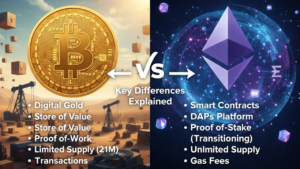
Bitcoin and Ethereum stand as the two dominant forces in the cryptocurrency landscape, collectively representing over 70% of the total market capitalization in late 2025. Bitcoin, launched in 2009 by the pseudonymous Satoshi Nakamoto, pioneered decentralized digital currency. Ethereum, introduced in 2015 by Vitalik Buterin and a team of developers, expanded the concept into a… Read More
Why Volatility Is Inevitable in Crypto Markets
Volatility, defined as the degree of variation in the price of an asset over time, is a hallmark of cryptocurrency markets. While all financial markets experience price fluctuations, cryptocurrencies exhibit extreme swings that can see assets like Bitcoin rise or fall by double-digit percentages in a single day. This characteristic has persisted since the inception… Read More