

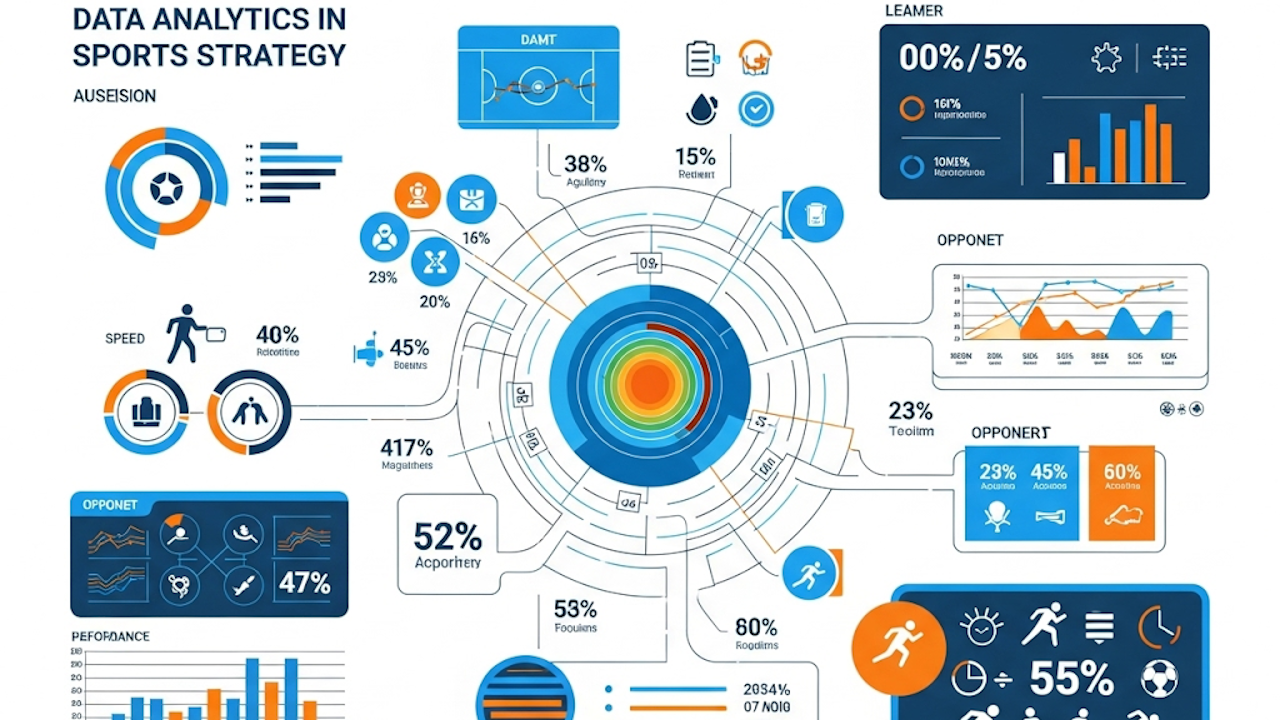
In the high stakes world of professional sports, every decision carries millions of dollars and careers in the balance. For decades coaches relied on gut instinct, scouts on sharp eyes, and general managers on decades of experience. Today that landscape has shifted dramatically. Data analytics has moved from the fringes of sports operations to the very core of strategy, transforming how teams recruit talent, design plays, prevent injuries, and even sell tickets. What began as simple box scores has evolved into a sophisticated ecosystem of sensors, algorithms, and predictive models that reveal patterns invisible to the naked eye. This article explores the mechanics, applications, and future of data analytics in sports strategy, showing how numbers have become the ultimate competitive edge.
The foundations of sports analytics stretch back further than many realize. In baseball, the systematic study of statistics dates to the late 19th century when Henry Chadwick created early box scores. The real leap came in the 1970s and 1980s with the work of Bill James and his Baseball Abstract publications. James coined the term sabermetrics, drawing from the Society for American Baseball Research, and challenged conventional wisdom by emphasizing on base percentage over batting average and runs created over traditional counting stats. His ideas remained largely academic until the early 2000s when Oakland Athletics general manager Billy Beane and his team applied them under severe budget constraints. The 2002 season immortalized in Michael Lewis book Moneyball showed how a small market team could compete with giants by valuing undervalued metrics such as on base plus slugging. The approach was not without controversy; traditional scouts derided it as soulless number crunching. Yet the results spoke volumes as the Athletics reached the playoffs four straight years despite one of the lowest payrolls in Major League Baseball.
The success of sabermetrics opened the floodgates across sports. Basketball adopted similar rigor when Daryl Morey joined the Houston Rockets in 2006 as general manager. He built a front office obsessed with expected value calculations for every shot attempt, prioritizing three pointers and shots at the rim while devaluing inefficient mid range jumpers. The Rockets analytics team developed models that quantified spacing, defensive rotations, and even the impact of a single pass on scoring probability. By the mid 2010s nearly every National Basketball Association franchise employed dedicated analytics departments. The league itself launched its tracking system in 2013, installing cameras in every arena to capture player and ball movement at 25 frames per second. This produced terabytes of data per game, enabling metrics such as player efficiency rating, true shooting percentage, and defensive real plus minus.
Football, both American and association varieties, followed a parallel path but faced unique hurdles due to the complexity of continuous play and team interactions. The National Football League introduced Next Gen Stats in 2016 using radio frequency identification chips in player shoulder pads and the ball. These sensors track speed, acceleration, separation, and route efficiency in real time. Coaches now consult win probability models before deciding whether to attempt a fourth down conversion or kick a field goal. Data showed that aggressive fourth down decisions in certain situations increased win probability by measurable margins, overturning decades of conservative play calling. In European soccer, companies such as Opta and Stats Perform built global databases that log every pass, shot, and duel with contextual tags. Premier League clubs employ data scientists who model expected goals, a metric that measures shot quality based on location, angle, and defensive pressure rather than simply counting goals scored. Liverpool under manager Jurgen Klopp famously integrated expected goals into recruitment and tactical planning, helping the club secure its first league title in 30 years in 2020.
The raw material for modern sports analytics comes from multiple streams. Wearable technology sits at the forefront. Devices from Catapult and WHOOP track heart rate variability, GPS positioning, and biomechanical loads during training. These metrics help strength and conditioning coaches manage player workload, identifying when an athlete is at elevated risk of soft tissue injury. In tennis, Hawk Eye systems have long provided ball tracking for line calls, but the data also feeds into strategy tools that reveal opponent tendencies down to the percentage of serves directed to the backhand on break points. Golf uses launch monitors that capture club head speed, spin rate, and launch angle, allowing players to optimize equipment and swing mechanics with precision once reserved for laboratory settings.
Video analysis has also undergone a revolution. Artificial intelligence algorithms now tag events in footage automatically, reducing the hours analysts once spent manually coding plays. In ice hockey, the National Hockey League player tracking system quantifies zone entries, puck possession time, and even the speed of passes. Machine learning models cluster players into archetypes, revealing for example that a certain defenseman excels in transition but struggles in board battles. These insights inform line matchups and trade deadlines far more objectively than traditional scouting reports ever could.
Strategy on the field has changed in profound ways because of these tools. Consider in game decision making. Traditional baseball managers pulled starting pitchers based on pitch count or qualitative feel for fatigue. Today algorithms incorporate velocity trends, spin rates, and exit velocity allowed to forecast when a pitcher is losing effectiveness, often before the eye can detect it. Soccer teams use heat maps and passing networks to adjust formations mid match. If data shows an opponent overloading one flank, coaches can instruct a tactical tweak via tablet computers on the sideline. In basketball, timeout decisions are now guided by models that calculate momentum shifts and foul trouble probabilities down to the final seconds.
Recruitment and roster construction represent another arena where analytics dominate. Scouting departments once relied on subjective grades. Modern organizations layer those evaluations with quantitative projections derived from comparable player histories. Machine learning algorithms trained on thousands of careers can estimate the probability that a college prospect will translate his athleticism to professional success. Teams also use clustering analysis to identify market inefficiencies, drafting players whose skill sets are undervalued league wide. The Golden State Warriors built their dynasty in part by recognizing the long term value of three point shooting specialists and defensive versatility that traditional metrics overlooked.
Injury prevention stands as one of the most impactful applications. Soft tissue injuries cost professional leagues billions annually in lost player time. Predictive models integrate training load data, sleep metrics, and even psychological stress indicators to flag athletes approaching overload thresholds. The English Premier League has seen clubs reduce hamstring injury rates by double digit percentages after implementing such systems. Return to play protocols now incorporate objective benchmarks from force plates and motion capture rather than relying solely on medical opinion. These advances not only protect athletes but also preserve team performance over a grueling season schedule.
Beyond on field results, data analytics influences the business side of sports. Fan engagement platforms analyze viewing habits and ticket purchase patterns to personalize marketing campaigns. Fantasy sports and sports betting have exploded in popularity, fueled by granular player projections that make every matchup a data rich puzzle. Stadium operators use foot traffic sensors and concession sales data to optimize layout and staffing. Even broadcast production teams rely on real time analytics to highlight compelling storylines, such as a defender covering more ground than any other in the league.
Despite these successes, sports analytics faces notable challenges. Data quality remains inconsistent across leagues and levels of competition. Small sample sizes plague interpretation, especially in individual sports where variance is high. Over reliance on models can blind decision makers to intangible factors such as leadership, chemistry, or clutch performance that resist easy quantification. Privacy concerns grow as players increasingly question who owns their biometric data and how it might affect contract negotiations or insurance premiums. There is also the risk of a data arms race widening the gap between wealthy franchises and smaller market teams, potentially undermining competitive balance.
Interpreting analytics correctly demands human judgment. The best organizations treat data as a complement to expertise rather than a replacement. Coaches who dismiss numbers outright miss opportunities, but those who treat every model output as gospel risk poor decisions when models fail to capture context. Successful integration requires clear communication between data scientists and on field staff, often through dashboards designed specifically for non technical users.
Looking ahead, the field stands poised for even deeper integration of artificial intelligence and real time processing. Computer vision systems will soon analyze body language and micro expressions to detect fatigue or frustration before they manifest in performance drops. Predictive models will incorporate environmental variables such as weather, altitude, and crowd noise with greater accuracy. In Olympic sports and niche disciplines, where resources were once limited, affordable sensor technology is democratizing analytics and leveling the playing field.
Emerging technologies such as edge computing will allow instant feedback during practice sessions. A soccer player might receive a vibration alert in his cleat when his positioning deviates from optimal pressing angles. Virtual reality training environments will simulate game situations drawn from actual league wide data sets, accelerating skill acquisition. As leagues expand globally, multilingual natural language processing tools will mine fan sentiment across social media platforms to inform everything from merchandise design to broadcast scheduling.
The cultural shift is equally significant. Players raised in the analytics era expect data driven feedback on their development. They review personal dashboards showing sleep efficiency alongside shooting efficiency and adjust routines accordingly. Front offices hire more data scientists than traditional scouts in some organizations. The language of sports itself has changed, with expected goals, win probability added, and player impact estimate becoming household terms among serious fans.
Ultimately data analytics has not diminished the drama or human element of sports. It has instead illuminated the hidden structures beneath the spectacle, allowing for smarter preparation and fairer competition. The thrill of a last second shot or a perfectly executed counter attack remains undiminished. What has changed is the preparation that makes those moments possible. Behind every record breaking performance or championship run today lies a foundation of meticulously collected and creatively analyzed numbers.
As sports continue to evolve, the organizations that master the balance between data and intuition will thrive. They will recruit more efficiently, strategize more precisely, and sustain peak performance longer. For athletes, coaches, executives, and fans alike, the numbers are no longer cold abstractions. They are the unseen coaches shaping the future of the games we love. The revolution that began with handwritten box scores in the 19th century has reached a new chapter, one written in code and powered by insight. The field is open, the data flows freely, and the next great competitive advantage awaits those willing to look closer at the numbers behind the numbers.