

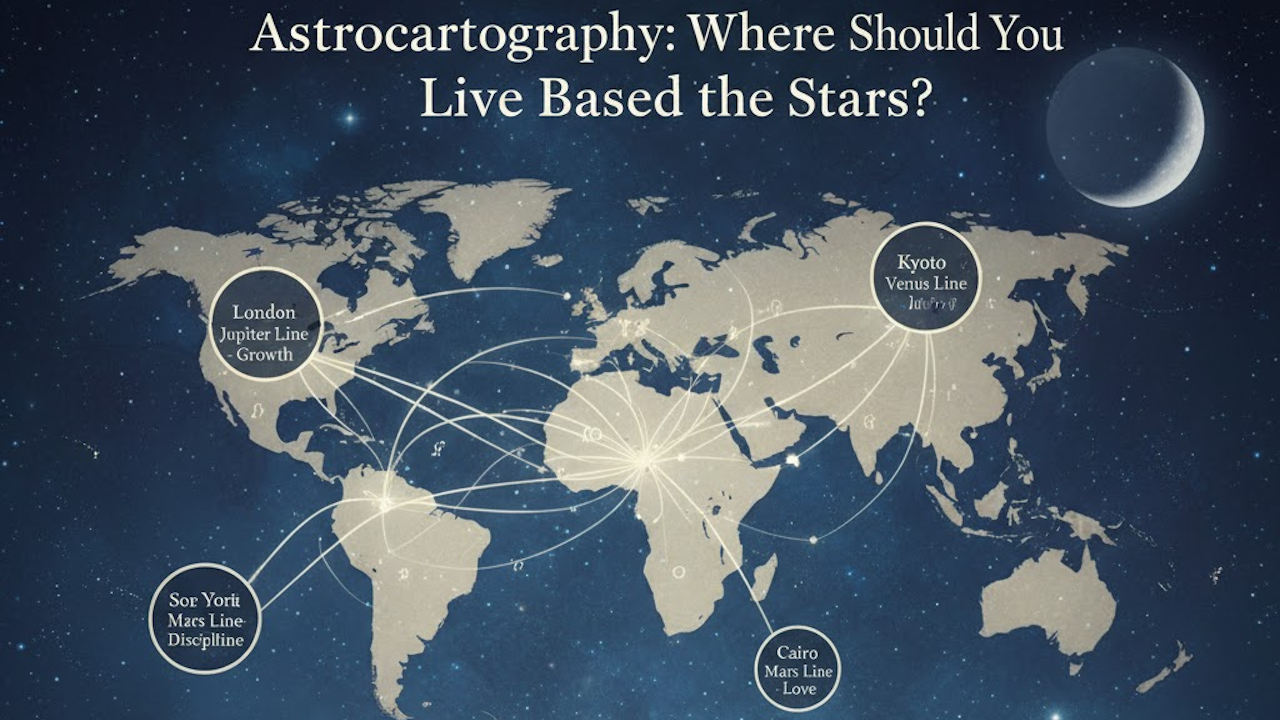
Astrocartography, also known as locational astrology or relocation astrology, is a specialized branch of astrology that maps the positions of planets from an individual’s birth chart onto the Earth’s surface. It suggests that different locations around the world can activate or emphasize specific planetary energies, influencing aspects of life such as career, relationships, personal growth, and challenges. By examining these planetary lines on a map, practitioners believe people can identify optimal places to live, work, travel, or visit for particular goals or transformations.
This approach offers a cosmic perspective on geography and human experience. Rather than viewing the world as uniform, astrocartography proposes that each place carries a unique energetic signature tailored to one’s natal chart. Developed in the 20th century, it has gained popularity among those seeking guidance on major life moves, from career relocations to personal retreats.
The Origins and Development of Astrocartography
Astrocartography traces its roots to traditional astrology but was formalized as a distinct system in the 1970s by American astrologer Jim Lewis. Lewis built upon earlier ideas in relocation astrology, which considers how a birth chart shifts when interpreted for a new location. He advanced this by projecting planetary positions onto a global map, creating visual lines that represent where planets align with key angles in the chart.
Lewis drew from the concept that at the moment of birth, planets occupy specific positions relative to the horizon and meridian. These positions, when extended across the globe, form lines of influence. His system, often called AstroCartoGraphy, became widely accessible through software and maps, allowing individuals to see their personal planetary geography. Over decades, it has evolved with contributions from other astrologers who incorporate additional elements like parans (simultaneous angular relationships) and local space lines.
The method gained traction in an era of increased global mobility. As people traveled more and considered international moves, astrocartography provided a framework for understanding why certain places felt energizing or draining. Today, online calculators and professional readings make it available to a broad audience, blending ancient symbolic traditions with modern mapping technology.
How Astrocartography Works
To create an astrocartography map, an astrologer or software uses the exact birth date, time, and place. The natal chart is then projected onto the world map. Each planet generates up to four main lines corresponding to the four cardinal angles: the Ascendant (rising), Descendant (setting), Midheaven (culminating overhead), and Imum Coeli (lowest point, or IC).
These lines indicate where a planet’s energy becomes angular and thus prominent in a relocated chart. An orb of influence, typically around 150 to 250 miles on either side of the line, means the effects can be felt in a broader region without needing to stand exactly on the line.
In addition to these primary lines, astrologers may examine parans, which are points where planets rise, set, culminate, or reach the nadir simultaneously with other planets or angles. Crossings where lines intersect can create compounded influences, either harmonious or challenging depending on the planets involved.
Relocation charts complement the map by recalculating the full birth chart for a specific new location, showing how houses and aspects shift. Together, these tools help interpret the potential experiences in different places.
Understanding the Planetary Lines
Each planet’s lines carry distinct themes, modified by the angle they align with and aspects in the natal chart. Here is an overview of the main planets and their general influences.
The Sun lines highlight areas for self-expression, vitality, and recognition. Living near a Sun Ascendant line might boost confidence and leadership, making one more visible in social or professional spheres. A Sun Midheaven line could support career success and public acclaim, while Sun Descendant lines emphasize partnerships and relationships.
Moon lines relate to emotional needs, home, and intuition. These areas may heighten sensitivity, family connections, or domestic life. A Moon IC line could foster a strong sense of roots and emotional security, ideal for building a nurturing home base.
Mercury lines activate communication, intellect, and travel. They suit writers, teachers, or anyone needing mental stimulation. Mercury lines might bring frequent short trips or opportunities for learning and networking.
Venus lines are often sought for romance, beauty, and pleasure. They can attract harmonious relationships, artistic inspiration, or financial ease. A Venus line might make a location feel more enjoyable and socially rewarding.
Mars lines energize action, ambition, and assertiveness. They can support pioneering efforts or physical activities but may also introduce conflict or high stress if not managed well. Mars Ascendant lines, for instance, encourage bold self-assertion.
Jupiter lines expand opportunities, growth, and optimism. They are considered fortunate for travel, education, or spiritual pursuits, often bringing luck, abundance, or broadening horizons in the corresponding life area.
Saturn lines demand structure, responsibility, and discipline. They can lead to long-term achievements through hard work but may feel restrictive or karmic. These lines suit serious career building or learning lessons in maturity.
Uranus lines bring innovation, change, and unpredictability. They might inspire breakthroughs or sudden shifts, appealing to those seeking excitement or unconventional lifestyles.
Neptune lines enhance creativity, spirituality, and compassion but can blur boundaries, leading to idealism or confusion. Ideal for artistic or healing work.
Pluto lines involve transformation, power, and intensity. They can facilitate profound personal evolution or confrontations with deeper issues, often marking places of significant change.
Chiron lines, sometimes included, focus on healing wounds and developing unique gifts. They may highlight areas for personal integration and mentoring others.
The angles modify these energies. Ascendant lines affect personal identity and immediate environment. Midheaven lines influence career and public image. Descendant lines highlight partnerships. IC lines relate to home, family, and inner foundations.
Interpreting Your Astrocartography Map
Reading a map begins with identifying prominent lines near desired locations or current residence. Consider the natal chart context: a well-aspected planet will express more positively than one with challenging aspects. Line crossings can amplify or balance energies.
For example, a Jupiter Venus crossing might indicate a place of great joy and opportunity in relationships or creativity. Conversely, a Saturn Pluto intersection could signal intense lessons around power and limitations.
Practical steps include generating a free map on sites like astro.com, noting lines within the orb of influence for current or potential homes, and cross-referencing with relocation charts for house placements. Consulting a professional astrologer can provide nuanced interpretations tailored to the full chart.
Real-World Applications and Examples
Many people use astrocartography for life decisions. Some move to Venus lines seeking love or artistic fulfillment. Others choose Jupiter lines for career expansion or educational opportunities.
Historical and celebrity examples illustrate its appeal. Astrologers have analyzed figures like Walt Disney, whose Mercury IC line connected to family-oriented creative legacies in specific locations. Political figures and artists reportedly experienced shifts aligned with their Mars or Sun lines during key periods.
Contemporary users share stories of feeling transformed in new places. One person might thrive creatively on a Neptune line, while another gains professional recognition under a Sun Midheaven line. Travel to beneficial lines can serve as temporary boosts even without permanent relocation.
Benefits and Considerations
Proponents highlight several benefits. Astrocartography encourages self-awareness by linking personal energies to geography. It can validate intuitive feelings about places and guide intentional moves that align with life goals. For digital nomads or frequent travelers, it adds a layer of cosmic timing to decisions.
It also promotes exploration and openness to change. Rather than staying stuck in unsupportive environments, individuals might discover supportive locales that enhance well-being.
However, it is important to approach with balance. Not every experience will match textbook descriptions, as free will, culture, and practical factors like economics or politics play major roles. Lines can manifest positively or challengingly depending on individual readiness and chart dynamics.
Criticisms and the Skeptical Perspective
Like broader astrology, astrocartography faces skepticism. Critics note the lack of empirical scientific evidence linking planetary positions to terrestrial experiences. Interpretations rely on symbolism rather than testable mechanisms, and confirmation bias may influence perceived results.
Skeptics argue that any benefits could stem from placebo effects, excitement of travel, or psychological reframing rather than celestial influences. Studies have not validated causal connections between astrocartography lines and life outcomes.
Despite this, many find value in it as a reflective tool, similar to personality frameworks or mindfulness practices. Whether viewed as literal cosmic guidance or metaphorical inspiration, it sparks curiosity about the interplay between self and environment.
Practical Tips for Exploring Astrocartography
Start by obtaining your birth data accurately and generating a map. Focus initially on a few key planets relevant to your current priorities, such as career (Sun, Jupiter, Midheaven) or relationships (Venus, Descendant).
Visit locations near beneficial lines for short trips to test the energies. Keep a journal of experiences. Combine insights with practical research on visas, cost of living, and community fit.
Remember that no single line dictates destiny. The entire chart and personal agency matter. Multiple lines or none in a region can still offer neutral or mixed experiences.
Conclusion: Navigating Life by the Stars
Astrocartography invites a fascinating dialogue between the heavens and the Earth. By revealing where planetary energies align with personal potentials, it provides a unique lens for choosing where to live or visit. Whether seeking growth on a Pluto line, harmony on a Venus line, or expansion on a Jupiter line, the system encourages mindful exploration of the world.
Ultimately, the stars may suggest directions, but the journey remains personal. Blending astrological insights with real-world wisdom can lead to more fulfilling places and chapters. For those drawn to its mysteries, astrocartography opens doors to deeper connections with both self and planet.