

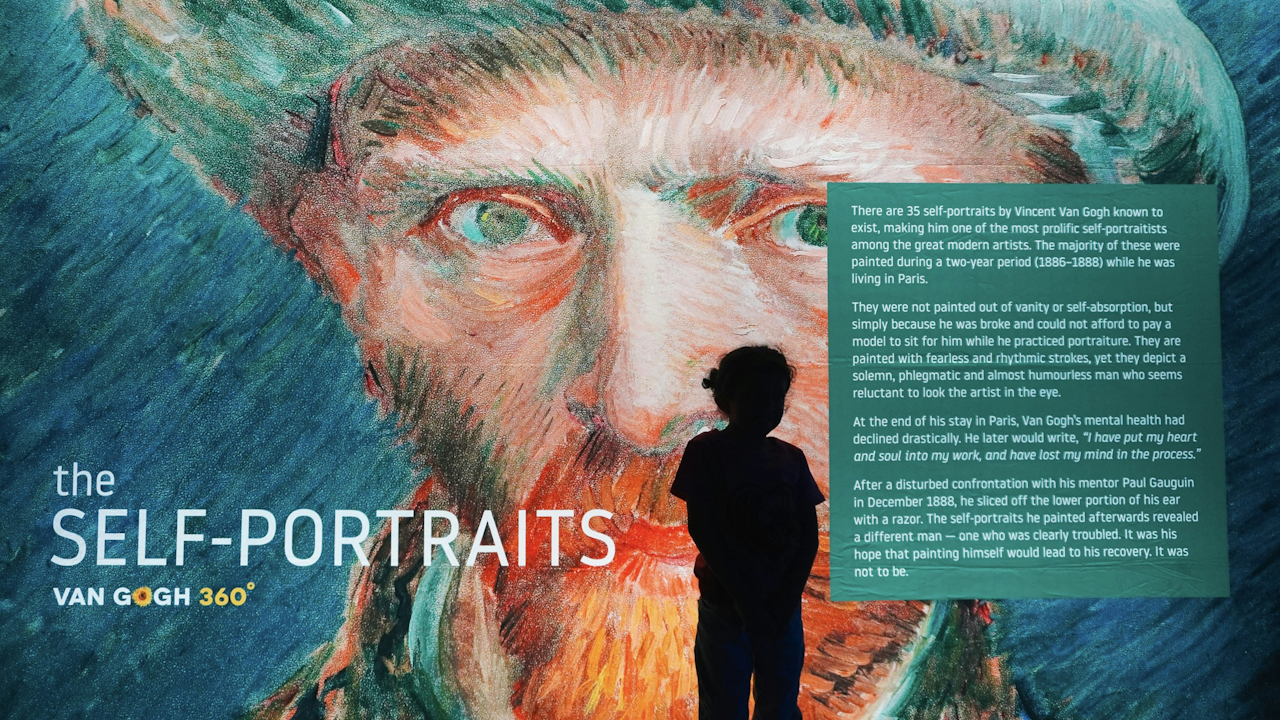
Vincent van Gogh has been dead for more than 130 years, yet his presence in contemporary culture feels remarkably alive. Walk into almost any museum gift shop and you will find his sunflowers on mugs, his starry skies on tote bags, and his self-portraits staring back from postcards. Major exhibitions dedicated to his work continue to draw record crowds. Biographies, novels, films, and even casual social media posts keep his story circulating. Auction houses still chase his paintings with feverish bids. What is it about this Dutch artist, who sold only one painting in his lifetime, that continues to captivate millions?
The obsession begins with the drama of his biography. Van Gogh’s life reads like a novel of unrelenting struggle. Born in 1853 in the Netherlands, he tried his hand at various careers, including art dealer, preacher, and teacher, before committing fully to painting in his late twenties. His most productive years were intense and short. In just over a decade he produced more than 2,000 artworks, many of them now considered masterpieces. Yet during his lifetime he lived in poverty, relied heavily on his brother Theo for financial and emotional support, and battled what we now recognize as severe mental illness.
The episode that has lodged itself most firmly in popular memory is the one in which he cut off part of his own ear in Arles, France, in December 1888. The act, which occurred after a heated argument with Paul Gauguin, has been interpreted, romanticized, and debated endlessly. It feeds into a broader narrative of the tormented genius, the sensitive soul pushed to the brink by inner demons and societal indifference. Van Gogh’s eventual suicide in 1890 at the age of 37, shortly after completing some of his most luminous works, only deepens the tragic aura. In an age that prizes resilience and redemption stories, his arc from obscurity and suffering to posthumous glory feels profoundly satisfying.
Yet the fascination is not merely voyeuristic. Van Gogh’s art itself exerts a powerful, almost physical pull. His mature style, developed during his time in Paris and especially in the south of France, broke away from strict realism. He used bold, unnatural colors to express emotion rather than merely describe appearances. The thick, swirling brushstrokes in paintings such as “The Starry Night” seem to capture movement and energy in the night sky, as if the stars themselves are alive and vibrating with feeling. “Sunflowers” radiates warmth and vitality even as the petals begin to wither. His self-portraits, painted with unflinching honesty, reveal a man confronting his own fragility.
These works speak directly to the senses. Viewers often describe feeling as though they can step into the landscapes or sense the texture of the paint. The emotional directness is part of the appeal. In a world increasingly mediated by screens and irony, Van Gogh’s sincerity stands out. He did not paint to impress critics or chase trends. He painted to understand and convey the intensity of lived experience, whether that experience was the quiet dignity of a peasant eating potatoes or the overwhelming beauty of an almond blossom against a blue sky.
His extensive correspondence with Theo provides another layer of intimacy. The letters, more than 600 of which survive, offer a window into his thoughts, doubts, and creative process. They reveal a man of deep intelligence and literary sensibility who read widely, from the Bible to contemporary novels, and who thought carefully about color theory and composition. Reading them, one encounters not a mad genius operating on pure instinct but a deliberate artist who studied Japanese prints, experimented with perspective, and sought to create work that could comfort and uplift others. This combination of vulnerability and intellectual rigor makes him unusually accessible. He feels like someone we could know.
Modern audiences also find resonance in the themes Van Gogh explored. His work celebrates the ordinary: wheat fields, worn boots, cafe interiors, local postmen. He found profound beauty in places and people often overlooked. In an era of environmental anxiety and digital disconnection, his passionate engagement with the natural world feels refreshing. “The Starry Night,” with its turbulent sky and peaceful village below, can be read as both a depiction of cosmic wonder and a metaphor for inner turmoil contained within a larger harmony. His portraits of working people carry quiet empathy, reminding viewers of shared humanity.
Mental health provides another contemporary hook. Van Gogh’s struggles with depression, anxiety, possible bipolar disorder, and hallucinations have been analyzed by doctors, psychologists, and historians. While retrospective diagnosis remains speculative, the raw honesty with which he described his episodes connects powerfully with today’s greater openness about mental illness. Many people see in him a figure who channeled suffering into creativity rather than being defined by it. His persistence in painting despite repeated breakdowns offers a message of hope, however qualified. Art did not cure him, but it gave his pain form and meaning that outlasted him.
Commercial success has amplified the obsession. Van Gogh’s paintings now command astronomical prices. “Portrait of Dr. Gachet” sold for $82.5 million in 1990, a record at the time. Major institutions compete to host his shows. The Van Gogh Museum in Amsterdam attracts more than two million visitors annually. His image has been reproduced so widely that it borders on ubiquity, appearing in advertising, fashion, and popular entertainment. This very commercialization can provoke backlash, with some critics arguing that the man has been reduced to a brand. Yet the popularity also testifies to genuine affection. People buy the mugs and posters because the images move them.
Popular culture has played a significant role in sustaining interest. Irving Stone’s 1934 novel “Lust for Life” and the subsequent 1956 film starring Kirk Douglas introduced Van Gogh to a mass audience. More recent works, such as the animated film “Loving Vincent” (2017), which used oil paintings in the style of Van Gogh to tell his story, demonstrate continued innovation in how his life and work are presented. Songs by Don McLean and others, as well as countless documentaries, keep the narrative fresh. Even casual references in television shows or internet memes assume a baseline familiarity with the artist.
The mystery surrounding certain aspects of his life adds fuel to the fire. Questions remain about the exact circumstances of his ear incident and his death. Some scholars have challenged the suicide narrative, suggesting accidental shooting by others, though the evidence for suicide remains strong. These debates ensure that new books and articles continue to appear. Each generation finds its own Van Gogh, whether as a symbol of misunderstood creativity, a case study in mental health, or an exemplar of artistic integrity.
His influence on later artists is substantial. The Expressionists, Fauvists, and countless modern painters drew from his bold color and emotional approach. Yet his appeal extends far beyond the art world. Teachers use his story to inspire students. Therapists sometimes reference his resilience. Tourists flock to Arles and Auvers-sur-Oise to walk in his footsteps. The cottage industry of Van Gogh-related tourism thrives because people want to feel closer to the source of that creative energy.
Ultimately, the enduring obsession stems from a rare alignment of factors: a compelling life story, visually stunning and emotionally resonant art, personal writings that reveal the man behind the myth, and themes that speak across time. Van Gogh failed by the standards of his own era, yet he succeeded spectacularly by creating work that feels urgent and alive more than a century later. In celebrating him, we celebrate the possibility that deep feeling and persistent effort can produce something lasting. We also confront the uncomfortable truth that genius and suffering often travel together, and that society frequently recognizes its brightest lights only after they have been extinguished.
His final letters express both despair and a stubborn attachment to beauty. In one, he wrote of feeling like a traveler who has gone as far as he could. That sense of having reached a limit, of having given everything, resonates with anyone who has pursued a passion against the odds. Van Gogh reminds us that art can be a form of communication that bridges isolation, that color and form can convey what words cannot, and that even in darkness there can be stars.
As long as people continue to seek meaning through creativity, to grapple with mental fragility, and to find wonder in the everyday world, Van Gogh’s work will retain its power. The obsession is not simply about nostalgia or marketing. It is about the recognition that one man’s intense, imperfect striving produced images that still quicken the pulse and expand the imagination. In a fragmented and often cynical age, that kind of authentic intensity feels not only rare but necessary. Van Gogh’s legacy is not frozen in the past. It lives in every viewer who stands before one of his canvases and feels, for a moment, less alone.