

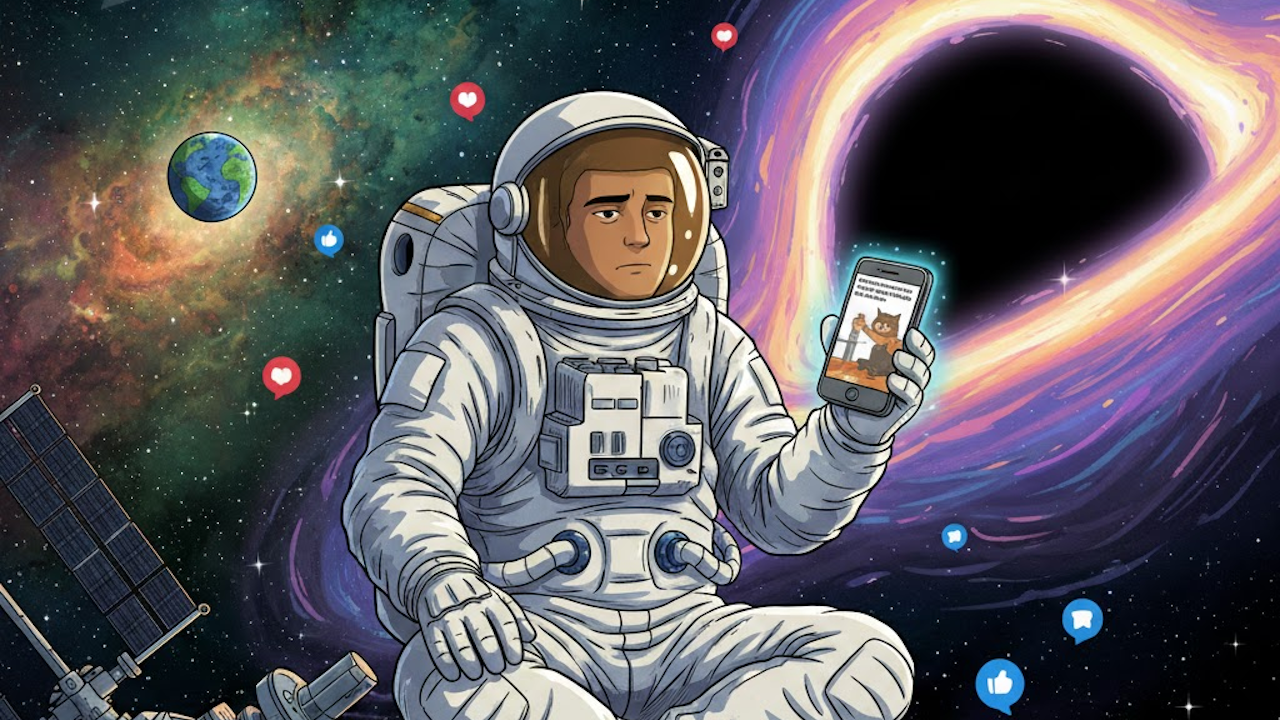
In the vast scroll of social media feeds, a peculiar genre of comedy has taken center stage. Cosmic humor, which blends the absurdity of human existence with the immense scale of the universe, has captured the attention of millions. It is the kind of wit that pokes fun at our tiny place in an indifferent cosmos, mixing existential dread with punchlines that make users laugh and ponder simultaneously. From memes about black holes swallowing egos to jokes about the meaninglessness of life set against stunning images of distant galaxies, this style of content thrives online. But why has social media become so fixated on it? The answer lies in a mix of cultural shifts, psychological needs, technological dynamics, and the timeless appeal of laughing at the void.
Cosmic humor is not entirely new. Philosophers and writers have long explored the idea of the “cosmic joke,” where the universe seems to play tricks on humanity through irony, fate, or sheer indifference. Think of Albert Camus and his absurdism, or ancient traditions that find enlightenment in laughing at life’s contradictions. In literature, cosmic irony refers to situations where fate thwarts human expectations in cruel or humorous ways. Yet on platforms like Instagram, TikTok, X, and Reddit, this concept has exploded into accessible, bite-sized entertainment. Users encounter posts that juxtapose everyday frustrations with the mind-boggling facts of astronomy, turning personal woes into universal punchlines.
One major driver is the role of cosmic humor as a coping mechanism in uncertain times. Modern life brims with anxieties: climate change, political instability, economic pressures, and the lingering effects of global events like pandemics. In such a backdrop, contemplating the sheer scale of the universe can make earthly problems feel insignificant. A meme showing a stressed office worker next to a caption about how Earth is a speck in a galaxy among billions offers relief. It reframes struggles as part of a grand, ridiculous story. Psychologists note that humor, especially dark or existential varieties, helps process grief and build resilience. Social media amplifies this by turning individual catharsis into collective sharing. When users like, share, or comment on these posts, they signal belonging to a community that gets the joke.
The accessibility of scientific knowledge has also fueled this obsession. Decades ago, only astronomers and enthusiasts could marvel at cosmic phenomena through telescopes or dense textbooks. Today, NASA posts, James Webb Space Telescope images, and educational creators bring stunning visuals of nebulae, exoplanets, and supernovas directly to smartphones. This democratization of wonder pairs perfectly with humor. A viral clip might show a penguin sliding on ice with a nihilistic voiceover about entropy, or a fish being shown an eclipse as a metaphor for sudden cosmic awareness. These combinations go viral because they merge education with entertainment, satisfying curiosity while delivering dopamine hits through laughs.
Algorithms play a crucial part in sustaining the trend. Platforms prioritize content that drives engagement, and cosmic humor excels here. It invites reactions: surprise at a clever twist, relatability to the absurdity, or debates in comment sections about free will and meaning. Short-form videos on TikTok, where absurd sounds overlay unrelated cosmic footage, reward quick consumption and remixing. The faster and more chaotic the humor, the better it performs. This creates feedback loops where creators produce more of what spreads, flooding feeds with existential memes. Gen Z and younger millennials, who grew up with these platforms, have developed tastes shaped by rapid, context-free absurdity. What starts as a silly penguin meme evolves into layered commentary on nihilism.
Nihilistic and dark humor threads run deep in this phenomenon. Many cosmic jokes lean into the idea that life has no inherent meaning, which resonates in a secular, information-saturated age. Subreddits dedicated to nihilist memes or philosophy humor feature thousands of posts blending highbrow ideas with lowbrow delivery. A classic example: a diagram of the solar system with Earth labeled “where all the drama happens” while the rest of the universe remains indifferent. Such content does not depress users; instead, it liberates them. By acknowledging the void, people find permission to enjoy the ride. This aligns with broader cultural movements toward skepticism of grand narratives, whether religious, political, or consumerist.
Social media also democratizes cosmic humor, allowing anyone to participate. No advanced degree is required to caption a Hubble image with a quip about how humanity is just “space dust arguing over Wi-Fi.” Influencers, scientists, and ordinary users contribute equally. Astrophysicists react to memes on YouTube, adding legitimacy and further reach. This inclusivity fosters creativity and community. Hashtags and trends like cosmic irony challenges encourage users to share personal stories through a universal lens, turning mundane events into profound comedy.
Another factor is the contrast between the cosmic and the everyday. Humans crave meaning yet face routines of work, bills, and small talk. Cosmic humor bridges this gap by inflating trivialities to interstellar proportions or shrinking epic concepts to relatable sizes. Imagine a post equating Monday mornings to the heat death of the universe: both inevitable and exhausting. This technique provides perspective without preachiness. It echoes spiritual traditions where laughter signals enlightenment, realizing the self is part of a larger, playful whole. The “cosmic joke” that one is what one seeks becomes a recurring motif, reminding audiences that seriousness might be the real illusion.
Critics sometimes worry that this obsession promotes apathy or cynicism. If everything is a joke on a cosmic scale, why strive or care? Yet evidence suggests otherwise. Many who engage with such humor report increased curiosity about science, greater empathy for shared human frailty, and even motivation to act precisely because time is fleeting. Laughter bonds people across divides, creating connections in polarized times. It also counters doom-scrolling by injecting levity into heavy topics.
Trends continue evolving. Emerging formats include AI-generated cosmic scenarios, interactive polls about multiverse theories wrapped in jokes, and crossovers with pop culture, such as comparing superhero multiverses to actual quantum ideas. As space tourism talk grows and private companies launch more missions, expect even more material. The universe provides endless fodder: black holes as metaphors for procrastination, quantum entanglement for complicated relationships, or the Fermi paradox for why aliens avoid us.
In essence, social media’s love affair with cosmic humor reflects deeper human needs. We seek connection, relief, and understanding in an overwhelming world. By laughing at our speck-like existence amid infinite stars, we affirm our humanity. This humor does not diminish life; it celebrates its ridiculous beauty. In a feed full of curated perfection and outrage, these posts remind us to step back, chuckle, and appreciate the grand absurdity. As more users join the conversation, the obsession shows no signs of fading. After all, in the words of countless memes, what else is there to do but laugh while hurtling through space on a rock?
The phenomenon reveals much about our era. Technology shrinks the universe to pocket size, making its wonders and ironies instantly shareable. Economic and social pressures heighten the appeal of perspective-giving comedy. Generational wiring toward quick, chaotic content accelerates its spread. And at the core lies an ancient truth: humor has always been a survival tool. When faced with the unknown, humans have chosen to smile. Social media has simply supercharged that instinct, turning cosmic contemplation into daily entertainment and quiet wisdom. As feeds keep updating, so too will the jokes, each one a small defiance against the silent expanse above.