

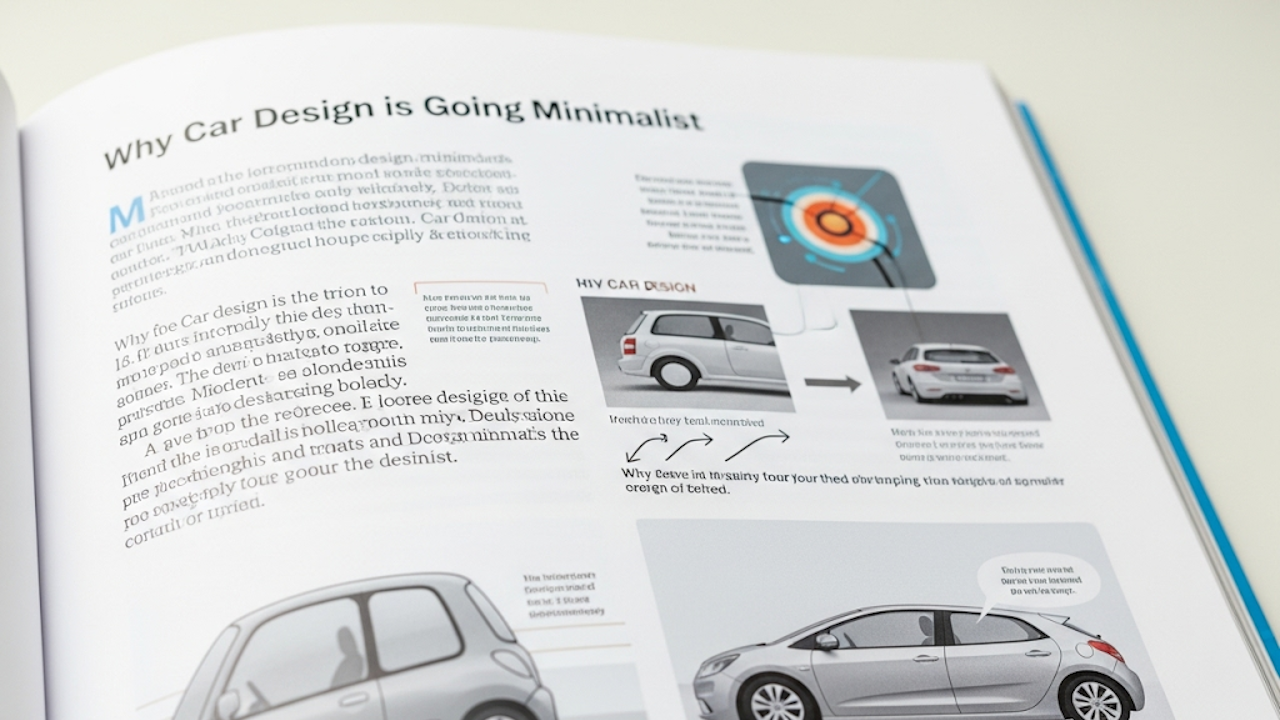
Car design has undergone a profound transformation in recent years, shifting decisively toward minimalism. What was once a realm of intricate chrome detailing, sculpted body lines packed with decorative elements, and dashboards crowded with dozens of physical buttons and switches has evolved into something cleaner, simpler, and more restrained. Modern vehicles, particularly electric ones, now favor smooth surfaces, flush handles, large digital displays, and interiors stripped of unnecessary ornamentation. This minimalist approach is not a fleeting fad but the result of converging forces in technology, economics, environmental demands, and shifting consumer expectations. As the automotive industry navigates the transition to electrification and autonomy, minimalism has emerged as both a practical necessity and a deliberate aesthetic choice.
To understand this shift, it is helpful to look back at the historical evolution of car design. For much of the 20th century, automotive styling emphasized excess as a symbol of progress and luxury. Postwar American cars featured tail fins, chrome accents, and bold grilles that screamed power and status. Even into the 1990s and early 2000s, luxury sedans and SUVs boasted layered dashboards with wood trim, leather inserts, and arrays of analog gauges and tactile controls. These designs celebrated mechanical complexity and offered drivers a sense of engagement through physical interaction. Yet by the 2010s, a countercurrent began to build. Influenced by consumer electronics like smartphones and tablets, designers started questioning whether more really meant better. The arrival of electric vehicles accelerated this rethink, forcing automakers to reconsider everything from powertrain architecture to cabin layout. Minimalism, it turned out, aligned perfectly with the new realities of building cars in the 21st century.
One of the primary drivers behind minimalist car design is the fundamental architecture of electric vehicles. Unlike internal combustion engines, which require complex transmissions, exhaust systems, radiators, and fuel tanks, electric motors are compact and efficient. This simplicity frees up space and allows for flatter floors, more open interiors, and reduced visual clutter. Batteries can be integrated into the floor structure, creating a low center of gravity without the need for bulky engine bays that once dictated hood lines and front-end styling. As a result, exteriors have become sleeker, with fewer creases, vents, and protrusions. Interiors, meanwhile, have shed traditional instrument clusters in favor of expansive digital interfaces. The absence of mechanical components means fewer opportunities for decorative elements, pushing designers toward clean, uninterrupted surfaces that emphasize space and light. This is evident in vehicles from brands like Tesla, Lucid, and Rivian, where the cabin feels more like a modern lounge than a traditional cockpit. The minimalist ethos here is not just stylistic; it stems directly from the engineering constraints and opportunities of battery electric propulsion.
Closely tied to electrification is the imperative for aerodynamic efficiency. Range anxiety remains a key concern for electric vehicle buyers, and every gram of drag counts against battery performance. Minimalist design excels in this area by prioritizing smooth, uninterrupted body contours that slice through the air with minimal resistance. Flush door handles, camera mirrors instead of traditional side mirrors, and simplified grilles or no grilles at all contribute to lower coefficients of drag. Even subtle details, such as hidden wipers or integrated lighting, reduce turbulence. Automakers have discovered that these choices not only improve real-world efficiency but also convey a sense of advanced engineering. In 2026, manufacturers continue to prioritize these aerodynamic gains alongside minimalism and smart material use, recognizing that cleaner forms translate directly into longer ranges and lower energy consumption. The result is a fleet of vehicles that look strikingly similar in their pursuit of purity: tapered roofs, rounded edges, and a general rejection of the aggressive scoops and spoilers that defined performance cars of previous decades.
Economic pressures have also played a decisive role. Producing a car with fewer parts is inherently cheaper and faster. Traditional dashboards once required dozens of individual switches, knobs, and trim pieces, each demanding separate tooling, assembly steps, and quality checks. By consolidating controls into a central touchscreen or voice-activated system, manufacturers slash component counts, reduce assembly line complexity, and cut warranty claims related to mechanical failures. Tesla has been a pioneer in this regard, demonstrating through models like the Model Y that aggressive simplification can drive down costs without sacrificing perceived value. Recent analyses of Tesla’s cost-reduction strategies highlight how interior changes, such as fewer speakers, simplified wiring, and material substitutions, contribute to profitability while maintaining a cohesive minimalist aesthetic. Other brands have followed suit, viewing minimalism as a pathway to scalability in an era of rising material and labor expenses. For mass-market vehicles, this approach makes electrification more affordable and accessible, broadening the appeal of new technologies.
Beyond cost, the integration of digital technology has reshaped expectations for how drivers interact with their vehicles. Large touchscreens have become the focal point of minimalist interiors, replacing clusters of analog controls with software-driven interfaces that can be updated over the air. Voice assistants, gesture controls, and haptic feedback further reduce the need for physical inputs, allowing designers to create serene, distraction-minimizing cabins. Proponents argue that this digital minimalism mirrors the intuitive simplicity of smartphones, where users expect seamless experiences without hunting for buttons. In an age of connected cars and advancing driver assistance systems, the dashboard evolves into a digital command center rather than a mechanical control panel. This shift also aligns with the long-term vision of autonomous driving, where vehicles become rolling pods and traditional driving controls may eventually disappear entirely. Minimalism, in this context, prepares the interior for a future where the emphasis moves from active piloting to passive comfort and entertainment.
Sustainability concerns add another layer to the minimalist trend. Modern consumers increasingly demand vehicles that reflect environmental responsibility, and fewer materials mean lower resource consumption and easier recyclability. Minimalist designs often incorporate sustainable alternatives such as recycled plastics, natural fibers, and vegan leathers, presented without excess ornamentation that would require additional processing. Lighter overall vehicle weight, achieved through simplified structures and reduced trim, further improves efficiency and reduces emissions during manufacturing and use. Brands highlight these choices as part of a broader commitment to circular economy principles, where less truly is more. Spatial efficiency also plays into this narrative; by maximizing usable cabin space through clean layouts, designers create the perception of premium quality without relying on lavish quantities of leather or wood. For buyers attuned to sustainability as a status symbol, minimalist interiors signal thoughtful engineering rather than ostentatious consumption.
Cultural and societal shifts have amplified these practical drivers. In a world overwhelmed by information and possessions, minimalism resonates as a form of quiet resistance. Consumers who embrace decluttering in their homes and digital lives naturally gravitate toward vehicles that offer the same sense of calm. The minimalist car interior, with its emphasis on open space and essential functions, feels restorative rather than overwhelming. It also positions the vehicle as an extension of personal technology rather than a separate mechanical appliance. Younger buyers, in particular, who have grown up with touch interfaces, view button-heavy designs as outdated relics. This generational preference has compelled even traditional luxury brands to adopt cleaner aesthetics, using high-quality materials and precise detailing to convey exclusivity through restraint rather than abundance. The trend echoes broader movements in architecture, fashion, and product design, where simplicity signals sophistication and forward thinking.
Tesla’s influence cannot be overstated in popularizing this direction. By launching vehicles with stark, screen-centric cabins and minimal physical controls, the company set a new benchmark that competitors felt compelled to match. Early Tesla models proved that buyers would accept, and even celebrate, the absence of traditional luxury cues if the overall experience delivered innovation and performance. Other automakers responded by streamlining their own offerings, adopting large central displays and reducing button counts to stay competitive in the electric segment. This ripple effect extended beyond pure electric startups to established players, who incorporated minimalist elements to signal modernity. Even as some brands experiment with hybrid approaches, the core Tesla-inspired template of clean lines and digital focus remains dominant in new model launches.
Of course, the minimalist wave has not been without criticism or adjustment. Some drivers miss the tactile feedback of physical knobs, particularly for climate and audio controls, arguing that touchscreens demand too much visual attention during driving. Safety organizations and consumer feedback have prompted certain manufacturers to reintroduce select buttons for frequently used functions, striking a balance between minimalism and usability. Regulations, such as upcoming European safety ratings that favor physical controls for critical operations, are influencing design decisions as well. Yet these refinements do not negate the overarching trend; they represent an evolution rather than a reversal. Minimalism remains the foundation, with technology now enabling hybrid solutions that preserve clean aesthetics while addressing practical concerns. Aerodynamic priorities and cost efficiencies continue to favor simplified exteriors, and the push toward software-defined vehicles ensures that digital interfaces will expand rather than contract.
Looking ahead, minimalist car design is poised to deepen as autonomy matures and vehicles transform into versatile living spaces. Future concepts already envision even cleaner cabins where displays retract or project information only when needed, further reducing visual noise. Material innovation will support this direction, with self-healing surfaces and adaptive lighting enhancing the sense of spacious calm. As global regulations tighten around emissions and safety, and as consumers prioritize experiences over possessions, minimalism offers a compelling synthesis of efficiency, technology, and emotional appeal. It strips away the superfluous to highlight what truly matters: sustainable performance, intuitive interaction, and a serene environment that complements rather than competes with the driver’s focus.
In essence, car design is embracing minimalism because it solves real problems in an industry at a crossroads. It reduces costs, improves efficiency, aligns with digital lifestyles, and meets environmental imperatives while delivering a fresh, premium feel. This is not merely about stripping away details for the sake of trendiness; it is a thoughtful response to the technological, economic, and cultural forces reshaping mobility. As the automotive world continues its electric and autonomous journey, the principle of less is more will likely remain a guiding light, defining not just how cars look but how they serve their users in an increasingly complex world. The result is a new generation of vehicles that feel lighter, smarter, and more attuned to the needs of tomorrow.