

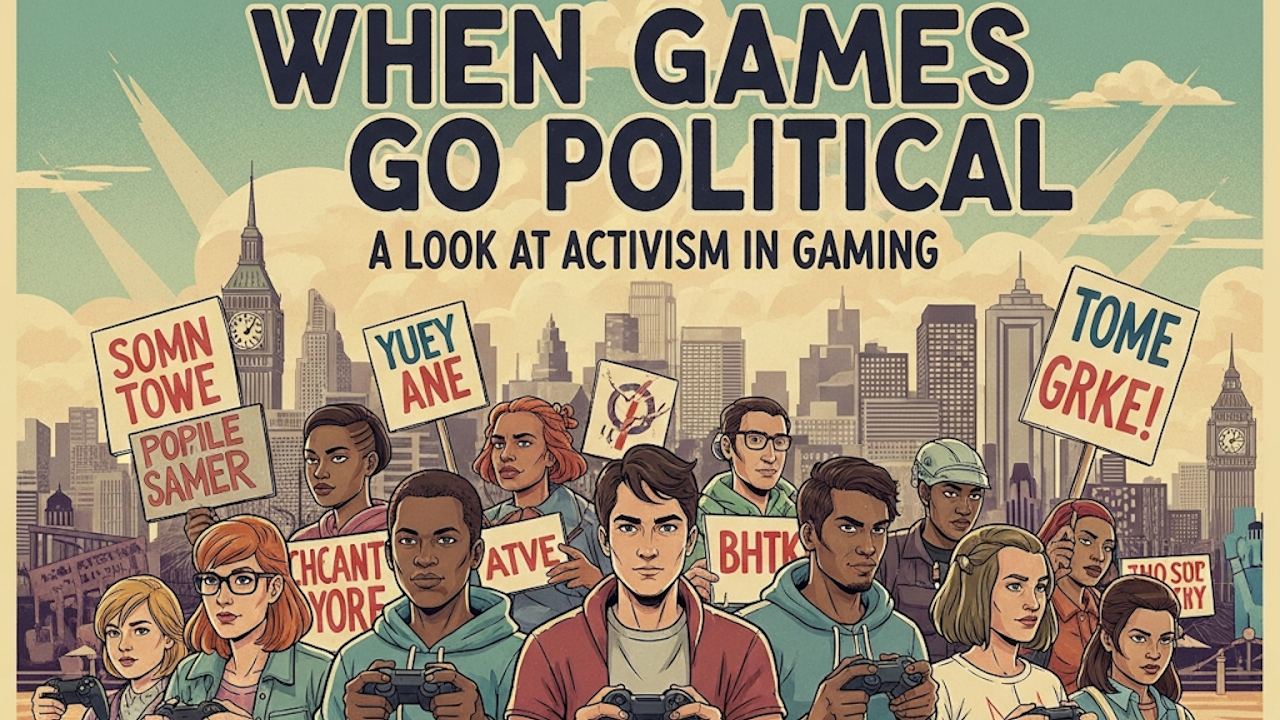
Video games have long served as digital playgrounds for escapism, competition, and storytelling. From the pixelated adventures of the 1980s to the sprawling open worlds of today, they offered players a break from everyday realities. Yet over the past two decades, a noticeable shift has occurred. Games increasingly incorporate explicit political themes, social commentary, and activist messaging. Developers weave in topics like identity politics, environmentalism, systemic inequality, and cultural critique. This evolution raises fundamental questions: Should games remain neutral entertainment, or do they have a responsibility to engage with the world beyond the screen? The debate touches on artistic freedom, consumer expectations, corporate influence, and the very nature of interactive media.
To understand this phenomenon, it helps to trace its roots. Early gaming history was largely apolitical by design. Titles from Atari, Nintendo, and Sega focused on mechanics and fun. A space invader or a plumber rescuing a princess carried no overt ideology. Even when stories emerged, they stayed in fantasy realms. The 1990s introduced more narrative depth with role-playing games and adventure titles, but politics remained subtle. Series like Metal Gear Solid explored anti-war sentiments and nuclear proliferation through espionage thrillers, yet these elements supported gameplay rather than dominating it. Players could engage with the story or ignore it while focusing on stealth and action.
The turning point arrived in the 2000s and accelerated in the 2010s. Independent developers, empowered by digital distribution platforms like Steam and itch.io, began creating smaller, more personal experiences. Games such as Papers, Please simulated the moral dilemmas of an immigration officer in a fictional authoritarian state. It forced players to balance bureaucratic rules against human compassion, sparking discussions about borders and ethics without preaching. Similarly, This War of Mine placed players in the shoes of civilians surviving a war zone, highlighting the human cost of conflict through resource management and survival choices. These titles used interactivity to make abstract issues feel immediate and personal. They represented activism through empathy rather than slogans.
As the industry matured, larger studios followed suit. BioShock critiqued unchecked capitalism and objectivism through its underwater dystopia, drawing from Ayn Rand’s philosophy. The game’s twists encouraged players to question authority and propaganda. Such works demonstrated that political undertones could enhance rather than detract from enjoyment when integrated organically into world-building and mechanics. Successes like these paved the way for more direct approaches. By the mid-2010s, social justice movements gained visibility in broader culture, and gaming reflected that. Developers began addressing representation, diversity, and inclusion more deliberately. Characters from marginalized backgrounds appeared with greater frequency, and storylines tackled real-world issues head-on.
One flashpoint in this timeline was the 2014 Gamergate controversy. What began as debates over ethics in games journalism quickly escalated into accusations of ideological infiltration. Critics argued that activist influences were prioritizing messaging over merit, while supporters framed it as a push for inclusivity against entrenched biases. The episode exposed deep divisions within the player base and developer community. It also highlighted how gaming, once niche, had become mainstream culture with billions in revenue. Suddenly, every major release faced scrutiny not just for fun factor but for its alignment with political values.
In the years that followed, activism in gaming took several forms. Some games embraced explicit advocacy. Life is Strange explored queer identity and mental health through choice-driven narratives, allowing players to shape relationships and outcomes. The series received praise for emotional depth and representation. Other titles incorporated environmental themes, such as the climate crisis in games like The Witness or more recent eco-focused mechanics in survival titles. Activist developers viewed games as powerful tools for education and mobilization. Interactive formats let players experience perspectives they might otherwise dismiss. A well-crafted mechanic could simulate systemic racism or gender dynamics more effectively than a pamphlet or lecture.
Corporate involvement added another layer. Major publishers like Ubisoft, Electronic Arts, and Sony began issuing diversity statements and partnering with advocacy groups. Narrative consultants emerged to advise on inclusive storytelling. This professionalization of activism aimed to broaden appeal and align with evolving audience demographics. Global markets, younger players, and shifting cultural norms all factored into decisions. Representation became a stated goal: more female protagonists, LGBTQ+ characters, and protagonists of color. Studios argued this mirrored society and fostered empathy. Data from player surveys sometimes supported broader appeal, though results varied by genre and region.
Yet not every example landed smoothly. The Last of Us Part II, released in 2020, exemplified the tensions. Its story featured strong queer representation and challenged traditional notions of heroism and revenge. While many praised its technical achievements and emotional complexity, others criticized it as heavy-handed. Backlash centered on perceived prioritization of messaging over character consistency or player agency. Review bombing and online discourse turned toxic, illustrating how political elements could polarize audiences. Similar patterns emerged with other releases. Some players felt lectured rather than entertained, leading to phrases like “get woke, go broke” entering the lexicon. Sales figures told mixed stories. Certain titles with prominent activist elements underperformed commercially, while others thrived despite or because of their themes.
The financial stakes are enormous. The global gaming industry exceeds $200 billion annually, dwarfing film and music combined. When activism influences design, it affects development costs, marketing, and risk assessment. Positive outcomes include expanded talent pools and fresh ideas. Diverse teams can bring authentic stories that resonate with untapped audiences. Failures, however, carry reputational damage and shareholder pressure. Cases like the 2024 launch of Concord, a hero shooter emphasizing progressive representation, highlighted risks. Despite high production values, the game struggled with player retention and was widely attributed to narrative choices that alienated core audiences. Executives at major firms began reassessing approaches, with some quietly scaling back overt messaging in favor of broader accessibility.
Player reactions form the core of the debate. Gaming communities are diverse, spanning casual mobile users, competitive esports athletes, and narrative enthusiasts. Many simply seek escapism after work or school. When a game interrupts with real-world politics, it can feel intrusive. Dialogue trees that force binary moral choices on hot-button issues risk alienating half the audience. Others welcome the engagement, arguing that neutrality is itself a political stance that upholds the status quo. Forums and social media amplify both views, often descending into echo chambers. Data from platforms like Steam shows review trends correlating with controversy levels. Titles perceived as activist-driven frequently receive polarized scores: near-perfect from supporters and rock-bottom from detractors.
From the developer perspective, motivations vary. Some creators genuinely aim to use their platform for change, viewing games as modern folklore capable of shaping values. Indie studios, less constrained by budgets, experiment freely. AAA teams face studio mandates, focus-group testing, and executive oversight. Interviews with industry veterans reveal internal conflicts. Writers and designers sometimes push back against formulaic inclusion requirements, preferring stories that emerge naturally from setting and character. Others embrace the challenge, seeing it as evolution rather than imposition. Unions and advocacy groups within the industry have lobbied for better representation and working conditions, further intertwining labor issues with political ones.
Critics of gaming activism point to several patterns. First, much of the messaging skews toward specific ideological frameworks, often progressive on social issues while sidelining others like economic populism or traditional values. This creates an impression of one-sided advocacy. Second, implementation can feel performative. Token characters or checkbox mechanics appear without depth, leading to accusations of pandering. Third, external pressures from investors, ratings boards, or social media campaigns influence content in ways that prioritize optics over artistry. The result, detractors claim, is homogenized output where innovation suffers. Successful counterexamples exist, such as strategy games that simulate governance without overt lectures or horror titles that explore fear through universal human experiences.
Supporters counter that games have always reflected their era. World War II shooters embodied patriotism during their time. Cold War narratives carried implicit anti-communist themes. Today’s activism simply updates the tradition for contemporary concerns. They highlight benefits: reduced stereotypes, broader cultural literacy, and emotional growth through play. Studies on interactive media suggest that empathy-building mechanics can influence attitudes more effectively than passive consumption. Moreover, player choice remains central. Unlike films, games allow opting out of certain paths or skipping cutscenes. The medium’s interactivity offers an advantage in handling complex topics without forcing consensus.
The industry’s response has been uneven. Some publishers doubled down, integrating activist themes into live-service models with seasonal events tied to awareness campaigns. Others pivoted toward neutrality, focusing on gameplay loops and universal appeal. Japanese developers, historically less focused on Western-style identity politics, gained favor among players seeking escapism. Titles from studios like FromSoftware or Nintendo emphasize challenge and wonder over messaging. Western responses include niche markets for explicitly conservative or libertarian games, though these remain smaller in scale. Crowdfunding platforms enable creators to bypass traditional gatekeepers entirely.
Looking ahead, several trends suggest the debate will intensify. Artificial intelligence tools could allow greater personalization, letting players filter political content or generate custom narratives. Virtual reality and augmented reality might deepen immersion, making activist simulations more impactful or off-putting depending on execution. Regulatory scrutiny is rising, with governments examining loot boxes, addiction mechanics, and content suitability through political lenses. In authoritarian contexts, games face outright censorship or state-sponsored propaganda. Democratic societies grapple with balancing free expression against calls for moderation.
Ultimately, games are a form of art, and art has engaged politics since ancient times. The question is not whether activism belongs in gaming but how it is executed. Organic integration that respects player agency and prioritizes fun tends to succeed across ideologies. Forced messaging that sacrifices coherence or enjoyment risks alienating the very audiences developers seek to reach. The healthiest path forward involves pluralism: diverse studios pursuing varied visions without monopoly on cultural narratives. Players vote with their wallets and time, rewarding what resonates and ignoring what does not.
As gaming continues maturing into a dominant cultural force, its political dimensions will evolve alongside society. The medium’s unique power lies in participation. When games go political, they invite players not just to observe but to act within simulated worlds. That invitation carries responsibility for creators and choice for audiences. Striking the right balance could enrich the industry for generations. Overreaching, however, might provoke stronger pushback and fragment an otherwise vibrant community. The future of gaming activism depends less on grand declarations and more on subtle craft: stories that provoke thought without demanding conversion, mechanics that entertain while illuminating, and a recognition that fun remains the primary currency of the medium. In an era of polarized discourse, games have the potential to bridge divides or widen them. The choice, as always, rests with those who design and those who play.