

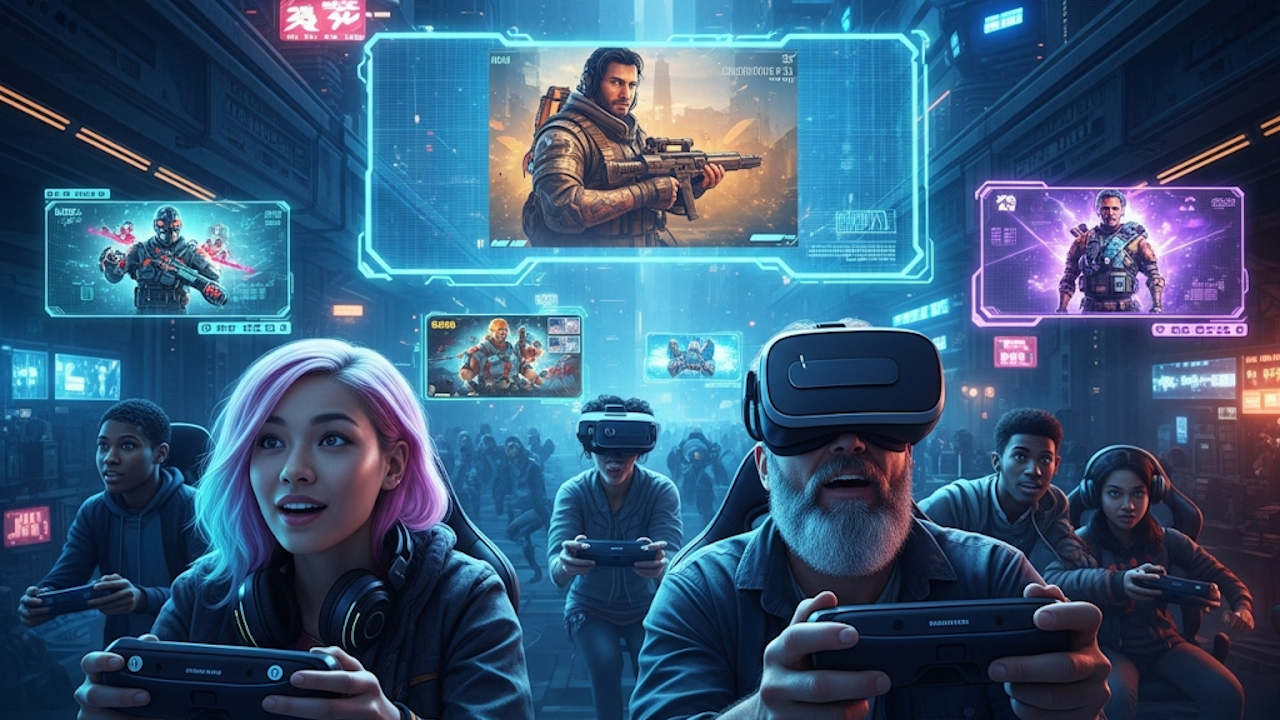
The video game industry thrives on cycles of innovation, saturation, and reinvention. Battle Royale exploded onto the scene in the late 2010s, redefining multiplayer gaming with its tense, last-player-standing formula. Titles such as PlayerUnknown’s Battlegrounds, Fortnite, and Apex Legends captured hundreds of millions of players by blending accessible shooting mechanics, massive maps, and constant progression through battle passes and cosmetics. For years, this genre dominated charts, esports, and cultural conversations. Yet data from 2025 shows a clear shift: battle royale playtime dropped by 27 percent compared to the previous year, even as legacy franchises held strong in raw numbers. Shooters overall saw a 5 percent decline in engagement. The era of pure battle royale supremacy appears to be waning, prompting the question of what comes next.
This transition does not mean the death of competitive multiplayer or large-scale online experiences. Instead, it signals evolution. Developers and players seek fresh risk-reward systems, deeper persistence, creative freedom, and technologies that leverage artificial intelligence and cross-platform convergence. The future points toward hybrid genres, user-driven worlds, smarter live services, and more immersive technologies. Here is a detailed look at the likely directions for video gaming in the coming years.
The Fatigue Sets In
Battle Royale succeeded because it delivered high-stakes drama in short-to-medium sessions, free-to-play accessibility, and endless replayability through randomized loot and shrinking safe zones. Fortnite turned itself into a cultural platform with concerts and collaborations, while Call of Duty integrated battle royale modes to retain its audience. Saturation followed. Dozens of clones flooded the market, many failing to differentiate themselves beyond minor map or weapon tweaks. Players grew tired of the same loop: drop in, loot, survive, repeat, often ending in frustrating third-party eliminations or long queue times.
By 2025, metrics revealed the cracks. While Fortnite and PUBG retained dedicated bases, overall genre engagement declined sharply. Sandbox games, by contrast, surged 35 percent in playtime, driven largely by Roblox and similar platforms. This shift reflects changing player preferences toward creation over pure competition, persistence over one-match resets, and social hangout spaces over pure combat arenas.
Industry watchers note that battle royale’s core tension remains appealing but needs reinvention. Some titles already blend elements, adding extraction or co-op layers, hinting at broader hybridization.
Extraction Shooters Emerge as a Strong Contender
One genre gaining rapid traction is the extraction shooter. Games in this category combine PvE and PvP elements where players enter a dangerous map, scavenge for loot, complete objectives, and attempt to extract safely. Losses carry real consequences because gear and progress can be lost, creating high tension absent in traditional battle royale respawns.
Escape from Tarkov pioneered the formula years ago with its gritty realism. Hunt: Showdown added bounty hunting and monster threats. The breakout moment arrived with ARC Raiders in 2025, which polished the loop for broader appeal: faster progression, satisfying crafting after just a few runs, and layered live operations that keep sessions rewarding. Its success opened floodgates, with 2026 poised for a wave of entries including reboots like Marathon and others from major studios.
Why does this feel like a natural successor? Extraction shooters maintain the shooting fantasy and large maps of battle royale but emphasize risk management, squad coordination, and persistent character growth. Revenue models differ too: higher conversion rates among dedicated players through premium stashes, expansions, and cosmetic depth rather than relying on massive free audiences. Delta Force reportedly outperformed PUBG in revenue per player despite far fewer daily active users, proving smarter monetization can thrive with smaller but more invested communities.
Challenges remain. The genre demands higher commitment than drop-in battle royale matches, potentially limiting mainstream casual appeal. Matchmaking toxicity and steep learning curves could cap growth. Still, refined versions with better onboarding and hybrid modes could sustain momentum through the late 2020s.
Sandbox Worlds and User-Generated Content Take Center Stage
While extraction shooters grab headlines in competitive circles, the real growth engine may lie in sandbox and user-generated content platforms. Roblox exploded in popularity by letting players create and monetize their own experiences within a shared ecosystem. Fortnite evolved beyond battle royale into a creative hub with user maps, social events, and persistent worlds. Minecraft continues to thrive decades later for similar reasons.
Projections suggest this trend accelerates. GTA 6 is expected to incorporate robust UGC tools, potentially blending Rockstar’s narrative polish with player-driven economies. More live-service titles plan revenue sharing for creators, lowering barriers for indie developers and fostering endless variety. Players crave ownership: building homes, running virtual businesses, or crafting stories with friends.
This shift addresses battle royale burnout by prioritizing emergence over scripted competition. A session might involve exploring a friend-built dungeon, hosting a virtual concert, or collaborating on massive construction projects. Cross-platform tools and improved modding support will amplify reach. For younger audiences raised on Roblox, these persistent social worlds feel more natural than arena shooters. Expect major publishers to launch or expand their own creator platforms, turning games into long-term metaverses rather than seasonal battle passes.
Artificial Intelligence Transforms Design and Play
Generative AI stands as perhaps the most transformative force on the horizon. Developers already use it for asset creation, dialogue, and balancing. In the coming years, AI could enable truly adaptive worlds where non-player characters react dynamically to player choices, generating quests, stories, or entire levels on the fly.
Imagine single-player campaigns that evolve based on your decisions across playthroughs, or multiplayer games where AI fills gaps in matchmaking and creates custom scenarios. Procedural generation, long used in roguelikes, will scale dramatically. Low-quality “gameslop” will proliferate, making curation vital, but breakout titles could emerge with novel, topical experiences that traditional development cannot match in speed or variety.
AI also aids accessibility: smarter tutorials, dynamic difficulty, and voice interactions. Ethical concerns around job displacement and content authenticity will arise, yet the net effect should expand creativity. Combined with live service, AI could keep games feeling fresh for years without constant developer intervention.
Immersive Technologies: VR, AR, and Cloud Convergence
Hardware advancements will push boundaries. Virtual reality headsets improve in comfort and fidelity, while augmented reality blends digital elements into real spaces. Cloud gaming removes hardware barriers, letting high-end experiences run on phones or low-spec devices. Platform convergence across console, PC, and mobile accelerates, with seamless cross-play becoming standard.
Battle royale attempted scale; future games may attempt presence. A VR extraction shooter where you physically duck behind cover, or an AR sandbox layered over your living room, changes the emotional stakes. Social features in these spaces could rival real-world hangouts. Challenges include motion sickness, cost, and content libraries, but steady progress suggests mainstream breakthroughs by the end of the decade.
Hybrid Genres and the Live-Service Evolution
Few genres will dominate outright. Hybridization rules. Expect battle royale elements mixed with extraction risk, sandbox creativity, and narrative depth. Co-op focused titles like Helldivers 2 show demand for shared triumphs over pure competition. Roguelikes with persistent multiplayer layers, survival crafting with story campaigns, and rhythm or party games with competitive twists could surge.
Live-service models mature. Instead of endless seasons chasing engagement, developers focus on quality updates, player feedback, and evergreen content. Monetization shifts toward fairer systems: cosmetic focus, battle passes with real value, and creator economies. AAA studios face pressure from nimble indies and platforms like Roblox, leading to more experimental mid-tier releases.
Single-player experiences may enjoy a renaissance alongside multiplayer. Polished narrative titles with optional online components satisfy players seeking depth without toxicity. Remakes and reboots of classics provide safe entry points while new intellectual properties test bold ideas.
Challenges and Opportunities Ahead
The industry faces headwinds: rising development costs, player fatigue with microtransactions, and regulatory scrutiny on loot boxes and data practices. Economic uncertainty could slow big-budget projects, favoring efficient live-service and UGC approaches. Yet global player counts exceed three billion, with revenue climbing toward new highs through convergence and emerging markets.
Diversity in audiences drives innovation. More women and players from Asia and other regions participate, demanding inclusive designs and varied themes. Mobile remains massive but evolves toward premium and cloud hybrids in the West.
A More Varied, Player-Driven Future
Battle Royale reshaped gaming by proving that accessible, high-drama multiplayer could achieve unprecedented scale. Its partial retreat opens space for richer experiences. Extraction shooters offer tactical depth and consequence. Sandbox platforms empower creativity. AI and immersive tech unlock personalization and presence. Hybrid designs blend the best elements while addressing past flaws.
No single genre will likely replicate battle royale’s total dominance. The next era emphasizes choice, persistence, and community ownership. Players will hop between competitive raids, creative builds, narrative adventures, and social worlds within unified ecosystems. Developers who listen to data, embrace tools like AI and UGC, and prioritize fun over fleeting trends will thrive.
The future of video gaming looks less like a single arena where one winner takes all and more like vast, interconnected playgrounds where everyone finds their niche. As 2026 and beyond unfold, expect surprises: a breakout hit no one predicted, or technologies that fundamentally alter how we interact with digital worlds. The only certainty is continued evolution, driven by players seeking novelty, connection, and mastery in ever more sophisticated forms.