

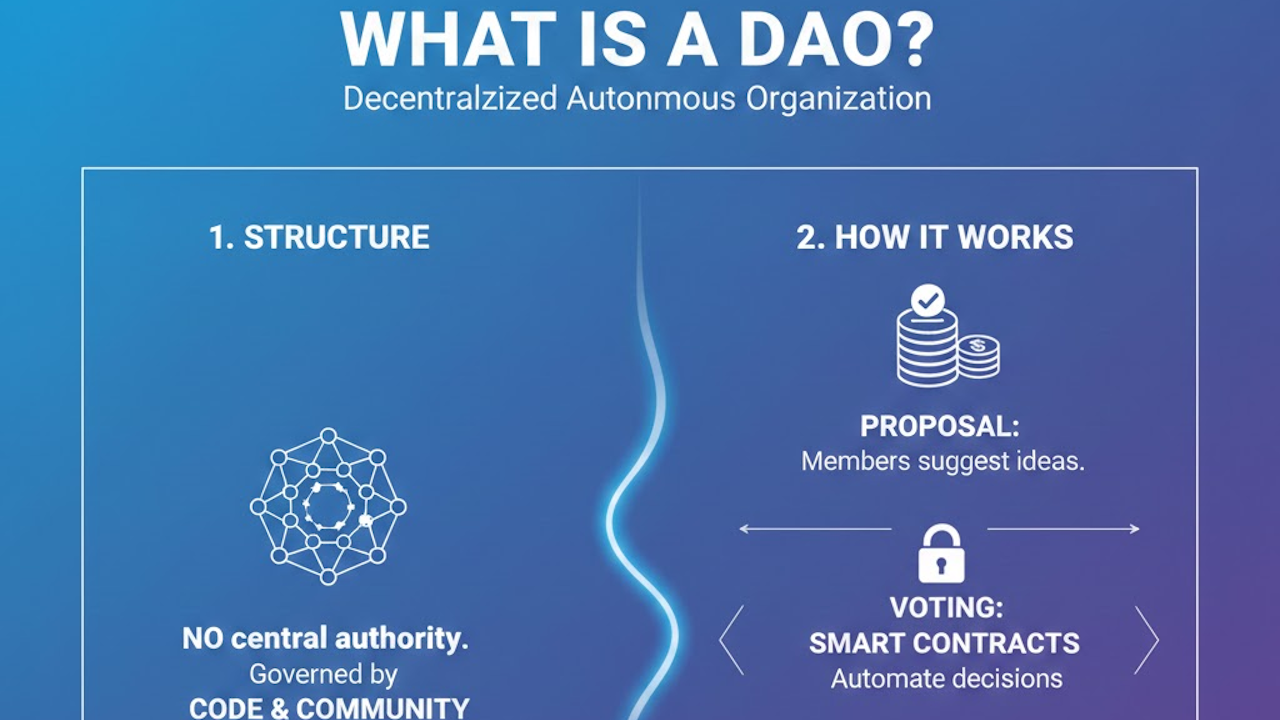
A Decentralized Autonomous Organization, commonly referred to as a DAO, is a blockchain-based entity that operates without centralized leadership. Instead, it is governed collectively by its members through rules encoded in smart contracts. These smart contracts are self-executing programs deployed on a blockchain, typically Ethereum, that automate decision-making, fund management, and operational processes. The core idea behind a DAO is to create an organization that is transparent, permissionless, and resistant to censorship, where decisions are made via community voting rather than by a board of directors or executives.
The term “DAO” traces its roots back to earlier concepts of autonomous systems, but it gained prominence in the blockchain era around 2013-2015. It was popularized with the launch of Ethereum in 2015, which provided a Turing-complete platform capable of supporting complex smart contracts. A DAO functions as a member-owned community with a shared goal, often managing a treasury of cryptocurrency assets. Membership is usually granted through ownership of governance tokens, which confer voting rights proportional to the holder’s stake.
Unlike traditional organizations, DAOs have no hierarchy. They aim to align incentives among participants by distributing control and rewards. This structure makes them suitable for various purposes, including investment funds, protocol governance, charities, and creative collectives. However, the legal status of DAOs remains ambiguous in many jurisdictions, often treated as general partnerships, which can expose members to personal liability.
The History of DAOs
The concept of decentralized autonomous organizations emerged alongside blockchain technology. Early references date to the 1990s, but practical implementations began with Bitcoin’s decentralized network in 2009, which some describe as a primitive DAO for value transfer.
The modern DAO era started in 2016 with “The DAO,” a venture capital fund on Ethereum. It raised over $150 million in ether through a token sale, marking one of the largest crowdfunding efforts at the time. Participants could propose and vote on investments in Ethereum-based projects. However, The DAO suffered a catastrophic hack in June 2016 due to a reentrancy vulnerability in its smart contract code. An attacker drained approximately 3.6 million ether, worth about $50-70 million.
This incident led to a controversial hard fork of Ethereum, restoring the stolen funds on the new chain (modern Ethereum) while a minority continued on the original as Ethereum Classic. The hack highlighted risks in smart contract code and sparked debates on immutability versus intervention.
Post-2016, DAOs proliferated. MakerDAO emerged to govern the DAI stablecoin, DASH for cryptocurrency management, and others like Lido for staking protocols. By the early 2020s, thousands of DAOs managed billions in assets, fueled by DeFi growth.
How DAOs Work Technically
DAOs rely on blockchain infrastructure, primarily Ethereum, for their operations. The foundation is a set of smart contracts that define the organization’s rules, treasury, and governance mechanisms. These contracts are immutable once deployed, meaning changes require community approval through upgrades.
Key Components:
- Smart Contracts: These encode the DAO’s logic. They handle treasury management (sending/receiving funds), proposal submission, and automatic execution of passed votes. Tools like Aragon or DAOstack provide frameworks for building these.
- Governance Tokens: Members acquire tokens (often ERC-20 standard) to gain voting power. Tokens can be bought, earned through contributions, or distributed via airdrops. Voting is typically token-weighted, though some DAOs experiment with one-person-one-vote or reputation-based systems.
- Proposal and Voting Process:
- Any member (meeting a minimum token threshold) submits a proposal, often discussed off-chain on forums like Discourse or Discord.
- Proposals go to on-chain or off-chain voting (using tools like Snapshot for gas-free votes).
- A quorum (minimum participation) and approval threshold must be met for passage.
- Passed proposals trigger smart contract execution, such as fund releases.
- Treasury Management: Funds are held in multi-signature wallets or directly in contracts. Disbursements require votes, reducing single-point failures.
- Membership Models:
- Token-based: Permissionless entry via token purchase.
- Share-based: More restricted, requiring proposals for new members.
This setup ensures transparency, as all actions are recorded on the blockchain and auditable by anyone.
Examples of Prominent DAOs
Several DAOs illustrate diverse applications:
- MakerDAO: Governs the DAI stablecoin and MKR token. Members vote on collateral types and stability fees.
- Uniswap DAO: Manages the Uniswap decentralized exchange, controlling protocol fees and grants.
- Lido DAO: Oversees liquid staking for Ethereum and other chains, deciding on node operators and parameters.
- Arbitrum DAO: Handles governance for the Arbitrum layer-2 scaling solution, including treasury allocations.
- ConstitutionDAO: A short-lived 2021 effort to buy a U.S. Constitution copy, raising millions but failing the bid.
Other types include investment DAOs (like BitDAO), collector DAOs (for NFTs), and service DAOs (providing decentralized labor).
Advantages of DAOs
DAOs offer several benefits over traditional structures:
- Decentralization and Inclusivity: No single authority controls decisions. Global participation is possible with just a wallet and tokens.
- Transparency: All transactions and votes are public on the blockchain, reducing corruption risks.
- Efficiency and Automation: Smart contracts eliminate intermediaries, lowering costs and enabling 24/7 operation.
- Alignment of Incentives: Token holders directly benefit from good governance, encouraging active involvement.
- Borderless Collaboration: Attracts talent worldwide without geographic or institutional barriers.
These features make DAOs ideal for open-source projects, DeFi protocols, and community-driven initiatives.
Disadvantages and Challenges of DAOs
Despite promise, DAOs face significant hurdles:
- Security Risks: Smart contract bugs can lead to massive losses, as seen in The DAO hack and others like Build Finance (2022 drain by token accumulation).
- Low Voter Participation: Many token holders abstain, leading to decisions by a small active minority.
- Token Concentration: Whales (large holders) can dominate votes, undermining decentralization.
- Governance Inefficiency: Debates can drag on, and poorly designed proposals spam systems.
- Regulatory Uncertainty: DAOs lack clear legal status, risking classification as securities or exposing members to liability.
- Scalability Issues: On-chain voting is expensive and slow; off-chain solutions reduce decentralization.
Recent Developments and the Future of DAOs
As of late 2025, the DAO landscape has matured but also shown signs of consolidation. Activity in major DAOs declined, with fewer proposals and voters, while governance became more concentrated. Some projects, like Jupiter on Solana and Yuga Labs’ ApeCoin, abandoned DAOs citing inefficiency.
Trends include AI integration for proposal analysis, improved user interfaces for accessibility, and hybrid models blending decentralization with elected councils for faster decisions. Legal wrappers (registering as LLCs) are increasing for liability protection. Treasury sizes remain large, with billions managed, but focus shifts to sustainable revenue like protocol fees.
DAOs continue evolving, balancing ideals of decentralization with practical needs. They represent a fundamental shift in organizational design, potentially reshaping governance in Web3 and beyond, though challenges persist in achieving true autonomy and broad participation.