

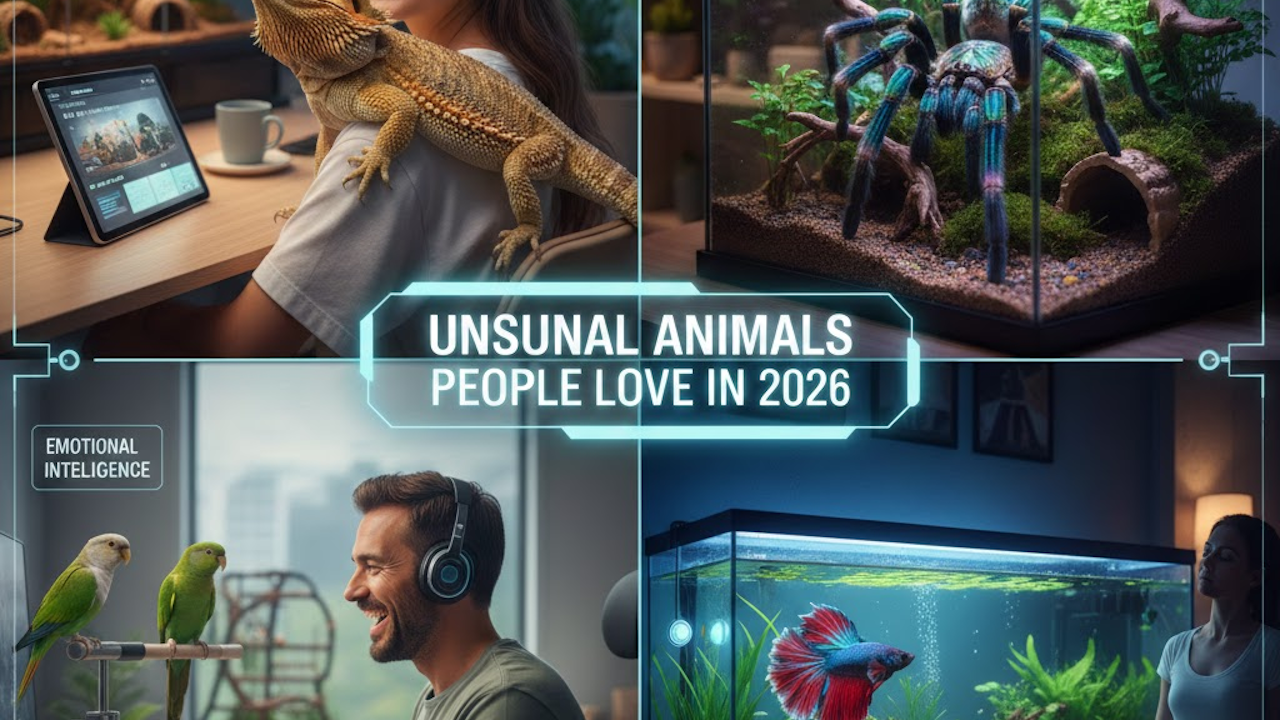
In 2026, amid endless scrolls of familiar pets and polished wildlife footage, a surprising shift has taken hold. People are turning toward the unconventional. Social media algorithms reward the strange and endearing, while zoos, aquariums, and conservation groups report rising interest in animals that defy easy categories. The exotic pet market continues its steady expansion, yet many enthusiasts now seek appreciation over ownership, drawn instead to viral moments, scientific breakthroughs, and the quiet charisma of creatures that look or behave nothing like household companions.
This fascination feels timely. In a world facing biodiversity pressures, these unusual animals serve as ambassadors for resilience and adaptation. They spark joy through memes, inspire medical research, and remind viewers that nature’s creativity often arrives in awkward, beautiful, or hilariously odd packages. From regenerating amphibians featured in major exhibitions to deep-sea icons redeemed by internet culture and mammals with lifestyles that challenge everything we assume about warm-blooded life, the animals people love this year reward curiosity rather than conventional cuteness.
Here are some of the standout unusual animals capturing hearts in 2026.
The Axolotl: The Smiling Regenerator
The axolotl remains one of the most beloved unusual animals in 2026, blending perpetual youth with almost mythical healing powers. Native to the ancient lake systems around Mexico City, this salamander never undergoes full metamorphosis. It keeps its external gills, wide smiling mouth, and lidless eyes throughout life, giving it the appearance of a permanent cartoon character. In the wild it is critically endangered, threatened by pollution, invasive species, and habitat loss in the shrinking remnants of Lake Xochimilco. Yet in captivity it thrives, becoming a staple of home aquariums and public displays.
What draws people most is its regenerative ability. An axolotl can regrow entire limbs, portions of its spinal cord, and even sections of its brain without scarring. Scientists study this process intensely for insights into human tissue repair and aging. In popular culture the axolotl gained enormous visibility through video games and online communities, where its friendly face and gentle demeanor turned it into a comfort animal for many.
In 2026 the axolotl featured prominently in exhibitions such as Exotic Pets World events, where visitors encountered live specimens alongside educational talks on responsible care and conservation. Its appeal crosses generations: children adore the smile, adults appreciate the biological wonder, and researchers see hope for future medicine. While axolotls can be kept successfully by dedicated hobbyists who maintain cool, clean water and proper diets, experts emphasize captive-bred animals and discourage wild collection. The axolotl shows how an unusual appearance paired with genuine superpowers can create lasting affection and support for its fragile wild counterparts.
The Capybara: The World’s Most Relaxed Giant
Few animals embody calm quite like the capybara. As the largest living rodent, reaching weights of over 150 pounds, this semi-aquatic mammal from South American wetlands and grasslands moves through life with remarkable composure. It spends much of its day grazing on grasses and aquatic plants, swimming with webbed feet, and resting in groups that can number from a handful to several dozen. Capybaras tolerate birds perching on their backs, allow monkeys to ride them in some documented interactions, and generally seem unbothered by the chaos of the surrounding world.
Their social nature and gentle temperament have fueled years of viral content, and that popularity shows no sign of fading in 2026. Videos of capybaras soaking in hot springs, accepting oranges from zoo keepers, or simply existing with serene expressions continue to circulate widely. People project onto them qualities of mindfulness and emotional steadiness that feel especially welcome in fast-paced times. Zoos around the world report capybara exhibits as consistent crowd favorites, with visitors lingering to watch the animals’ unhurried routines.
Although some enthusiasts dream of keeping capybaras as pets, their size, need for swimming space, social requirements, and specialized diet make them unsuitable for most households. The widespread love for capybaras instead manifests through observation, photography, and conservation support for wetland habitats. In 2026 they represent a particular kind of appeal: the unusual animal that teaches relaxation simply by existing. Their presence online and in zoos offers a gentle counterpoint to more high-energy content, proving that sometimes the most loved creatures are those that appear perfectly content doing very little.
The Blobfish: Deep-Sea Icon of Redemption
Once voted the world’s ugliest animal in a lighthearted poll, the blobfish has undergone a complete image transformation. In its natural habitat more than a thousand meters below the ocean surface, this fish maintains a normal shape thanks to the crushing pressure that keeps its gelatinous body intact. When brought to the surface, the pressure change causes it to expand into the droopy, pinkish form that became an internet sensation. Far from being a freak of nature, the blobfish is perfectly adapted to its extreme environment, where strong muscles would be unnecessary and energy costly.
The blobfish’s journey from punchline to beloved symbol began with memes but evolved into something more meaningful. It now serves as the mascot for the Ugly Animal Preservation Society, drawing attention to lesser-known deep-sea species that receive little conservation focus compared with charismatic megafauna. People connect with its story of misjudgment and eventual acceptance. The blobfish reminds viewers not to evaluate worth by surface appearances, a message that resonates strongly in image-driven online spaces.
In 2026 the blobfish continues to appear in educational content about ocean exploration and the importance of protecting abyssal ecosystems. Its popularity demonstrates how even animals that seem strange or unappealing at first can win affection once their context is understood. While few people will ever encounter a living blobfish, its cultural presence encourages broader curiosity about the deep ocean and the many unusual life forms thriving there under conditions humans can barely imagine.
The Naked Mole Rat: The Eusocial Underground Pioneer
The naked mole rat challenges nearly every assumption about mammalian life. These nearly hairless, wrinkled rodents live in extensive underground burrow systems in East Africa, organized into colonies with a single breeding queen, workers, and soldiers in a structure remarkably similar to that of bees or ants. They tolerate extremely low oxygen levels, show remarkable resistance to cancer, and can live more than thirty years while remaining fertile, far longer than typical rodents of their size.
Their biology has made them superstars in laboratories studying aging, cancer resistance, and hypoxia. Researchers investigate the high molecular weight hyaluronan in their skin that appears to suppress tumor formation, as well as their ability to survive without pain responses in certain acidic conditions. Outside science, the naked mole rat earns affection for its sheer weirdness and underdog status. Its buck teeth, tiny eyes, and pink, folded skin give it an appearance that many find oddly charming once they learn about its extraordinary adaptations.
In 2026 the naked mole rat features in popular science communication and museum exhibits highlighting extreme life forms. Its eusocial lifestyle and longevity research attract both casual viewers and those interested in future medical applications. People love the naked mole rat because it proves that nature contains solutions to problems we are only beginning to understand. It stands as living evidence that the unusual often holds keys to resilience that conventional organisms lack.
The Okapi: The Elusive Zebra of the Forest
The okapi looks like a creature assembled from spare parts of other animals. It possesses the rich chocolate-brown coat of a horse, striking zebra-like stripes on its legs and hindquarters, and a long, prehensile tongue capable of reaching its own ears for grooming. Closely related to the giraffe yet built for dense rainforest life in the Democratic Republic of Congo, the okapi remained unknown to science until the early twentieth century. Its secretive habits and remote habitat earned it the nickname “African unicorn” long before its formal description.
Today the okapi is endangered, primarily due to habitat loss, poaching, and civil unrest in its limited range. Conservation organizations work to protect the Ituri Forest and maintain captive breeding programs that support both research and public education. People who encounter the okapi in zoos or through documentaries often describe a sense of wonder at its improbable combination of features. The stripes provide camouflage in the dappled light of the forest floor, while the long tongue and flexible neck allow it to browse leaves and strip bark with precision.
In 2026 the okapi continues to symbolize the hidden treasures of tropical forests and the ongoing need for habitat protection. Its unusual appearance and elusive nature make sightings feel special, whether in person or through high-quality footage. Fans appreciate the okapi as proof that even large mammals can remain mysterious well into the modern era, inspiring both awe and a desire to safeguard the wild places that still hold such surprises.
The Platypus: Nature’s Evolutionary Mashup
When European naturalists first encountered platypus specimens in the late eighteenth century, many assumed the animal was a hoax stitched together from a duck’s bill, a beaver’s tail, and a mole’s body. The truth proved even stranger. The platypus is a monotreme, one of the few mammals that lay eggs rather than give birth to live young. Males possess venomous spurs on their hind legs. Its bill contains electroreceptors that detect the tiny electrical fields generated by prey in murky water, allowing the animal to hunt with eyes, ears, and nostrils closed.
Despite its bizarre collection of traits, the platypus has become an Australian icon and a global favorite. Its awkward waddle on land contrasts with graceful swimming, and its duck-like bill combined with soft fur creates an endearing visual mismatch. Conservation concerns have grown in recent decades as pollution, habitat alteration, and climate impacts affect its freshwater streams and rivers. Public affection helps drive support for river health initiatives and research into this living link to early mammalian evolution.
In 2026 the platypus appears regularly in nature documentaries and educational campaigns that celebrate Australia’s unique fauna. People love it for the same reason scientists do: it forces a reevaluation of what a mammal can be. Its existence demonstrates that evolution explores every possible combination, producing forms that continue to astonish centuries after their discovery.
The Sea Lion: Goofy Charisma Takes Center Stage
While sea lions are not the most obscure animals biologically, they earned special status in 2026 as the viral sensation of the year. Playful videos of California sea lions and other species performing tricks, barking with apparent enthusiasm, balancing objects, and displaying what viewers interpret as goofy smiles flooded social media platforms. Zoo and aquarium content creators who had been posting such footage for years suddenly found their clips reaching millions, turning the animals into the unexpected “it” creatures of the moment.
Sea lions possess intelligence, strong social bonds, and a natural curiosity that translates well to both wild observations and trained behaviors. In the wild they hunt fish with speed and coordination, haul out on beaches in noisy groups, and interact playfully with their surroundings. Their expressive faces and vocalizations make them highly relatable to human audiences. The 2026 surge in popularity boosted attendance at marine mammal exhibits and increased donations to organizations working on ocean health and bycatch reduction.
People love sea lions in 2026 for their combination of athleticism, personality, and apparent sense of humor. The viral moment reminded viewers that even familiar animals can reveal new layers of charm when presented in fresh ways. Their rise also highlighted the value of ethical facilities that prioritize welfare while fostering public connection to marine life.
Looking Forward with Appreciation
These unusual animals share a common thread. Each one rewards deeper attention. The axolotl offers hope through regeneration. The capybara models calm acceptance. The blobfish teaches against snap judgments. The naked mole rat expands our understanding of aging and society. The okapi and platypus reveal hidden evolutionary stories. The sea lion demonstrates how personality can bridge species.
In 2026 the love for these creatures manifests in many healthy ways: through support for ethical zoos and aquariums, donations to habitat protection, responsible captive breeding programs for species like the axolotl, and simple enjoyment of high-quality photography and video. The growing exotic pet market brings both opportunities and responsibilities; those who choose to keep unusual animals must commit to expert-level care rather than impulse decisions.
Ultimately, the unusual animals people love this year reflect something essential about human nature. We are drawn to difference. We find comfort in creatures that thrive despite looking or living nothing like us. By celebrating the axolotl’s smile, the capybara’s serenity, the blobfish’s resilience, and all the rest, we practice a form of empathy that extends beyond our own species. Nature’s quirkiest stars remind us that wonder is not reserved for the conventionally beautiful. It belongs equally to the strange, the awkward, and the magnificently odd. In protecting and appreciating them, we keep alive the full spectrum of life that makes our planet extraordinary.