

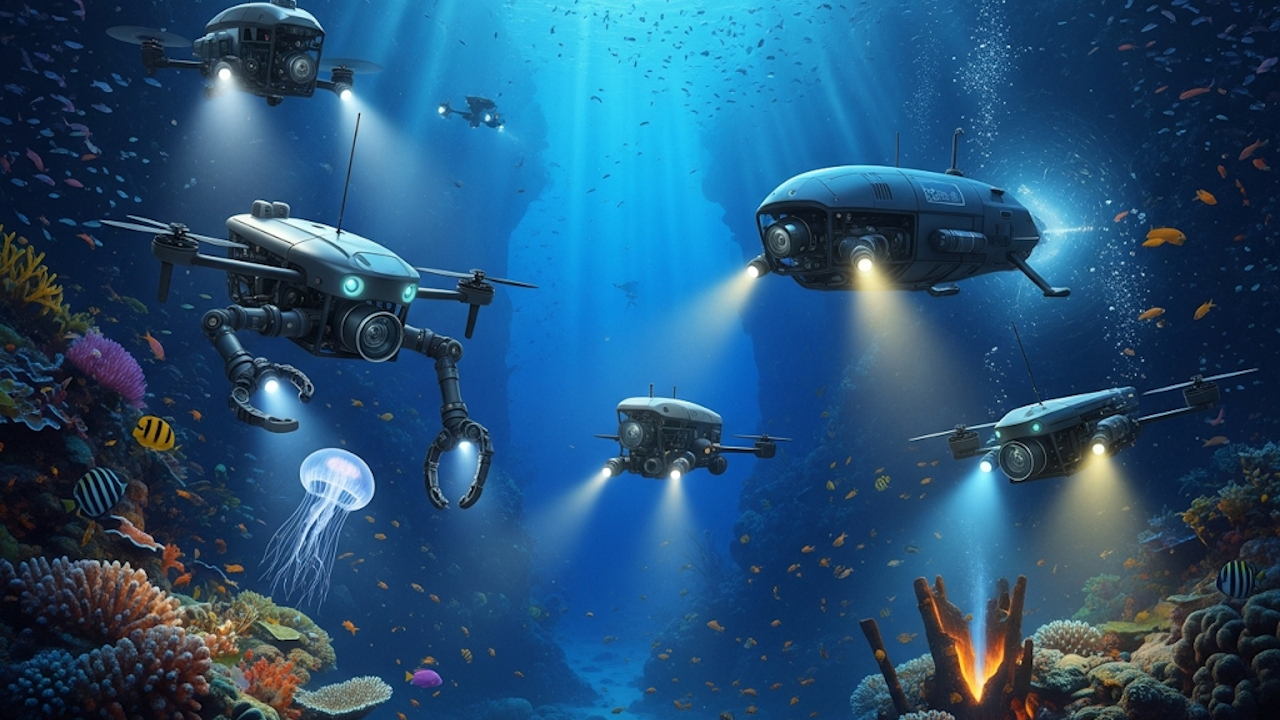
The oceans cover more than 70 percent of Earth’s surface, yet humanity has explored less than 5 percent of their depths in detail. This vast underwater realm holds secrets about climate change, marine biodiversity, geological formations, and untapped resources. Underwater drones, also known as autonomous underwater vehicles (AUVs) or remotely operated vehicles (ROVs), have emerged as essential tools for scientists, engineers, and explorers to access these hidden worlds safely and efficiently. These sophisticated machines bridge the gap between human limitations and the extreme conditions of the deep sea, where high pressure, darkness, and cold temperatures make direct human exploration risky and expensive.
Underwater drones come in various forms, from small portable units used in shallow waters to large, advanced systems capable of descending thousands of meters. They carry sensors, cameras, robotic arms, and sampling equipment to collect data, images, and physical specimens. As technology advances, these drones are transforming our understanding of the ocean and enabling new discoveries that were once impossible.
A Brief History of Underwater Exploration Technology
Human efforts to explore beneath the waves date back centuries. Early divers used simple breathing tubes and weighted suits, but these methods were limited to shallow depths. The development of scuba gear in the mid-20th century expanded access, yet even advanced diving equipment could not reach the deepest ocean trenches.
The first underwater vehicles appeared during World War II for military purposes, such as mine detection. In the 1950s and 1960s, research institutions began building early submersibles. The famous bathyscaphe Trieste, which reached the Challenger Deep in the Mariana Trench in 1960, marked a milestone in manned deep-sea exploration. However, manned missions remained rare due to high costs and safety concerns.
The shift toward unmanned systems accelerated in the 1970s and 1980s. The United States Navy and companies like Hydro Products developed early ROVs for offshore oil operations and wreck investigations. These tethered vehicles relied on cables for power and control, limiting their range but providing real-time video feeds. By the 1990s, advances in computing, batteries, and materials science led to the first true AUVs, which could operate independently without constant human supervision.
The 21st century brought rapid progress. Organizations like the Woods Hole Oceanographic Institution (WHOI) and international research bodies deployed drones such as the REMUS series and the Sentry AUV. Commercial companies entered the market, offering affordable models for industries ranging from aquaculture to underwater archaeology. Today, underwater drones are used by governments, universities, environmental groups, and private explorers alike.
Types of Underwater Drones
Underwater drones fall into several categories based on their design and operation.
Remotely Operated Vehicles (ROVs) are connected to a surface ship or control station via an umbilical cable. This tether supplies power and transmits data, allowing operators to control the vehicle in real time. ROVs excel in detailed inspection tasks, such as examining shipwrecks, pipelines, or underwater infrastructure. Models like the Saab Seaeye series or the heavy-duty work-class ROVs used in the oil and gas industry can operate at depths exceeding 6,000 meters and feature powerful manipulator arms for complex tasks.
Autonomous Underwater Vehicles (AUVs) operate without tethers. They follow pre-programmed missions or use artificial intelligence to adapt to conditions. AUVs are ideal for large-scale surveys because they can cover wide areas efficiently. Popular examples include the Kongsberg HUGIN series and the Bluefin Robotics vehicles. These drones use acoustic communication or surface buoys to relay critical data while submerged.
Hybrid vehicles combine features of both ROVs and AUVs. They can switch between tethered and autonomous modes depending on the mission requirements. Some advanced hybrids, like those developed by companies such as Ocean Infinity, incorporate glider technology that uses buoyancy changes to move with minimal energy consumption, enabling missions lasting weeks or months.
Gliders represent a specialized type focused on long-duration monitoring. These torpedo-shaped drones move slowly through the water column by adjusting their buoyancy and using wings to generate lift. They collect data on temperature, salinity, and ocean currents over vast distances.
Micro and mini drones have also gained popularity for accessible exploration. Consumer-grade models from manufacturers like PowerVision or Chasing offer high-definition cameras and are controlled via smartphones. These smaller units serve educational purposes, shallow-water inspections, and hobbyist exploration.
Core Technologies Powering Underwater Drones
Several key technologies enable underwater drones to function effectively in harsh environments.
Propulsion systems vary by design. Most use electric thrusters for precise maneuvering. Some advanced models incorporate biomimetic designs inspired by fish or jellyfish to improve efficiency and reduce noise that might disturb marine life.
Navigation relies on a combination of inertial measurement units (IMUs), Doppler velocity logs (DVL), and acoustic positioning systems. In the absence of GPS underwater, drones use sound waves to triangulate their position relative to surface beacons or seafloor transponders. Machine learning algorithms help them avoid obstacles and optimize paths.
Sensors form the heart of data collection. Multibeam sonar creates detailed maps of the seafloor. High-resolution cameras, often paired with LED lighting, capture images and video in low-light conditions. Chemical sensors measure pH, oxygen levels, and pollutants. Some drones carry biological sampling tools to collect water, sediment, or organism specimens without contamination.
Communication presents unique challenges. While ROVs use fiber-optic cables for high-bandwidth video, AUVs depend on acoustic modems that transmit data slowly over long distances. Emerging technologies like underwater optical wireless communication promise faster transfers when drones surface or approach relay stations.
Power sources have improved dramatically. Lithium-ion batteries provide hours of operation for smaller units, while larger drones use fuel cells or even nuclear power in specialized military applications. Energy-efficient designs and solar-powered surface charging stations extend mission durations.
Applications Across Industries and Science
Underwater drones serve diverse purposes that benefit society and scientific knowledge.
In marine science, they enable researchers to study coral reefs, deep-sea vents, and migration patterns of marine animals. Drones have documented previously unknown species and helped monitor the effects of climate change, such as ocean acidification and warming waters. Projects like the Ocean Observatories Initiative use networks of gliders and AUVs to gather continuous data across entire ocean basins.
The offshore energy sector relies heavily on drones for inspecting oil rigs, wind turbine foundations, and underwater cables. Regular inspections reduce downtime and prevent environmental disasters from leaks or structural failures.
Underwater archaeology has been revolutionized by these vehicles. Drones have explored ancient shipwrecks like the Titanic and Phoenician trading vessels without disturbing fragile sites. High-resolution mapping allows virtual reconstructions that preserve cultural heritage for future generations.
Environmental monitoring and conservation efforts use drones to track pollution, plastic waste, and illegal fishing. Conservation groups deploy them to assess marine protected areas and support restoration projects, such as planting coral fragments using robotic arms.
Search and rescue operations benefit from rapid deployment of drones in disaster scenarios, such as locating sunken vessels or aircraft. Military applications include mine countermeasures, intelligence gathering, and port security.
Commercial aquaculture farms use small drones to monitor fish health, water quality, and net integrity, improving sustainability and reducing disease outbreaks.
Challenges and Limitations
Despite their capabilities, underwater drones face significant hurdles.
Extreme pressure at great depths requires robust pressure housings made from materials like titanium or specialized composites. Corrosion from saltwater demands careful material selection and maintenance.
Battery life remains a constraint for long missions. While gliders can operate for extended periods, most powered drones must surface periodically to recharge or be recovered.
Data transmission bandwidth limits real-time control and high-definition streaming from deep waters. Acoustic signals travel slowly and can be disrupted by thermoclines or marine life.
The high cost of advanced systems restricts access primarily to well-funded organizations. Smaller operators sometimes struggle with maintenance and training requirements.
Environmental concerns include potential noise pollution affecting marine mammals and the risk of losing drones in sensitive ecosystems. Responsible design incorporates biodegradable components and recovery protocols.
Regulatory frameworks vary by country, complicating international operations in shared waters. Issues of data ownership and intellectual property also arise when exploring international seabeds.
Future Prospects and Innovations
The future of underwater drones looks promising as several emerging technologies mature.
Artificial intelligence and machine learning will enable greater autonomy. Drones will make real-time decisions about sampling sites, avoid dynamic hazards, and collaborate in swarms to cover larger areas efficiently.
Improved materials, such as carbon nanotubes and self-healing polymers, will allow lighter, stronger, and more durable vehicles capable of reaching even greater depths, potentially beyond 11,000 meters in the hadal zone.
Integration with satellite systems and surface autonomous vessels will create comprehensive ocean monitoring networks. Some concepts involve drone “motherships” that deploy and recover fleets of smaller vehicles.
Biomimetic and soft robotics may produce drones that interact more gently with marine life. Soft-bodied designs could squeeze through tight spaces in underwater caves or wrecks.
Quantum sensors and advanced lidar systems promise unprecedented resolution in mapping and detection. Miniaturization will make powerful drones affordable for citizen scientists and educational programs.
International collaborations, such as those under the United Nations Decade of Ocean Science for Sustainable Development, aim to standardize technologies and share data globally.
Conclusion
Underwater drones have opened new frontiers in ocean exploration, turning the deep sea from an inaccessible mystery into a domain of active study and responsible use. From mapping unknown seafloor features to monitoring fragile ecosystems, these vehicles provide critical insights that inform climate policy, resource management, and conservation strategies.
As technology continues to evolve, the line between human oversight and machine independence will blur, creating opportunities for deeper, longer, and more comprehensive investigations. The ocean’s depths still hold countless discoveries, and underwater drones will remain at the forefront of uncovering them. By investing in these tools and addressing their challenges responsibly, humanity can better protect and understand the blue heart of our planet for generations to come. Continued innovation and collaboration will ensure that exploration leads to sustainable stewardship rather than exploitation.