

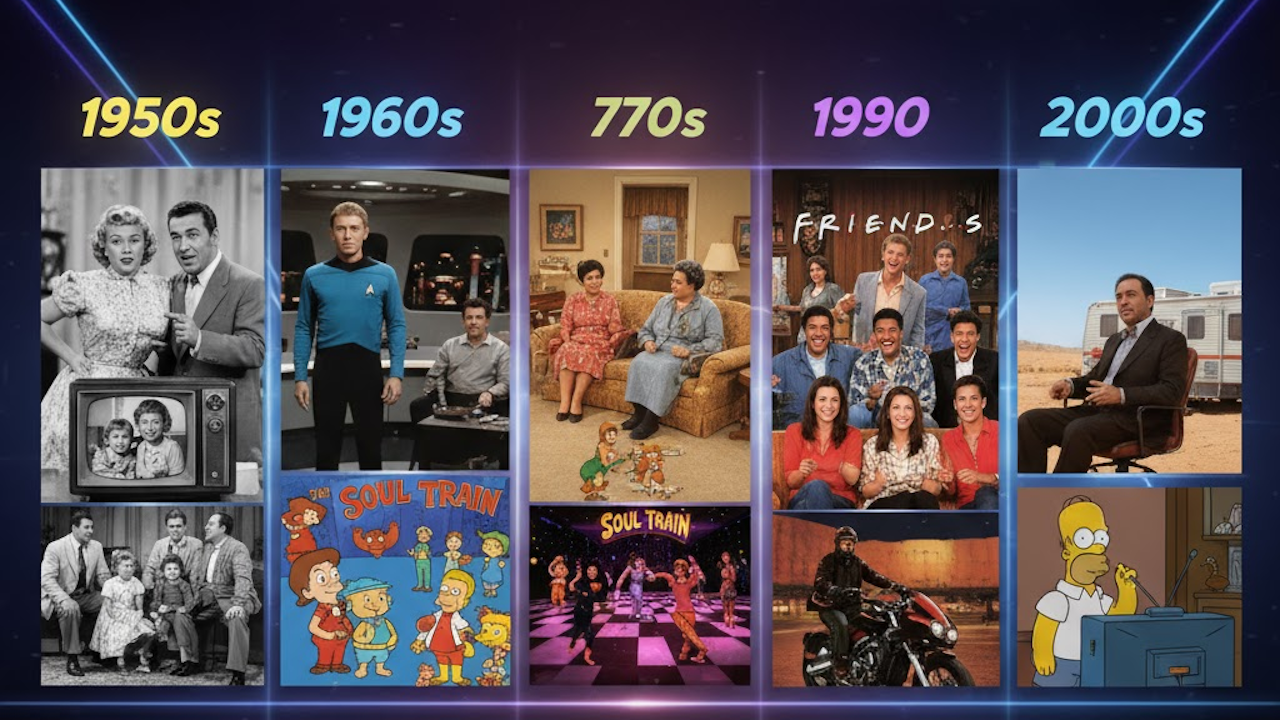
Television has always served as both a mirror and a mold for society. From its early days as a flickering novelty in living rooms to today’s on-demand global platform, the medium has captured the hopes, fears, anxieties, and aspirations of each generation. Certain programs rose above the rest, not only achieving massive viewership or critical acclaim but also shaping how stories are told, how audiences engage, and how culture processes the world around it. These shows became touchstones, sparking conversations at dinner tables, water coolers, and now on social media. They reflected the social fabric of their times while pushing the boundaries of what television could achieve technically, narratively, and thematically.
This article explores one defining program from each decade, from the 1950s onward, examining why it captured the spirit of its era and left a lasting legacy. Along the way, we see television evolve from live broadcasts and simple sitcoms to complex serialized dramas, from three-network dominance to the fragmented streaming landscape of today.
The 1950s: I Love Lucy and the Foundation of the Modern Sitcom
The 1950s marked the true arrival of television as a mass medium in American homes. Postwar prosperity, suburban growth, and the baby boom created a demand for wholesome family entertainment. With only three major networks controlling the airwaves, programming was often live, simple, and designed to sell products through sponsorships. Into this landscape stepped I Love Lucy, which premiered on CBS in 1951 and ran until 1957.
Starring Lucille Ball as the scheming housewife Lucy Ricardo and Desi Arnaz as her bandleader husband Ricky, the show followed Lucy’s endless attempts to break into show business or simply get attention, much to Ricky’s exasperation. Episodes revolved around classic setups like hiding celebrities in closets or dealing with the consequences of Lucy’s latest scheme. What set it apart was its production innovation. Rather than broadcasting live, the creators filmed episodes in front of a studio audience using multiple cameras. This approach allowed for tighter editing, better lighting, and, crucially, high-quality prints that could be rerun indefinitely. The multi-camera sitcom format became the industry standard for decades.
Culturally, I Love Lucy embodied the era’s ideal of domestic life while subtly pushing against it. Lucy was a devoted wife and mother, yet her wild antics revealed a restless energy and desire for independence that many women felt beneath the surface of 1950s conformity. The show topped ratings year after year, with individual episodes drawing tens of millions of viewers. Its success helped establish the half-hour comedy as television’s dominant form and turned Ball into one of the most powerful women in Hollywood through her production company, Desilu.
The program also launched a wave of similar family comedies. While other hits like Dragnet brought procedural realism to police stories and The Honeymooners offered working-class humor, none matched I Love Lucy’s blend of physical comedy, relatable marital dynamics, and broad appeal. Its legacy endures in every multi-camera sitcom that followed, from The Dick Van Dyke Show to modern revivals. In an age before widespread syndication or home recording, I Love Lucy proved that television could create shared national experiences and repeatable entertainment that families watched together.
The 1960s: The Twilight Zone and Television’s Moral Imagination
The 1960s brought dramatic change. The civil rights movement gained momentum, the Vietnam War escalated, the space race captured imaginations, and cold war tensions simmered beneath suburban calm. Television itself transitioned toward color broadcasting and began exploring more ambitious storytelling. While westerns and variety shows remained popular, anthology series offered something different: standalone stories with big ideas.
Rod Serling’s The Twilight Zone, which aired on CBS from 1959 to 1964, became the decade’s most intellectually ambitious program. Each episode presented a self-contained tale, often with a twist ending, that used science fiction, fantasy, or the supernatural to comment on human nature. Serling, a veteran of live television drama, wrote or adapted many scripts himself. Classic installments explored conformity and mob mentality in “The Monsters Are Due on Maple Street,” the dangers of technology in “Time Enough at Last,” and prejudice in episodes that used aliens or futuristic settings as stand-ins for contemporary issues.
The show reflected the era’s underlying anxieties. Nuclear fears, McCarthy-era paranoia, and questions about individuality versus groupthink found expression in stories that felt both escapist and cautionary. Serling’s narration bookended each tale with poetic warnings, giving the series its distinctive voice. Despite network censorship battles over content, The Twilight Zone pushed boundaries on what prime-time television could address.
Its cultural footprint extended far beyond its original run. Catchphrases like “to serve man” entered the lexicon, and the twist-ending structure influenced countless later works. The program demonstrated that television could be more than light entertainment. It could provoke thought and discomfort while remaining accessible. In a decade of social upheaval, The Twilight Zone offered viewers a distorted mirror that revealed uncomfortable truths about themselves and their society. Other notable programs like Star Trek, which debuted in 1966, offered optimistic visions of exploration and diversity, but The Twilight Zone captured the decade’s mix of wonder and dread most sharply.
The 1970s: MAS*H and the Rise of Relevant Television
The 1970s tested America’s institutions. The Vietnam War wound down amid protests and disillusionment, Watergate eroded trust in government, and economic challenges replaced postwar optimism. Television responded with “relevance programming” that tackled social issues more directly than before. Norman Lear’s socially conscious sitcoms led the charge, but one program blended comedy, drama, and anti-war sentiment like no other.
MASH*, which premiered on CBS in 1972 and ran until 1983, followed a mobile army surgical hospital during the Korean War. Though set in the early 1950s, the show clearly paralleled the ongoing conflict in Vietnam. Created by Larry Gelbart and developed from the 1970 film, it centered on surgeons Hawkeye Pierce and Trapper John (later B.J. Hunnicutt), along with a colorful ensemble including Radar, Hot Lips Houlihan, and Colonel Potter. Episodes mixed slapstick humor with moments of profound sadness as the doctors confronted the human cost of war.
The series reflected the decade’s skepticism toward authority and its growing awareness of institutional failures. It humanized the military while critiquing bureaucracy and the futility of conflict. Characters evolved over the long run, and the tone darkened as the years progressed, culminating in the record-breaking finale in 1983 that drew over 100 million viewers. That episode remains one of the most-watched television broadcasts in U.S. history.
MASH* proved that comedy could carry serious weight. It balanced laugh-track humor with operating-room tragedy and character-driven storytelling. Its success helped legitimize longer-form character arcs and tonal shifts within a single series. While other 1970s hits like All in the Family confronted bigotry head-on in the living room and Happy Days offered nostalgic escapism, MASH* captured the era’s complicated relationship with war and institutions. It showed that television could entertain millions while asking difficult questions about power, compassion, and the price of conflict.
The 1980s: The Cosby Show and the Return of the Idealized Family
The 1980s celebrated wealth, style, and family values under the Reagan administration. Prime-time soaps like Dallas delivered melodrama and cliffhangers that became national obsessions, with the “Who shot J.R.?” mystery captivating audiences worldwide. Yet one program stood out for reviving the family sitcom and presenting an aspirational vision of middle-class life.
The Cosby Show, which aired on NBC from 1984 to 1992, followed the Huxtable family in Brooklyn. Cliff Huxtable, an obstetrician played by Bill Cosby, and his lawyer wife Clair raised five children amid warmth, humor, and gentle life lessons. Episodes often centered on everyday challenges like school, dating, and sibling rivalry, resolved through communication and parental wisdom. The show featured jazz, art, and references to African American culture, presenting a successful Black family without relying on stereotypes.
It arrived at a moment when family sitcoms had declined in popularity. The Cosby Show demonstrated that audiences still craved stories about loving, functional homes. It consistently ranked at or near the top of the Nielsen ratings and helped NBC dominate Thursday nights. Culturally, it offered a positive image of Black achievement during a decade when discussions of race remained fraught. The program influenced a wave of family comedies and proved that broad, warm humor could succeed without cynicism.
While Dallas and Dynasty reflected the era’s fascination with excess and power, The Cosby Show captured the desire for stability and togetherness. Its legacy includes launching spin-offs and shaping expectations for what a successful family looked like on screen. Though later controversies surrounding its star complicated its reputation, the show’s impact on 1980s television and its role in bringing multigenerational audiences together remains significant.
The 1990s: Seinfeld and the Art of Observational Comedy
The 1990s embraced irony, self-awareness, and ensemble casts. “Must See TV” on NBC created shared cultural moments, while shows explored the minutiae of daily life with unprecedented detail. Seinfeld, which ran from 1989 to 1998, perfected the “show about nothing” and redefined what a sitcom could be.
Created by Larry David and Jerry Seinfeld, the series followed comedian Jerry and his friends George, Elaine, and Kramer as they navigated New York City with petty grievances, elaborate schemes, and social awkwardness. Episodes revolved around mundane topics like waiting for a table at a Chinese restaurant, losing a car in a parking garage, or debating the merits of “master of your domain.” There were no hugs, no learning, and few traditional plot resolutions. The humor came from precise observation of human behavior and the characters’ shared neuroses.
Seinfeld reflected Gen X detachment and urban alienation while becoming a massive hit. Catchphrases entered everyday speech, and episodes like “The Soup Nazi” or “The Junior Mint” became cultural shorthand. It influenced a generation of comedies to prioritize wit over sentiment and to treat friendship as something messy rather than purely supportive. Ratings grew steadily, and the series finale drew enormous attention, even if reactions were mixed.
While Friends offered a more optimistic, hug-filled vision of young adulthood in the city and The X-Files tapped into conspiracy paranoia, Seinfeld most sharply defined the decade’s comedic sensibility. It proved that television could thrive on small moments and that audiences would embrace characters who rarely grew or changed. Its influence on later shows, from Curb Your Enthusiasm to The Office, is impossible to overstate.
The 2000s: The Sopranos and the Dawn of Prestige Television
The 2000s saw the rise of cable as a creative force and the beginning of television’s “second golden age.” Reality programming exploded, yet scripted drama reached new artistic heights. The Sopranos, which premiered on HBO in 1999 and concluded in 2007, changed perceptions of what television could accomplish.
Created by David Chase, the series followed Tony Soprano, a New Jersey mob boss struggling with panic attacks, family tensions, and the contradictions of his criminal life. He visited a therapist, dealt with his mother’s manipulations, and navigated power struggles within his crew. The show blended brutal violence, dark humor, and psychological depth. It featured cinematic direction, complex anti-heroes, and storylines that unfolded over multiple episodes and seasons.
The Sopranos arrived as HBO positioned itself as a home for adult, challenging content free from network standards. Its success proved that viewers would embrace difficult protagonists and ambiguous morality. Tony’s therapy sessions opened windows into his psyche while commenting on American masculinity, consumerism, and the pursuit of the good life. The series influenced a wave of prestige dramas that followed, including The Wire, Mad Men, and Breaking Bad. It elevated television’s status relative to film and demonstrated that long-form storytelling could rival the novel in depth.
In a decade marked by 9/11, the war on terror, and economic uncertainty, The Sopranos captured a sense of moral ambiguity and institutional rot beneath surface prosperity. While other shows like Lost experimented with mystery and ensemble plotting, The Sopranos defined the era’s shift toward character-driven, morally complex television that rewarded patient viewing.
The 2010s: Game of Thrones and the Global Water-Cooler Phenomenon
The 2010s represented peak television in volume and ambition. Streaming services disrupted traditional models, binge-watching became common, and social media amplified discussion. Fantasy and genre storytelling achieved mainstream dominance like never before. Game of Thrones, which aired on HBO from 2011 to 2019, became the decade’s defining cultural event.
Adapted from George R.R. Martin’s novels, the series depicted power struggles among noble houses in the fictional land of Westeros, interwoven with threats from the supernatural North and political intrigue in the capital. It featured large casts, sweeping battles, moral grayness, and shocking twists. Sex, violence, and political maneuvering coexisted with themes of loyalty, betrayal, and the cost of power.
The show created genuine appointment viewing even as on-demand options multiplied. Episodes like “The Red Wedding” generated immediate global reactions. Catchphrases, memes, and theories flooded social media. Its scale, production values, and willingness to kill major characters distinguished it from safer network fare. While the final seasons divided fans, the cultural impact during its run was unmatched. It proved that complex, adult-oriented fantasy could dominate mainstream conversation.
Other programs like Breaking Bad offered intense character studies and Stranger Things delivered nostalgic thrills, but Game of Thrones most fully embodied the decade’s blend of high production, serialized storytelling, and internet-fueled communal experience. It expanded television’s global reach and set new expectations for what an event series could deliver.
The 2020s: Ted Lasso and the Search for Comfort and Connection
The 2020s began amid pandemic isolation, social upheaval, and the full maturation of streaming. Fragmentation increased as platforms competed for attention, yet certain shows still broke through to create shared moments. Ted Lasso, which premiered on Apple TV+ in 2020 and ran through 2023, captured the decade’s need for kindness and hope.
The series followed an American college football coach hired to lead a struggling English Premier League soccer team. Played by Jason Sudeikis, Ted brought relentless optimism, genuine curiosity about others, and a coaching philosophy rooted in empathy rather than tactics. Supporting characters dealt with divorce, anxiety, professional pressure, and personal growth. The show balanced humor with sincere explorations of mental health, leadership, and found family.
Ted Lasso resonated deeply during a period of division and uncertainty. It offered comfort viewing without sacrificing intelligence or emotional honesty. The “Believe” sign became a symbol, and the series swept awards while sparking conversations about vulnerability and positivity. Its success highlighted how streaming could nurture distinctive voices and how audiences craved stories that affirmed human connection.
Other notable entries included Squid Game, whose 2021 debut demonstrated the global power of non-English-language content and critiqued inequality through a deadly survival game, and The Bear, which portrayed the intensity of family trauma and kitchen pressure with raw energy. Yet Ted Lasso most clearly defined the early 2020s’ hunger for uplift and community in a fragmented media landscape.
Conclusion: Television’s Enduring Power
Across eight decades, these programs illustrate television’s remarkable adaptability. From the multi-camera innovations of I Love Lucy to the psychological depth of The Sopranos and the global conversations sparked by Game of Thrones, each era’s defining show both reflected its cultural moment and expanded the medium’s possibilities. They created shared language, challenged assumptions, and offered escape or insight when needed most.
Today’s landscape looks different. Algorithms personalize feeds, short-form content competes for attention, and no single show dominates the way earlier hits once did. Yet the hunger for stories that matter persists. New programs continue to emerge that capture the spirit of their time, whether through sharp social commentary, emotional resonance, or pure spectacle. Television remains a powerful force for connection, even as the ways we watch continue to evolve.
The shows that defined each decade remind us that great television does more than fill time. It helps us understand who we are, who we were, and who we might become. As long as stories are told on screens, new defining programs will arise to meet the challenges and hopes of their eras.