

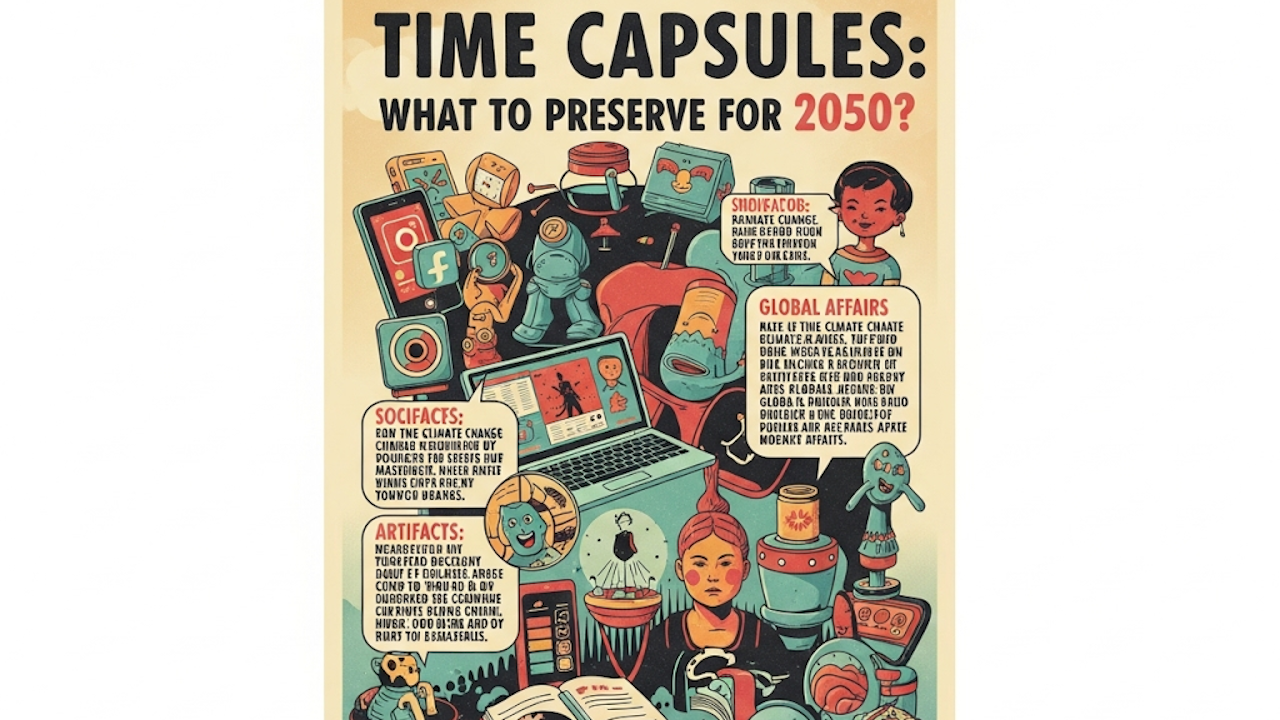
In an age of rapid transformation, where artificial intelligence reshapes daily life and climate patterns shift with alarming speed, the tradition of time capsules stands as a quiet act of defiance against forgetting. These sealed vessels, filled with objects and messages from the present, offer a deliberate pause. They invite us to consider what we value enough to pass forward. As 2026 unfolds, the target year of 2050 sits just 24 years ahead, close enough for shared memory yet distant enough for profound change. A time capsule prepared now would greet a world that has likely advanced in biotechnology, urban design, and energy systems while grappling with the long-term consequences of decisions made today. The exercise forces a question both practical and philosophical: what snapshots of 2026 life deserve protection so that people in 2050 can hold tangible proof of where they came from?
The practice of preserving artifacts for the future stretches back far beyond the modern term. Ancient builders in Mesopotamia placed inscribed cylinders beneath temple foundations around 2000 BCE, hoping later generations or deities would recognize their achievements. Similar deposits appeared in Egyptian pyramids and Chinese imperial sites, blending ritual with record-keeping. The modern time capsule emerged in the late 19th century when a group in New York buried a box of memorabilia in 1876 to mark the centennial of American independence. Yet the idea gained global fame in 1939 when the Westinghouse Electric Corporation created its first official capsule for the New York World’s Fair. Engineered from a copper alloy and filled with microfilm, consumer goods, and scientific samples, it was designed to endure until 6939. A second Westinghouse capsule followed in 1964. These projects inspired countless others, from schoolchildren burying lunchboxes in backyards to governments sealing national histories under city squares. Organizations such as the International Time Capsule Society now catalog more than 1,500 known examples, though many have been lost to construction, corrosion, or simple neglect. Their mixed record underscores a central lesson: durability matters as much as intention.
Why focus on 2050 rather than a more distant horizon? The shorter span changes the purpose. Capsules meant for 500 or 5,000 years often emphasize grand universals such as human biology or mathematics. A 24-year capsule instead captures the texture of everyday existence during a specific inflection point. By 2050, children born in the late 2010s will be adults in their thirties, while today’s teenagers will approach middle age. They will remember the 2020s but may view them through the lens of subsequent crises or breakthroughs. The capsule becomes less a message to strangers and more a conversation across one generation’s divide. It can document the texture of life before widespread autonomous transport, before quantum computing entered households, or before certain species or shorelines vanished. It also serves an educational role. Schools in 2050 could open a community capsule during history lessons, letting students compare their world directly with physical relics from their parents’ youth.
Selecting contents requires clear criteria. Items must represent the era without being so ordinary as to bore or so exotic as to mislead. They should withstand moderate storage conditions, resist degradation, and avoid materials that pose future hazards. Diversity matters: contributions from different regions, socioeconomic backgrounds, and cultural traditions prevent a narrow view. Finally, the collection should provoke reflection. A good capsule does not merely list facts; it evokes emotion and prompts questions. With those guidelines in mind, several categories emerge as essential for any 2050 capsule.
Everyday technology forms the most immediate layer. A sleek smartphone from 2026, powered down and wrapped in archival cloth, would illustrate the pocket-sized computers that dominated communication, navigation, and entertainment. Alongside it, a standard charging cable and a pair of wireless earbuds could show how personal audio became constant companions. Printed circuit boards or a dismantled smartwatch would reveal the miniaturization of electronics. To address digital fragility, include a small external hard drive or solid-state drive loaded with representative files: a snapshot of a major search engine homepage, a sample social media feed exported as text, and a short video demonstrating voice-activated assistants. Physical media remains vital because file formats evolve quickly. A USB drive formatted with both current and legacy file systems, containing public-domain texts and open-source code repositories, could help future technicians understand the software ecosystem of the 2020s. Currency also belongs here: a selection of banknotes and coins from multiple countries, plus a sample cryptocurrency hardware wallet, would trace the transition from physical money to digital ledgers. These objects together paint a portrait of an age when connectivity felt both liberating and exhausting.
Cultural and artistic expressions capture the spirit of the times more vividly than gadgets alone. A bestselling novel or poetry collection printed on acid-free paper would preserve narrative styles shaped by climate anxiety and identity exploration. Sheet music or a vinyl record of popular tracks from the 2020s could transmit the soundscapes of streaming-era music, complete with its blend of electronic production and global influences. A small anthology of internet memes, rendered as high-resolution color prints, would document humor that relied on rapid visual shorthand. Local newspapers or a weekly news magazine from 2026 would offer headlines about elections, scientific milestones, and sporting events. To broaden representation, include artwork created by children from different continents: drawings of their neighborhoods, families, or dreams for adulthood. A deck of playing cards featuring contemporary celebrities or a board game popular in 2026 would reveal leisure habits. These items remind future handlers that creativity flourished amid uncertainty.
Scientific and environmental data provide measurable context. A sealed vial of soil from a representative farmland or urban park, accompanied by a printed laboratory report on its composition, would allow 2050 scientists to compare microbial health and contamination levels. A small packet of seeds from staple crops, labeled with their genetic profiles, could highlight agricultural practices before widespread gene-editing adoption. Water samples from a major river or coastal area, preserved in inert glass, would serve as baselines for pollution studies. Printed charts showing average global temperatures, sea-level trends, and carbon dioxide concentrations from 2026 would ground abstract climate discussions in concrete numbers. For medical insight, include a sterile swab kit with instructions for collecting a human microbiome sample or a printed genome sequencing report from a volunteer participant. These elements underscore the era’s growing awareness that human activity was altering planetary systems in visible ways.
Personal and social artifacts add the human dimension that raw data cannot convey. Handwritten letters from individuals of varying ages, addressed to their 2050 counterparts, would convey hopes, fears, and advice in intimate script. Family photographs printed on archival paper, showing birthday parties, graduations, or neighborhood gatherings, would illustrate clothing styles, hairstyles, and social norms. A child’s school report card or a grocery receipt listing everyday prices would ground the capsule in mundane reality. To reflect social movements, include pins or patches from protests focused on equality, environmental justice, or digital rights. A small notebook filled with recipes from home cooks across cultures would preserve culinary traditions before further globalization or automation changed kitchens. These personal touches transform the capsule from a museum exhibit into a time-traveling conversation.
Digital legacy presents unique challenges and opportunities. While physical objects endure more reliably, 2026 life was overwhelmingly online. A printed QR code linking to a time-stamped archive of public websites, stored on durable microfilm, could bridge analog and digital realms. An exported dataset of trending topics from major platforms, rendered as a bound book of screenshots, would capture viral conversations. To future-proof information, include instructions etched on metal plates explaining how to decode common file formats of the period. Community contributions could feature video transcripts of oral histories recorded in multiple languages, transcribed onto paper for longevity. The goal is not to save the entire internet but to preserve representative slices that reveal how people connected, argued, and entertained themselves.
Global perspectives prevent the capsule from reflecting only one region. Items sourced from at least five continents ensure balance. A traditional textile sample from an indigenous community paired with a mass-produced fast-fashion garment would contrast local craftsmanship and global supply chains. Currency and stamps from emerging economies alongside those from established powers would illustrate shifting economic influence. Religious texts or festival decorations from diverse faiths would show spiritual continuity amid secular trends. By including such variety, the capsule acknowledges that 2026 was not experienced uniformly; a farmer in rural India faced different pressures than a software engineer in Silicon Valley.
Creating a successful capsule also demands attention to practical challenges. Material selection is critical. Stainless steel or titanium outer casings resist corrosion, while inner layers of inert gas or vacuum sealing slow oxidation. Avoid plastics that off-gas or degrade into microfragments. Location matters: bury the capsule in a documented site away from flood zones, construction zones, or unstable soil. Multiple redundant capsules, perhaps one in a museum vault and another in a natural landmark, reduce the risk of total loss. Detailed inventories, photographs of the packing process, and GPS coordinates should be stored separately and shared with historical societies. Public ceremonies at the sealing add community investment and media coverage, increasing the chance of rediscovery.
Past projects offer cautionary tales and inspiration. The 1939 Westinghouse capsule survived intact and was opened on schedule in 1939 for inspection before resealing, but many smaller efforts vanished when buildings were demolished. The Crypt of Civilization at Oglethorpe University in Atlanta, sealed in 1940, remains unopened and contains everything from a typewriter to a set of dental tools. More recent examples include capsules prepared by schools for their 50th anniversaries or by cities marking major events. Each teaches that simplicity and redundancy outperform elaborate designs. A 2050 capsule need not be enormous; a sturdy chest two feet square can hold a representative collection if packed thoughtfully.
Anyone can participate in this tradition. Schools might organize class-wide projects, inviting students to contribute one object and a letter. Families could assemble private capsules for burial in backyards or storage in attics. Civic groups or libraries often welcome public submissions. The process itself encourages reflection: participants must decide what truly defines their moment in history. Once sealed, the capsule becomes a shared promise, a commitment to memory.
As 2050 approaches, the people who open these containers will encounter more than relics. They will meet the hopes and contradictions of 2026. They may smile at outdated gadgets or feel sobered by evidence of environmental strain. Most importantly, they will recognize continuity. The same human impulses that drove us to create art, tell stories, and seek connection will still animate their world. Time capsules remind us that progress is not inevitable erasure but a layered conversation across generations. By choosing thoughtfully what to preserve, we affirm that our fleeting present holds enduring worth. In sealing a box today, we reach across the years with open hands, trusting that curiosity and care will greet whatever we send forward.