

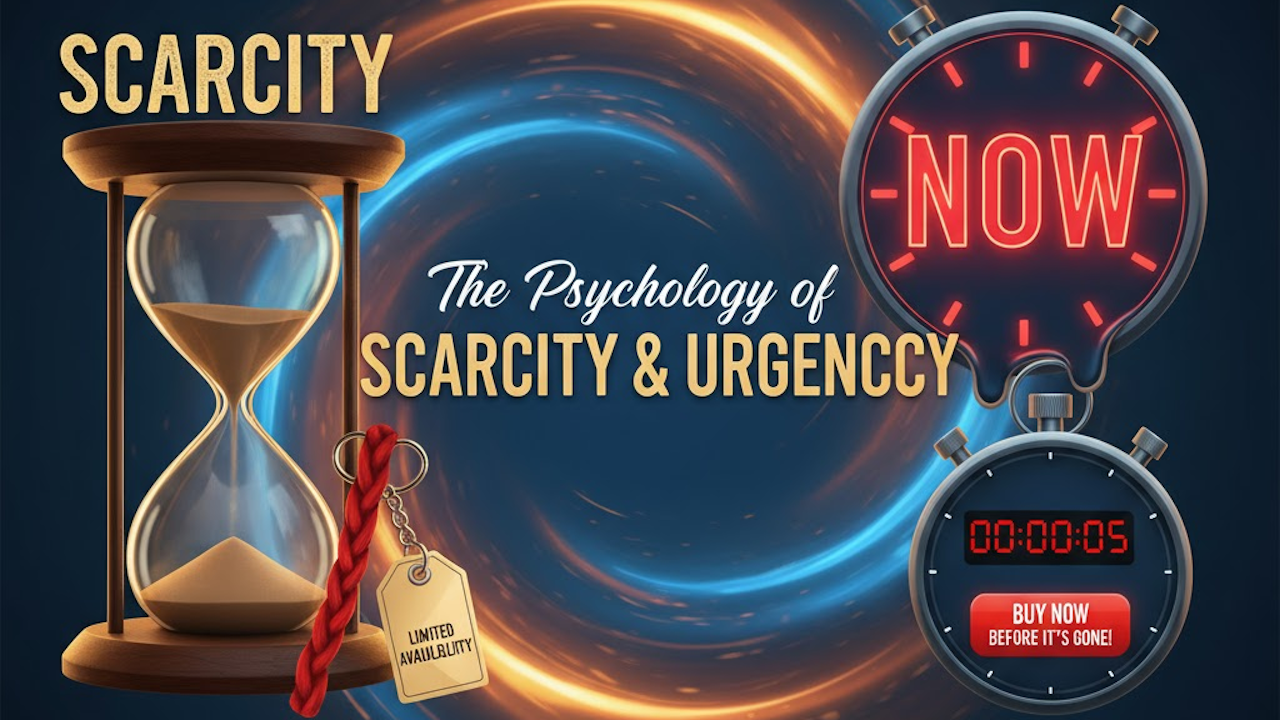
Human decision making often defies pure logic. People frequently assign greater value to things that seem limited and rush into choices when time appears to be running out. These patterns stem from deep psychological processes rather than fleeting trends. Scarcity and urgency shape consumer behavior, personal relationships, financial decisions, and even societal responses during crises. Marketers exploit them constantly, yet their influence extends far beyond sales tactics into the core of how the mind evaluates options and allocates attention.
Scarcity refers to the perception that a resource, opportunity, or item exists in limited supply. Urgency arises from the sense that action must occur quickly before the window closes. When combined, the two create intense motivational pressure. This pressure can produce beneficial focus in some situations and costly mistakes in others. Understanding the mechanisms involved allows individuals to make more deliberate choices and helps explain why certain influence strategies prove so effective across cultures and contexts.
The Scarcity Principle and Its Core Logic
Psychologist Robert Cialdini identified scarcity as one of the fundamental principles of persuasion. The central idea holds that opportunities appear more valuable when their availability is restricted. This principle operates through two primary routes. First, scarce items often carry an implicit signal of quality or high demand. Second, restrictions on access threaten personal freedom, which triggers a motivational response to reclaim that freedom.
The principle appears consistently in everyday settings. Limited edition products command higher prices even when functional differences from standard versions remain minimal. Exclusive access to events or memberships elevates perceived status. In negotiations, the party that conveys credible limits on flexibility frequently gains leverage. These outcomes occur because the human mind treats scarcity as a reliable heuristic in a complex world filled with too many choices.
Evolutionary pressures likely contributed to this sensitivity. In environments where food, shelter, and social alliances were often uncertain, prioritizing limited resources conferred survival advantages. Modern brains retain this wiring even amid material abundance. The result is a persistent bias toward valuing what feels difficult to obtain.
Classic Experiments Demonstrating Scarcity Effects
One of the most direct demonstrations comes from a 1975 study by Worchel, Lee, and Adewole. Researchers presented participants with identical chocolate chip cookies in two conditions. One group received a jar containing ten cookies. The other group received a jar containing only two cookies. Participants consistently rated the cookies from the nearly empty jar as more desirable, more valuable, and better tasting despite the cookies being exactly the same. The mere perception of lower availability increased assigned worth.
A related finding showed that the effect strengthens when scarcity appears suddenly. When participants first saw abundant cookies and then watched the supply reduced to two, desirability ratings rose more sharply than when the low supply existed from the start. The shift itself signals changing conditions and heightens the sense that an opportunity may soon disappear entirely.
Another powerful illustration involved wholesale beef buyers. When informed of an impending shortage, buyers more than doubled their orders compared with control conditions. When they were additionally told that they alone had received this information, making the knowledge itself scarce, orders increased by approximately 600 percent. Scarcity of both the product and exclusive information combined to drive dramatic behavioral change.
These experiments reveal that scarcity does not require actual rarity in objective terms. Perceived limitation suffices to alter evaluations and actions. The mind fills in assumptions about quality and competition even when objective evidence remains absent.
Reactance Theory and Loss Aversion as Underlying Drivers
Psychological reactance theory, developed by Jack Brehm, provides one key explanation. When people perceive that their freedom to choose or obtain something faces restriction, they experience an unpleasant motivational state. To reduce this discomfort, they often increase desire for the restricted option. Scarcity messages implicitly threaten freedom by suggesting that delay or inaction may eliminate the choice. The resulting reactance amplifies pursuit of the scarce item.
Loss aversion, identified through prospect theory by Daniel Kahneman and Amos Tversky, supplies a complementary mechanism. Losses register more intensely in subjective experience than equivalent gains. Scarcity frames situations around potential loss: failing to act now may mean forever losing access to the item, deal, or opportunity. This asymmetry makes the threatened loss feel disproportionately painful and motivates immediate action to avoid it.
Research on messaging language supports this account. Homeowners received communications about home insulation framed either as money they could save or money they stood to lose by failing to insulate. The loss-framed messages produced 150 percent more insulation uptake than the gain-framed versions, even though the financial figures remained identical. The same principle explains why “while supplies last” or “offer ends soon” language outperforms neutral descriptions.
Urgency, Deadlines, and the Fear of Missing Out
Urgency introduces a temporal dimension that intensifies scarcity effects. Deadlines create concrete endpoints that prevent indefinite postponement. Without such endpoints, many worthwhile actions never occur because other demands always compete for attention. Yet urgency also narrows attentional focus and shifts processing toward faster, more emotional pathways.
The fear of missing out, commonly abbreviated as FOMO, represents a contemporary expression of urgency. It combines scarcity of the opportunity with social comparison. Seeing others participate or benefit heightens the sense that one’s own inaction carries social costs. Social media platforms amplify this dynamic through real-time updates, disappearing content, and visible indicators of others’ engagement.
Under time pressure, individuals rely more heavily on heuristics and less on deliberate analysis. Quick decisions become necessary, but accuracy and long-term alignment with goals often suffer. The Zeigarnik effect contributes here as well: unfinished tasks or open opportunities remain more salient in memory, creating internal pressure to close the loop before the deadline passes.
Neurological responses reinforce these patterns. Anticipation of acquiring a scarce or time-limited item activates dopamine pathways associated with reward seeking. Simultaneously, urgency can elevate stress hormones that prioritize immediate action over reflective evaluation. The combination produces a state of heightened motivation accompanied by reduced capacity for complex trade-off analysis.
The Scarcity Mindset and Its Cognitive Consequences
Beyond momentary tactics, prolonged exposure to scarcity shapes broader patterns of thought. Economists Sendhil Mullainathan and psychologist Eldar Shafir explored this phenomenon in depth. They demonstrated that the experience of having too little, whether money, time, or other resources, imposes a “bandwidth tax” on mental resources. Cognitive capacity that would otherwise support planning, self-control, and problem solving becomes consumed by the immediate demands of managing the shortage.
This scarcity mindset produces tunneling. Attention narrows intensely onto the scarce resource at the expense of other considerations. The focus can prove adaptive in the short term by enabling quick responses to pressing needs. Over longer periods, however, it crowds out attention to education, health maintenance, relationship building, and financial planning. The result is often a cycle in which short-term coping undermines long-term stability.
Laboratory and field studies showed that people experiencing financial scarcity performed worse on cognitive control tasks and intelligence measures when financial concerns were made salient. Importantly, these performance drops occurred regardless of baseline intelligence. The condition itself, rather than any inherent deficit, impaired executive function. Similar patterns appear when time scarcity or social isolation occupies mental bandwidth.
Applications in Marketing, Sales, and Digital Environments
Marketers have refined scarcity and urgency into highly effective tools. Limited-quantity claims, countdown timers, flash sales, and “only X remaining” notifications appear across e-commerce, travel booking, and subscription services. These tactics work because they simultaneously trigger loss aversion, reactance, and FOMO while compressing decision time.
Real-world cases illustrate the power. When British Airways announced the discontinuation of Concorde flights for economic reasons, sales for remaining seats increased sharply the following day despite no change in the flight experience itself. The sudden scarcity of the opportunity drove renewed interest. Online retailers report measurable lifts in conversion rates and average order value when countdown timers accompany offers.
Digital platforms add new layers. Personalized notifications create the impression that an opportunity is uniquely available to the individual. Ephemeral content formats, such as stories that vanish after 24 hours, manufacture urgency around viewing and engagement. Limited drops in fashion, gaming, and collectibles generate intense competition and rapid sell-outs even when production could be scaled.
Authenticity matters for sustained effectiveness. When consumers detect manufactured scarcity, such as false countdowns or misleading stock levels, reactance can turn negative. Skepticism rises, trust erodes, and future messages from the same source lose impact. Genuine limitations produce stronger and more durable responses.
Effects on Decision Quality and Long-Term Outcomes
Decisions made under strong scarcity or urgency cues frequently deviate from what individuals would choose with more time and information. People pay premiums for scarce items, accept unfavorable terms to avoid missing deadlines, and prioritize immediate acquisition over evaluation of alternatives. Post-decision regret and cognitive dissonance often follow once the pressure subsides.
In financial domains, scarcity framing contributes to high-interest borrowing and underinvestment in preventive measures. In relationships, urgency can accelerate commitments that later prove mismatched. In health contexts, last-minute appeals may prompt action yet also generate anxiety that discourages sustained behavior change.
The scarcity mindset compounds these issues for those already facing resource constraints. Bandwidth consumed by immediate survival leaves less capacity for the very planning and self-regulation that could alleviate long-term scarcity. This dynamic helps explain why poverty can persist even when external opportunities exist.
Vulnerabilities, Manipulation Risks, and Ethical Concerns
Not all individuals respond equally. Those high in need for closure or low in tolerance for ambiguity show greater susceptibility to urgency tactics. Impulsive personality traits interact with FOMO to increase unplanned purchases. Older adults and those experiencing cognitive load from other sources may have reduced capacity to detect manipulative framing.
Unethical applications raise serious concerns. Fake scarcity messages, high-pressure limited-time offers that disappear upon hesitation, and fabricated social proof exploit psychological vulnerabilities for commercial gain. Vulnerable populations, including those under financial stress or with limited digital literacy, face elevated risks of exploitation.
Chronic exposure to urgency in work and personal life contributes to decision fatigue, elevated stress, and diminished well-being. Constant notifications and disappearing offers train the mind to remain in a reactive state rather than a deliberate one. Over time, this pattern can reduce overall life satisfaction even when individual transactions appear successful.
Individual, Cultural, and Situational Differences
Responses to scarcity and urgency vary across personality, culture, and context. People with strong future time orientation may resist urgency better than those focused on the present. Collectivist cultures sometimes show different patterns of social proof amplification compared with individualistic ones. Situational factors such as overall resource abundance or recent experiences of loss also moderate effects.
Age influences susceptibility as well. Younger adults immersed in social media environments encounter more frequent FOMO triggers. Older adults may weigh potential regret more heavily when evaluating urgent offers. These differences suggest that one-size-fits-all influence strategies have limits.
Practical Strategies for Recognition and Resistance
Individuals can reduce unwanted influence through deliberate practices. The first step involves pausing when urgency or scarcity language appears. Asking whether the limitation is genuine or manufactured introduces a moment of reflection that disrupts automatic responding.
Implementing personal cooling-off rules helps. For any purchase above a chosen threshold, commit to a 24- or 48-hour delay before finalizing. This interval allows emotional arousal to subside and permits comparison with alternatives or consideration of opportunity costs.
Focusing on core values and long-term objectives provides an internal reference point. When an offer feels urgent, explicitly comparing it against personal priorities reveals whether the pressure aligns with genuine importance or manufactured demand.
Mindfulness practices that strengthen present-moment awareness can counteract the narrowing of attention that scarcity mindsets produce. Regular review of financial, time, and energy budgets also builds resistance by making true resource constraints visible rather than letting them operate as vague background pressure.
Constructive Uses in Productivity, Policy, and Personal Growth
Scarcity and urgency need not function solely as external manipulation tools. Individuals can apply them intentionally to support valued goals. Setting clear personal deadlines for important projects leverages urgency to overcome procrastination while preserving control over the timeframe. Creating self-imposed limits on distractions during focused work periods mimics beneficial scarcity of attention.
Public health and environmental campaigns sometimes employ careful urgency framing to encourage beneficial actions such as screenings or energy conservation. When messages emphasize genuine time sensitivity without exaggeration, they can prompt timely behavior without generating counterproductive alarm or fatigue.
In education and professional development, structured milestones with meaningful consequences help translate intentions into completed work. The key lies in maintaining transparency and ensuring that the imposed limits serve the individual’s or group’s actual interests rather than external agendas.
Conclusion
Scarcity and urgency tap into fundamental features of human psychology. They draw on loss aversion, reactance to threatened freedom, social comparison, and the allocation of limited cognitive bandwidth. These processes evolved to help navigate uncertain environments yet continue to shape choices in modern contexts of relative abundance.
The same mechanisms that drive beneficial focus and timely action can also produce impulsive decisions, regret, and exploitation when deployed without regard for long-term consequences. Awareness of the underlying dynamics provides the foundation for greater autonomy. By recognizing manufactured pressure, implementing reflective pauses, and aligning responses with considered priorities, individuals can engage with scarcity and urgency selectively.
Ultimately, the goal is not to eliminate sensitivity to limitations. That sensitivity remains part of what makes opportunities feel meaningful. The aim is instead to ensure that this sensitivity serves thoughtful pursuit of what matters rather than reflexive reaction to whatever appears scarce or fleeting at any given moment. In a world saturated with signals of limited availability and pressing deadlines, this capacity for discernment represents a valuable form of psychological freedom.