

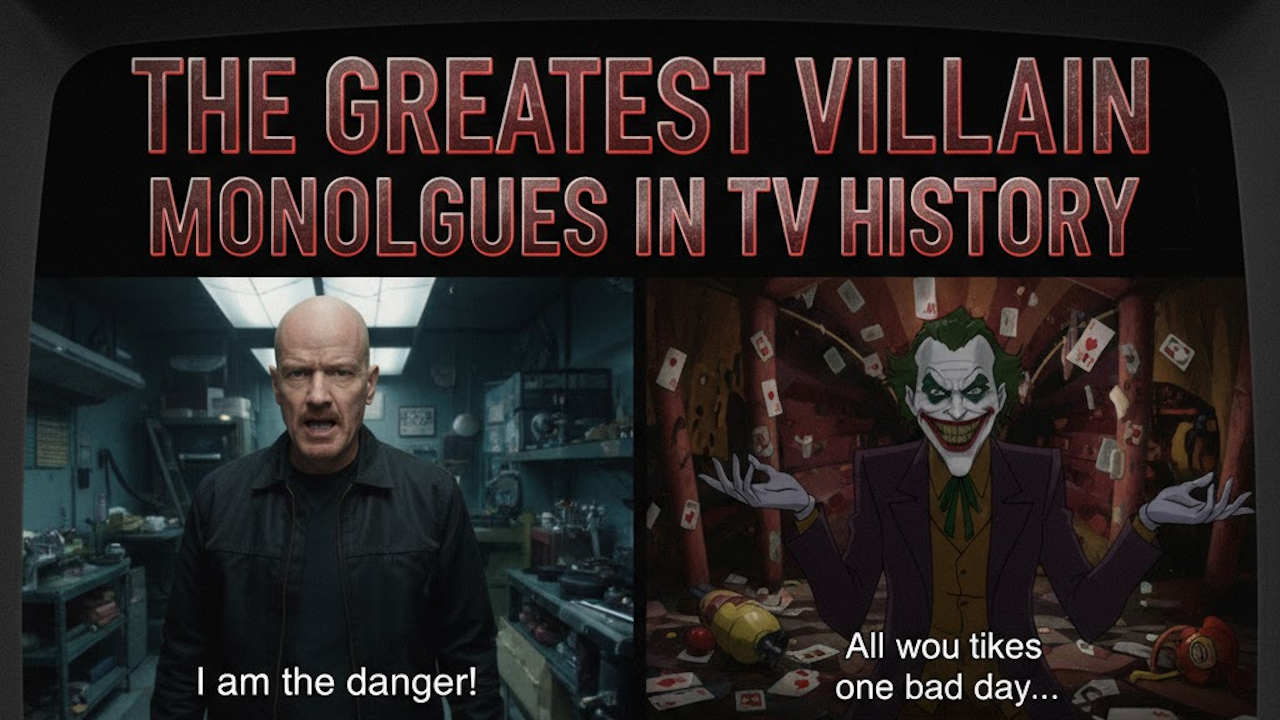
Villain monologues have long served as one of television’s most potent storytelling tools. In the confined yet expansive format of a series, these extended speeches allow antagonists to reveal their twisted philosophies, justify their atrocities, and assert dominance in ways that linger with audiences long after the credits roll. Unlike quick quips or action set pieces, a well-crafted monologue humanizes the villain just enough to make them terrifyingly relatable, exposing the fragile line between ambition and monstrosity. Television, with its character-driven arcs spanning seasons, excels at building to these moments, turning them into cultural touchstones. From antiheroes who embrace darkness to outright predators, here are some of the greatest villain monologues in TV history, examined for their impact, delivery, and enduring resonance.
Walter White’s “I Am the One Who Knocks” in Breaking Bad
Few transformations in television match Walter White’s descent from mild-mannered chemistry teacher to methamphetamine kingpin Heisenberg. In Season 4, Episode 6 of Breaking Bad, Walter confronts his wife Skyler, who fears the dangers of his criminal life. Instead of reassurance, he unleashes a chilling declaration of power.
The monologue builds methodically. Walter recounts how ordinary people lock their doors at night out of fear of men like him. “I am not in danger, Skyler. I am the danger,” he growls. “A guy opens his door and gets shot and you think that of me? No. I am the one who knocks.” Delivered with Bryan Cranston’s precise mix of rage, pride, and vulnerability, this speech marks the point of no return. Walter no longer sees himself as a victim of circumstance but as the architect of his empire.
What makes this monologue exceptional is its psychological depth. It captures Walter’s ego inflation while hinting at the terror he feels at his own evolution. Audiences who once rooted for him now confront the monster he has become. The scene’s domestic setting heightens the horror, contrasting suburban normalcy with Heisenberg’s menace. It exemplifies how TV villains use monologues not just for exposition but for self-mythologizing, solidifying their identity in the narrative.
Cersei Lannister’s Revelations in Game of Thrones
In the ruthless world of Westeros, Cersei Lannister stands as a master of calculated cruelty. One of her most memorable confrontations occurs in Season 1, when she faces Ned Stark after he uncovers the truth about her children’s parentage. Cersei explains her worldview with cold clarity: “When you play the game of thrones, you win or you die.” She acknowledges the brutality of her actions but frames them as necessary for survival and family.
Another standout comes later in the series, where Cersei addresses her tormentors with raw defiance. She admits the satisfaction of revenge: “It felt good, beating me. Starving me. Frightening me. Humiliating me.” Here, she turns victimhood into strength, rejecting atonement and embracing her wrath. Lena Headey’s performance layers venom with regal poise, making Cersei both loathsome and sympathetic.
Cersei’s monologues thrive on the fantasy genre’s epic scale. They blend personal vendettas with political philosophy, revealing how power corrupts through cycles of trauma and retaliation. Unlike one-off rants, these speeches evolve across seasons, mirroring her character’s growth from schemer to queen. They remind viewers that the most dangerous villains believe their cause is just, even when it dooms everyone around them.
Frank Underwood’s Direct Addresses in House of Cards
Kevin Spacey’s Frank Underwood redefined the charismatic TV villain through fourth-wall-breaking monologues that treat the audience as confidants. In early episodes, he dissects power dynamics with surgical precision. One iconic explanation contrasts money and power: money is fleeting like a McMansion, while power endures like an ancient stone building.
A particularly ruthless monologue follows a key betrayal, where Frank speaks directly to viewers about his cold calculations. “Did you think I’d forgotten you? Perhaps you hoped I had,” he begins, before dismissing sentimentality and outlining his next moves with predatory calm. These asides pull the audience into complicity, making us accessories to his schemes.
Underwood’s speeches excel because of their theatricality and relatability. They expose the cynicism of Washington politics, where ambition trumps morality. By breaking the fourth wall, the show implicates viewers in the thrill of manipulation. Even after Spacey’s departure, the series continued this tradition, proving how monologues can define a show’s stylistic signature and sustain viewer investment through moral ambiguity.
Lorne Malvo’s Primal Philosophy in Fargo
Billy Bob Thornton’s Lorne Malvo in Season 1 of Fargo embodies quiet, philosophical evil. In a pivotal scene with Lester Nygaard, Malvo delivers a monologue that strips away societal pretensions: “Your problem is you spent your whole life thinking there are rules. There aren’t. We used to be gorillas. All we had is what we could take and defend.” He urges Lester to embrace his inner ape, rejecting civilization’s constraints for raw survival.
Malvo’s delivery is understated yet hypnotic, laced with dark humor and evolutionary insight. Another moment sees him philosophizing about Romans and saints, illustrating humanity’s predatory nature through historical analogy. These speeches transform a hitman into a force of nature, challenging protagonists and audiences to question morality’s foundations.
Fargo‘s anthology format allows such monologues to shine as self-contained masterclasses. Malvo’s words justify chaos without grandiosity, making evil feel inevitable and almost logical. They highlight television’s ability to explore nihilism through articulate predators who tempt ordinary people toward darkness.
Other Standout Examples and Enduring Appeal
Television offers many more gems. In The Sopranos, Tony Soprano’s sessions and reflections often blur villainy with vulnerability, though his actions cement his antagonistic role. Gus Fring in Breaking Bad delivers measured monologues that mask his ruthlessness with politeness, proving restraint can amplify menace. V.M. Varga in later Fargo seasons spins elaborate tales that obfuscate truth, embodying postmodern villainy.
What unites these monologues is their narrative function. They provide insight into the villain’s psyche, advance themes of power and corruption, and create unforgettable acting showcases. Great ones avoid pure exposition by revealing contradictions: Walter’s fear beneath bravado, Cersei’s maternal instincts twisted by ambition, Frank’s loneliness amid conquest, and Malvo’s intellectual justification for savagery.
Directors and writers time these moments carefully, often in quiet settings that contrast verbal intensity with visual stillness. Performers elevate the material through nuance, turning pages of dialogue into visceral experiences. In an era of peak TV, where complex antiheroes dominate, villain monologues remind us why we watch: to confront the darkness within and without, articulated with eloquence that borders on poetry.
These speeches endure because they mirror real-world figures who rationalize harm through ideology or self-interest. They challenge viewers to empathize without excusing, to admire craft while recoiling from deeds. As television continues evolving, the greatest villain monologues will remain those that not only terrify but also illuminate the human condition’s shadowy corners. In the end, they prove that words, wielded by the right monster, can be more devastating than any weapon.