

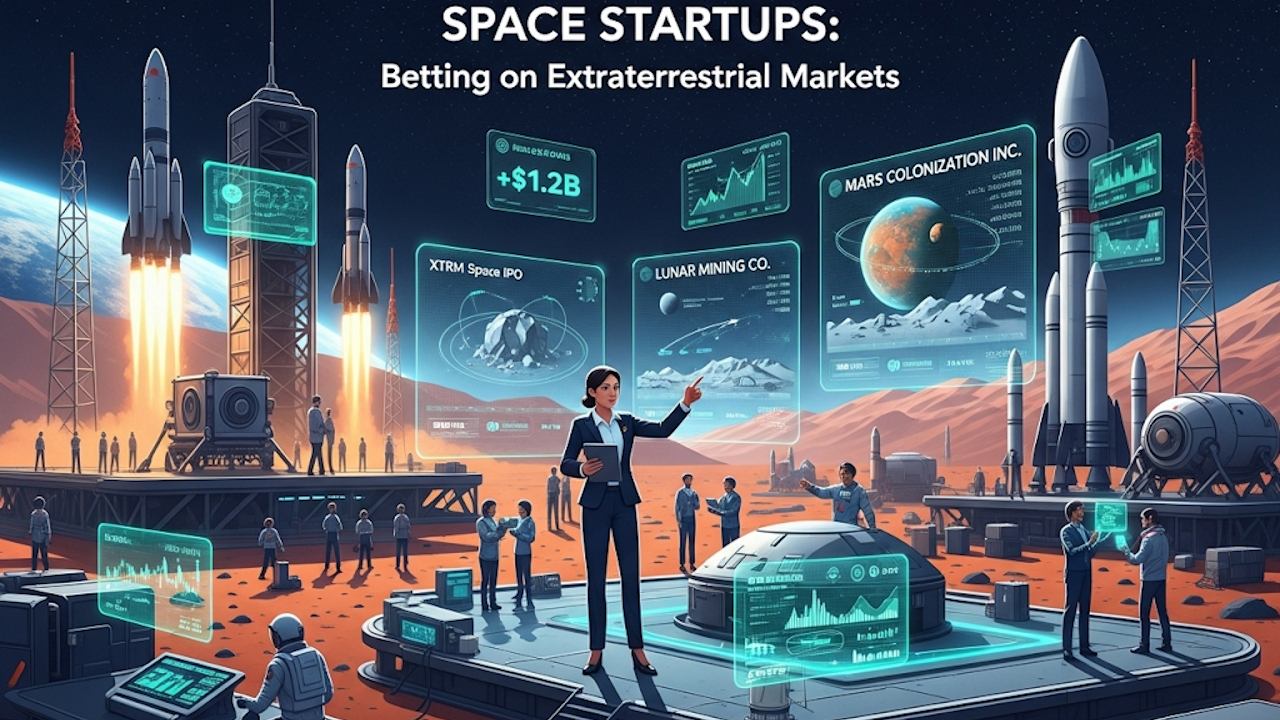
The space industry has transitioned from a domain dominated by governments and a handful of massive defense contractors to a vibrant ecosystem of innovative startups chasing commercial opportunities far beyond Earth’s atmosphere. Entrepreneurs and investors are placing substantial bets on extraterrestrial markets, envisioning everything from satellite mega-constellations that deliver global internet to lunar resource extraction and orbital manufacturing facilities. This shift, often called the New Space movement, is fueled by plummeting launch costs, technological advancements, and growing demand for space-enabled services on Earth. As of 2026, the global space economy stands at approximately 500 to 600 billion dollars, with projections indicating growth to 1 trillion dollars or more by 2040.
This article explores the rise of space startups, the markets they target, the challenges they face, and the potential rewards of betting on humanity’s expansion into the cosmos.
The Dawn of the Commercial Space Era
For decades, space activities remained the preserve of national space agencies like NASA, ESA, Roscosmos, and CNSA. Launches were infrequent and extraordinarily expensive, often exceeding 10,000 dollars per kilogram to low Earth orbit. The game changed dramatically in the 2010s when companies like SpaceX demonstrated reusable rocket technology. Falcon 9 landings and rapid turnaround times slashed costs, opening the door for smaller players.
Today, dozens of startups are building on this foundation. They range from launch providers competing directly with established giants to niche firms developing in-orbit services, space tourism experiences, and resource utilization technologies. Private investment has poured in, though it has fluctuated with market conditions. In recent years, funding has matured, with companies securing hundreds of millions in venture capital, growth equity, and public market debuts.
Key Market Segments Attracting Startup Investment
Launch Services: Democratizing Access to Orbit
Launch remains the foundational sector. While SpaceX dominates with its Falcon family and is developing Starship for even greater capacity, startups are carving out niches. Rocket Lab, founded in New Zealand, has established itself as a leader in small satellite launches with its Electron rocket and is preparing the larger Neutron vehicle to challenge medium-lift markets. Firefly Aerospace focuses on end-to-end transportation, including lunar missions. Relativity Space emphasizes 3D printing to accelerate rocket production, aiming for rapid iteration and lower costs.
These companies bet that increasing launch cadence will unlock more demand. As costs drop below a few thousand dollars per kilogram, new applications become viable. Government contracts, particularly from NASA and the Department of Defense, provide crucial revenue while startups scale.
Satellite Constellations and Earth Observation
Satellites represent the largest commercial slice of the space economy. SpaceX’s Starlink has deployed thousands of satellites, generating billions in annual revenue from broadband services. Competitors like Amazon’s Project Kuiper and various international efforts are racing to build their own mega-constellations.
Startups in Earth observation, such as Planet Labs with its Dove constellation, provide daily high-resolution imaging of the entire planet. This data supports agriculture, disaster response, climate monitoring, and defense applications. Other firms develop synthetic aperture radar or hyperspectral sensors for specialized insights. The bet here is on data as a service: recurring revenue from analytics rather than one-off hardware sales.
Space Tourism and Human Spaceflight
Virgin Galactic and Blue Origin have already flown paying customers on suborbital flights. Startups are pushing further. Axiom Space is developing commercial modules for the International Space Station and plans independent stations. Sierra Space and Vast are pursuing similar orbital habitats. The vision extends to point-to-point travel on Earth via suborbital hops and eventual lunar tourism.
While current prices limit this to ultra-wealthy adventurers, proponents argue that economies of scale and technological progress will broaden access, much like aviation evolved from luxury to mass transit.
In-Space Services and Manufacturing
Microgravity offers unique conditions for producing materials impossible or inefficient to make on Earth. Varda Space Industries, for example, focuses on pharmaceutical manufacturing in orbit. Other startups explore crystal growth, fiber optics, or advanced alloys.
In-orbit servicing, refueling, and debris removal are also hot areas. Astroscale works on active debris removal to ensure sustainable orbital environments. Companies develop robotic arms, docking mechanisms, and space tugs to extend satellite lifespans or reposition assets. ClearSpace, with European Space Agency support, targets debris capture missions.
Extraterrestrial Resource Markets: The Ultimate Bet
The most ambitious startups target space resources. ispace from Japan has attempted lunar landings and plans resource prospecting. AstroForge aims at asteroid mining for platinum-group metals. The economic case rests on in-situ resource utilization: extracting water ice for rocket propellant (oxygen and hydrogen) or oxygen for life support, dramatically reducing the need to launch everything from Earth.
Lunar regolith could supply building materials for habitats. Asteroids might yield rare metals for terrestrial markets or space-based solar power components. While full-scale mining remains years or decades away, early demonstrations through NASA’s Commercial Lunar Payload Services program and private missions are laying groundwork. Legal frameworks, such as the U.S. Artemis Accords and national laws recognizing resource rights, provide increasing certainty for investors.
Challenges Facing Space Startups
High technical risk defines the sector. Space hardware must survive extreme environments, and failures can be catastrophic both financially and in terms of human safety. Regulatory hurdles, including spectrum allocation for satellites, export controls, and international treaties, add complexity.
Capital intensity is another barrier. Developing a launch vehicle or constellation requires hundreds of millions, often billions, before revenue flows. Many startups rely on government anchor customers or billionaire backers. Market competition is intensifying, with established players like SpaceX achieving vertical integration that newcomers struggle to match.
Orbital congestion and space debris pose long-term sustainability issues. Insurance costs remain high, and supply chain vulnerabilities, particularly for specialized components, can delay programs.
Investment Landscape and Economic Projections
Despite risks, investor interest persists. Space-focused funds and traditional venture capital firms back promising teams. Public markets have seen entries like Firefly Aerospace’s IPO. Sovereign wealth funds and corporate strategics are also participating, viewing space as strategic infrastructure.
Projections vary but converge on strong growth. McKinsey and others estimate the space economy reaching 1.8 trillion dollars by 2035, driven by backbone services like communications and navigation as well as downstream applications across industries. Satellite broadband, Earth observation data, and eventual in-space production could generate outsized returns.
The Role of Policy and International Competition
Governments play a dual role as customers and regulators. NASA’s Commercial Crew and Artemis programs have accelerated private capabilities. The U.S. Space Force emphasizes resilient architectures, creating opportunities for startups. Internationally, Europe, India, China, and others are fostering their own ecosystems, leading to a multipolar space economy.
Startups must navigate geopolitical tensions, particularly in dual-use technologies. Collaboration through public-private partnerships often proves essential for de-risking early stages.
Future Horizons: Multi-Planetary Ambitions
Looking ahead, successful space startups could enable permanent human presence beyond Earth. Lunar bases supported by local resources, Martian outposts, and asteroid mining outposts represent logical progressions. Space solar power, orbital data centers, and even extraterrestrial tourism hubs could emerge as trillion-dollar markets over decades.
The bet on extraterrestrial markets is ultimately a bet on human expansion. Lower costs, reusable systems, and innovative business models are turning science fiction into investable opportunities. While not every startup will succeed, those that do could capture enormous value in the emerging off-world economy.
Conclusion
Space startups are at the forefront of one of the most transformative industries of the 21st century. From reducing launch costs to pioneering new markets in orbit and on other celestial bodies, they are betting that space will become integral to global commerce and human civilization. Investors, entrepreneurs, and policymakers who understand the risks and rewards stand to benefit as humanity takes its next giant leaps. The extraterrestrial markets of tomorrow are being built by the bold decisions of today.