

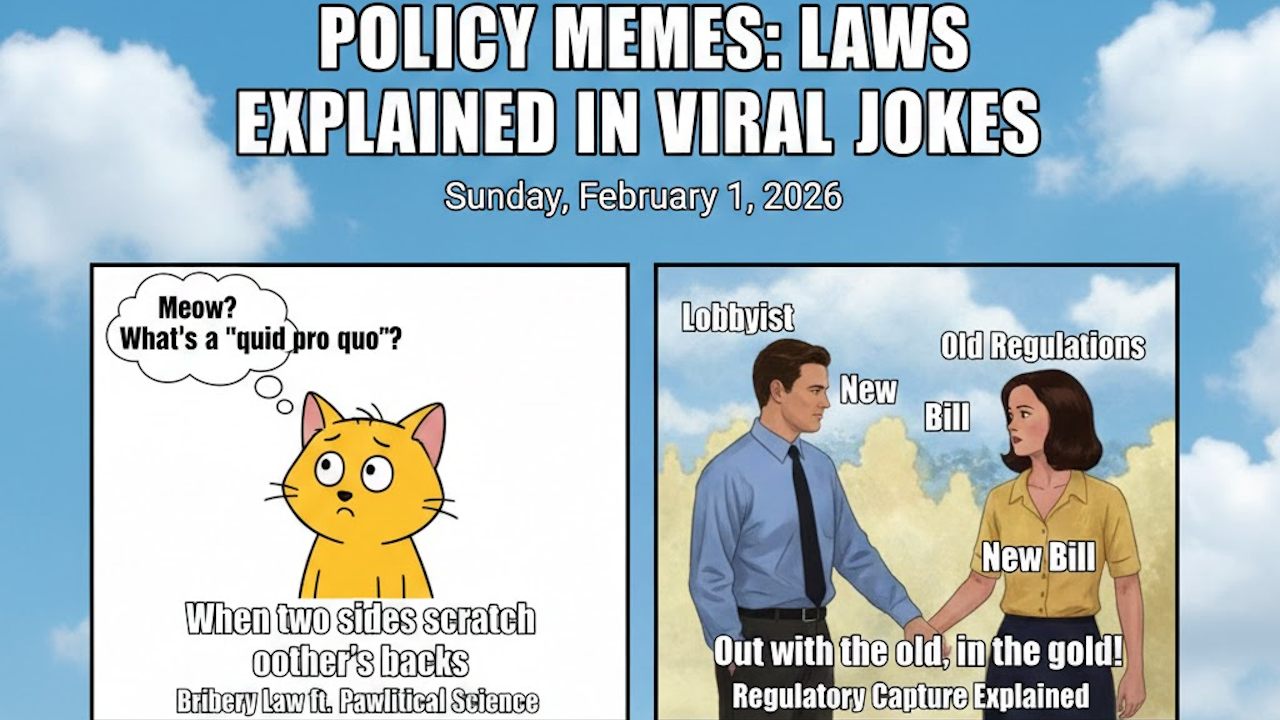
In the age of endless scrolls and rapid-fire social media feeds, few things cut through the noise faster than a well-timed meme. What began as simple image macros and reaction faces has evolved into a powerful tool for public discourse. Among the most intriguing developments is the rise of policy memes: those viral jokes, captions, and formats that take dense legal text, bureaucratic procedures, and government regulations and translate them into something instantly shareable and often hilarious. These digital artifacts do more than entertain. They compress complicated statutes into digestible punches, shape public understanding of the law, and sometimes even influence the conversation around legislation itself.
The core appeal of a policy meme lies in its efficiency. A multi-hundred-page bill filled with clauses, exceptions, and technical definitions can feel impenetrable to most citizens. A single image paired with a sharp caption can convey the perceived absurdity, hypocrisy, or practical impact of that same law in seconds. The format rewards brevity and wit. It punishes verbosity. In doing so, it forces complex ideas into the constraints of internet culture, where attention spans are short and the reward for engagement is measured in likes, shares, and quote tweets.
Consider how privacy regulations have been treated. When the European Union’s General Data Protection Regulation took effect, websites worldwide suddenly sprouted pop-up banners demanding consent for cookies. The public response was a flood of memes depicting endless consent forms, cartoon characters trapped in digital bureaucracy, and jokes about needing a lawyer just to browse a recipe site. The memes did not replace the legal text. They highlighted the friction between ambitious privacy goals and the everyday user experience. In many cases they also educated people about the existence of the rules in the first place. Someone who had never heard of data subject rights might still understand, after seeing enough jokes, that companies could no longer treat personal information as an unlimited free resource.
Tax policy provides another rich vein. Complicated deductions, brackets, and loopholes lend themselves perfectly to formats that show escalating levels of absurdity. One recurring style places ordinary taxpayers at the bottom of a ladder while corporations or high earners occupy the higher rungs with captions about legal avoidance strategies. Another popular approach uses the “two buttons” template, forcing a character to choose between paying full taxes or navigating an elaborate scheme that somehow remains within the letter of the law. These jokes rarely offer precise legal analysis. What they do offer is a gut-level sense of fairness or unfairness that formal explanations often fail to transmit.
Election and voting laws have generated their own ecosystems of humor. Debates over voter identification requirements, mail-in ballots, or campaign finance rules frequently appear as side-by-side comparisons. One panel might show a rigorous process for opening a bank account. The next shows a comparatively relaxed process for casting a ballot, or vice versa depending on the creator’s perspective. The format itself becomes an argument. Viewers absorb the implied critique without reading a single section of electoral code. Similar patterns appear around campaign contribution limits, where memes portray politicians as puppets controlled by oversized dollar signs or, alternatively, as victims of overly restrictive speech rules.
Intellectual property rules have long inspired online humor, partly because the internet itself constantly tests the boundaries of copyright, fair use, and trademark. Classic examples include exaggerated warnings about downloading content, reimagined as warnings against ordinary activities such as borrowing a library book or singing in the shower. More recent waves have targeted automated content filters and notice-and-takedown systems. Creators post screenshots of their own work being flagged by algorithms, accompanied by captions that mock the gap between the law’s intent and its automated enforcement. These jokes circulate among people who may never read the underlying statutes yet come away with strong opinions about whether the system protects creativity or stifles it.
Health and safety regulations supply endless material. During periods of rapid policy change, such as public health emergencies, memes often track the shifting guidance in real time. One day a particular activity is restricted. The next day exceptions appear. The following week the rules reverse. The resulting joke cycles treat the law as a moving target, with templates that show characters struggling to keep up or celebrating each new loophole. While some of these posts veer into pure cynicism, others serve as informal public service announcements, reminding people of current requirements through humor rather than official bulletins.
The mechanics of how these memes spread matter as much as their content. Platforms reward emotional intensity and relatability. A dry explanation of a zoning ordinance is unlikely to trend. A joke about the same ordinance that captures the frustration of trying to build a backyard shed under layers of permits can travel widely. Algorithms amplify what already performs well, creating feedback loops. Successful policy memes spawn derivatives, remixes, and countermemes. Over time a single legal concept can acquire a visual language that becomes more familiar to many citizens than the official text.
This accessibility carries clear benefits. Complex systems become less opaque. Citizens who would never open a legislative database still encounter the core issues. Humor can lower defensive barriers, allowing people to consider uncomfortable realities about how laws actually function. In some cases memes have helped surface genuine problems. When enforcement of a rule produces ridiculous outcomes, the resulting jokes can pressure officials to clarify or amend the policy. Public attention generated by viral content has, on occasion, accelerated legislative review or administrative guidance.
Yet the same traits that make policy memes effective also create risks. Compression necessarily involves omission. Nuance disappears. Exceptions, sunset clauses, and carefully negotiated compromises vanish in favor of the punchiest possible framing. A meme that depicts a regulation as pure overreach may ignore the harms the regulation was designed to prevent. One that celebrates a law as pure justice may overlook unintended consequences or enforcement costs. Viewers absorb the emotional payload without the supporting evidence. Over time this can harden tribal interpretations of the law, where opposing sides speak past each other using incompatible sets of jokes rather than shared facts.
Misinformation travels just as easily as insight. A clever caption can invent procedural requirements that never existed or exaggerate penalties beyond recognition. Because the content feels informal and humorous, audiences may lower their usual skepticism. Corrections rarely achieve the same reach as the original joke. The result is a distorted mental map of the legal landscape in which certain rules seem far more oppressive or far more permissive than they actually are.
The relationship between policymakers and meme culture has grown more self-aware. Some legislators and agencies now monitor online humor for early signals of public reaction. A few even attempt to participate, releasing their own official memes in hopes of controlling the narrative. These efforts often feel awkward. Institutional voices struggle to match the irreverence and speed of anonymous creators. When they succeed, the result can humanize government. When they fail, the attempt itself becomes fresh material for mockery.
Legal professionals occupy an interesting middle ground. Many lawyers and law students consume and create policy memes as a form of professional humor, a way to bond over shared frustrations with statutory interpretation or procedural complexity. At the same time, the profession remains wary of the medium’s tendency to flatten careful analysis. Classroom discussions sometimes begin with a viral joke and then unpack the actual doctrine it misrepresents. In this limited sense, memes can serve as teaching tools, provided they are treated as starting points rather than conclusions.
Looking ahead, the influence of policy memes is likely to grow rather than shrink. As more of public life moves onto platforms optimized for visual and emotional content, the translation of law into joke form will continue. Artificial intelligence tools that generate images and captions may accelerate the process, allowing even more rapid responses to new legislation. The challenge for citizens will be to develop the habits of mind that allow enjoyment of the humor without surrendering the capacity for deeper inquiry. The challenge for lawmakers will be to draft rules that can withstand not only judicial review but also the merciless clarity of a well-constructed meme.
Ultimately, policy memes reveal something fundamental about democratic society. Laws gain legitimacy in part through public understanding and acceptance. When formal channels of explanation fail to reach people, informal channels fill the gap. Humor has always played a role in political critique, from political cartoons of earlier centuries to late-night monologues. The internet simply accelerates the cycle and democratizes the means of production. Anyone with a phone can now participate in the ongoing commentary on the rules that govern us.
The best policy memes do more than score points. They crystallize a genuine observation about how power, procedure, and everyday life intersect. They remind us that statutes are not abstract monuments. They are instructions that shape real behavior, create real winners and losers, and occasionally produce results so strange that the only rational response is laughter. In a world of ever more intricate regulation, that laughter serves as both pressure valve and diagnostic tool. It tells us when the system is working as intended and when it has drifted into the territory of the absurd. For better or worse, the joke is often the first draft of public opinion.