

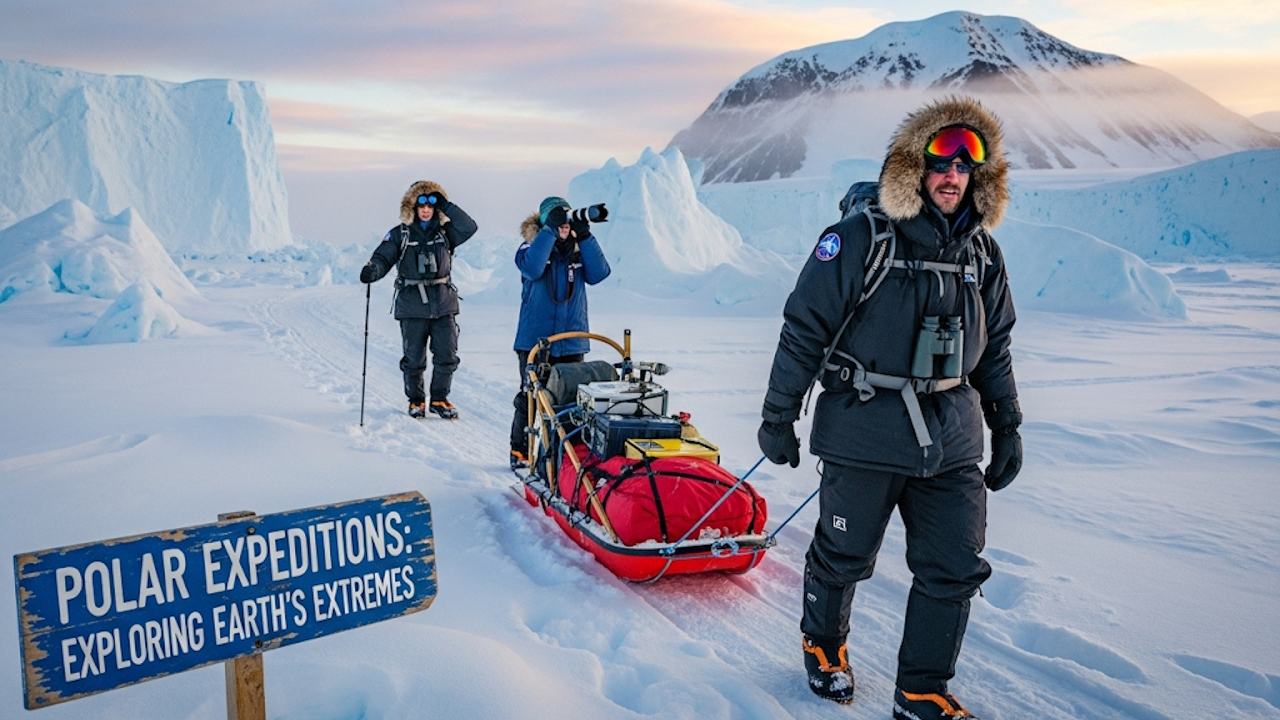
Polar expeditions represent humanity’s enduring quest to conquer the most unforgiving environments on Earth. The Arctic and Antarctic regions embody extremes of temperature, isolation, and natural forces that test the limits of human endurance, technology, and ambition. From the frozen expanses of the North Pole to the vast ice sheets of Antarctica, these expeditions have driven scientific discovery, expanded geographic knowledge, and inspired generations. They reveal not only the raw power of nature but also the resilience of the human spirit. This article explores the history, challenges, achievements, and future of polar expeditions, highlighting how explorers have ventured into these remote frontiers.
The Unique Challenges of Polar Environments
The polar regions stand apart from the rest of the planet due to their extreme conditions. In the Arctic, temperatures can plunge below minus 50 degrees Celsius during winter, while the Antarctic holds the record for the coldest place on Earth, with a low of minus 89.2 degrees Celsius recorded at Vostok Station. These areas experience polar nights lasting months, where the sun never rises, and polar days where it never sets. Blizzards with winds exceeding 200 kilometers per hour can bury camps in snowdrifts within hours. Sea ice, crevasses hidden under thin snow layers, and unpredictable weather add layers of danger to every journey.
Isolation compounds these physical hardships. The nearest rescue in many polar zones lies thousands of kilometers away, making self-reliance essential. Wildlife poses both threats and opportunities: polar bears in the Arctic hunt opportunistically, while penguins and seals in the Antarctic provide food sources but also attract predators. Logistics remain a constant hurdle. Supply chains depend on icebreakers, aircraft, or dog sleds, and fuel must be transported across vast distances. These extremes have shaped every aspect of polar exploration, from clothing and shelter to navigation and survival strategies.
Early Explorations and the Dawn of Polar Discovery
Human fascination with the poles dates back centuries. Indigenous peoples of the Arctic, including the Inuit and Sami, have thrived in these environments for millennia using traditional knowledge of ice, animals, and seasonal patterns. Their kayaks, igloos, and layered fur clothing demonstrated sustainable adaptation long before European explorers arrived.
European interest surged during the Age of Exploration. In the 16th century, sailors sought the Northwest Passage, a sea route connecting the Atlantic and Pacific through the Canadian Arctic Archipelago. Sir Martin Frobisher led early attempts in the 1570s, followed by Henry Hudson in 1610. These voyages often ended in disaster due to pack ice that crushed ships and scurvy that decimated crews. By the 18th century, Captain James Cook circumnavigated Antarctica during his second voyage from 1772 to 1775, crossing the Antarctic Circle but never sighting land. His reports fueled speculation about a southern continent.
The 19th century marked a shift toward systematic exploration. Sir John Franklin’s 1845 expedition aboard HMS Erebus and HMS Terror aimed to complete the Northwest Passage but vanished, prompting over 40 search missions. The mystery of Franklin’s fate, solved only in recent decades through wrecks discovered in 2014 and 2016, underscored the perils of polar travel. Meanwhile, expeditions led by Sir James Clark Ross in the 1840s mapped parts of the Antarctic coast and discovered the Ross Sea.
The Heroic Age: Races to the Poles
The early 20th century, often called the Heroic Age of Antarctic Exploration, produced some of history’s most legendary expeditions. In 1909, Ernest Shackleton’s Nimrod Expedition came within 180 kilometers of the South Pole before turning back due to dwindling supplies. Shackleton’s leadership emphasized crew safety, a lesson that defined his later feats.
The race to the poles intensified in 1911. Roald Amundsen, a Norwegian explorer, reached the South Pole on December 14 using skis, dog sleds, and meticulous planning. His team relied on Inuit-inspired techniques and pemmican for sustenance. Just weeks later, on January 17, 1912, Captain Robert Falcon Scott’s British Terra Nova Expedition arrived at the pole only to find Amundsen’s tent and flag. Scott’s return journey ended tragically in a blizzard; the frozen bodies of Scott and his companions were found months later. Their diaries revealed tales of bravery amid starvation and frostbite.
Shackleton’s Endurance Expedition of 1914 to 1917 further cemented the era’s reputation for resilience. When ice crushed his ship in the Weddell Sea, Shackleton led his 27 men across drifting ice floes and then sailed 1,300 kilometers in a small lifeboat to reach South Georgia Island for rescue. Not a single life was lost, a testament to navigational skill and morale management.
In the Arctic, similar daring defined the period. Robert Peary claimed to reach the North Pole in 1909 with Matthew Henson and four Inuit companions, though debates persist over the accuracy of his measurements. Fridtjof Nansen’s 1893 to 1896 Fram expedition drifted with the ice pack across the Arctic Ocean, proving the existence of a transpolar current and collecting vital oceanographic data.
Scientific Breakthroughs and Technological Advances
Post-Heroic Age expeditions transitioned from pure discovery to science. The International Geophysical Year of 1957 to 1958 coordinated global research, establishing permanent bases like the United States’ South Pole Station and the Soviet Union’s Vostok. These outposts enabled studies of auroras, meteorology, and glaciology. The discovery of the ozone hole over Antarctica in the 1980s, confirmed through expeditions, highlighted human impact on the atmosphere and led to the Montreal Protocol.
Technology revolutionized polar travel. In the 1950s, the British Commonwealth Trans-Antarctic Expedition, led by Vivian Fuchs, completed the first overland crossing of Antarctica using modified tractors and Sno-Cats. Aircraft, including ski-equipped planes, allowed rapid deployment of supplies. Nuclear power briefly powered some bases, though environmental concerns later phased it out. Today, satellite communications, GPS, and drones provide real-time weather data and mapping. Icebreakers like Russia’s Arktika-class vessels can smash through ice up to three meters thick, while autonomous underwater vehicles explore beneath sea ice.
Clothing evolved from wool and fur to synthetic fibers with Gore-Tex insulation and heated suits. Nutrition advanced with freeze-dried meals and vitamin supplements to combat scurvy. Medical kits now include portable hyperbaric chambers for frostbite treatment and telemedicine links to distant hospitals.
Modern Polar Expeditions: Research, Tourism, and Adventure
Contemporary expeditions blend science, adventure, and conservation. National programs operate dozens of research stations. The British Antarctic Survey, for instance, conducts climate studies at Rothera Research Station, while the United States Antarctic Program supports over 3,000 personnel during summer months. Scientists drill ice cores that preserve 800,000-year-old atmospheric records, revealing past climate cycles and informing predictions of future warming.
Tourism has surged. Cruise ships carry thousands of visitors annually to the Antarctic Peninsula, where passengers observe penguins, whales, and icebergs. Arctic tourism focuses on Svalbard and Greenland, offering wildlife safaris and Northern Lights viewing. Adventure expeditions, such as unsupported ski treks to the poles, attract elite athletes. In 2018, Colin O’Brady completed the first solo, unsupported, and unassisted crossing of Antarctica in 54 days, covering 1,500 kilometers.
Under-ice exploration has expanded knowledge of subglacial lakes and hydrothermal vents. In 2012, a British team drilled into Lake Ellsworth, while Russian efforts at Lake Vostok yielded microbial life forms isolated for millions of years. These findings suggest possibilities for life on icy moons like Europa.
Environmental Concerns and the Impact of Climate Change
Polar expeditions now confront the consequences of a warming planet. Arctic sea ice has declined by over 40 percent since 1979, opening new shipping routes like the Northern Sea Route but threatening traditional Inuit hunting grounds and polar bear habitats. Antarctic ice shelves, such as Larsen B, have collapsed dramatically, contributing to sea-level rise.
Expeditions themselves face altered conditions. Warmer temperatures create thinner ice, increasing crevasse risks and complicating travel. Paradoxically, melting exposes more land for geological surveys while accelerating the release of ancient microbes and greenhouse gases from permafrost. Organizations like the International Association of Antarctica Tour Operators enforce strict guidelines to minimize environmental footprints, including waste removal and wildlife distancing.
Climate research conducted during expeditions underscores urgency. Data from polar stations show the Arctic warming four times faster than the global average, altering ocean currents and weather patterns worldwide. International treaties, including the Antarctic Treaty System signed in 1959, promote peaceful scientific cooperation and ban military activity or mineral extraction.
Notable Recent and Ongoing Expeditions
Several modern endeavors stand out for innovation and impact. The 2019 to 2020 Endurance22 Expedition located the wreck of Shackleton’s ship at a depth of 3,000 meters in the Weddell Sea using submersibles, preserving a historic site for future study. In the Arctic, the Multidisciplinary Drifting Observatory for the Study of Arctic Climate (MOSAiC) expedition from 2019 to 2020 stationed the German research vessel Polarstern amid drifting ice for a full year, gathering unprecedented data on atmosphere, ice, and ocean interactions.
Private initiatives have also pushed boundaries. In 2022, a team led by explorer Mike Horn completed a circumnavigation of the Arctic Ocean by sail and ski, documenting plastic pollution. Youth-focused programs, such as those run by the Students on Ice Foundation, introduce new generations to polar science through ship-based expeditions.
The Future of Polar Exploration
Looking ahead, polar expeditions will integrate emerging technologies. Artificial intelligence could predict ice movements with greater accuracy, while 3D printing might enable on-site repair of equipment. Space agencies view Antarctica as a training ground for Mars missions due to its isolation and extreme cold. The European Space Agency and NASA conduct analog studies there, testing habitats and rovers.
Sustainable practices will define success. Expeditions increasingly use renewable energy sources like wind and solar to power bases, reducing reliance on fossil fuels. Citizen science apps allow global volunteers to analyze expedition data from home. International collaboration remains vital amid geopolitical tensions over resource claims in the Arctic.
Challenges persist. Rising costs, regulatory hurdles, and ethical questions about tourism’s ecological toll demand careful management. Yet the poles continue to draw explorers motivated by curiosity, discovery, and the need to understand Earth’s changing climate.
Conclusion
Polar expeditions embody the pinnacle of human exploration, transforming unknown frontiers into windows on our planet’s past, present, and future. From the wooden ships of early sailors to the high-tech vessels of today, these journeys reveal the fragility and ferocity of Earth’s extremes. They teach lessons in humility before nature, the value of teamwork, and the imperative of stewardship. As climate shifts reshape the poles, future expeditions will not only explore but also safeguard these vital regions. In venturing to the ends of the Earth, humanity ultimately learns more about itself and the interconnected systems that sustain life on this remarkable planet. The call of the poles endures, inviting new generations to push boundaries while honoring the legacy of those who came before.