

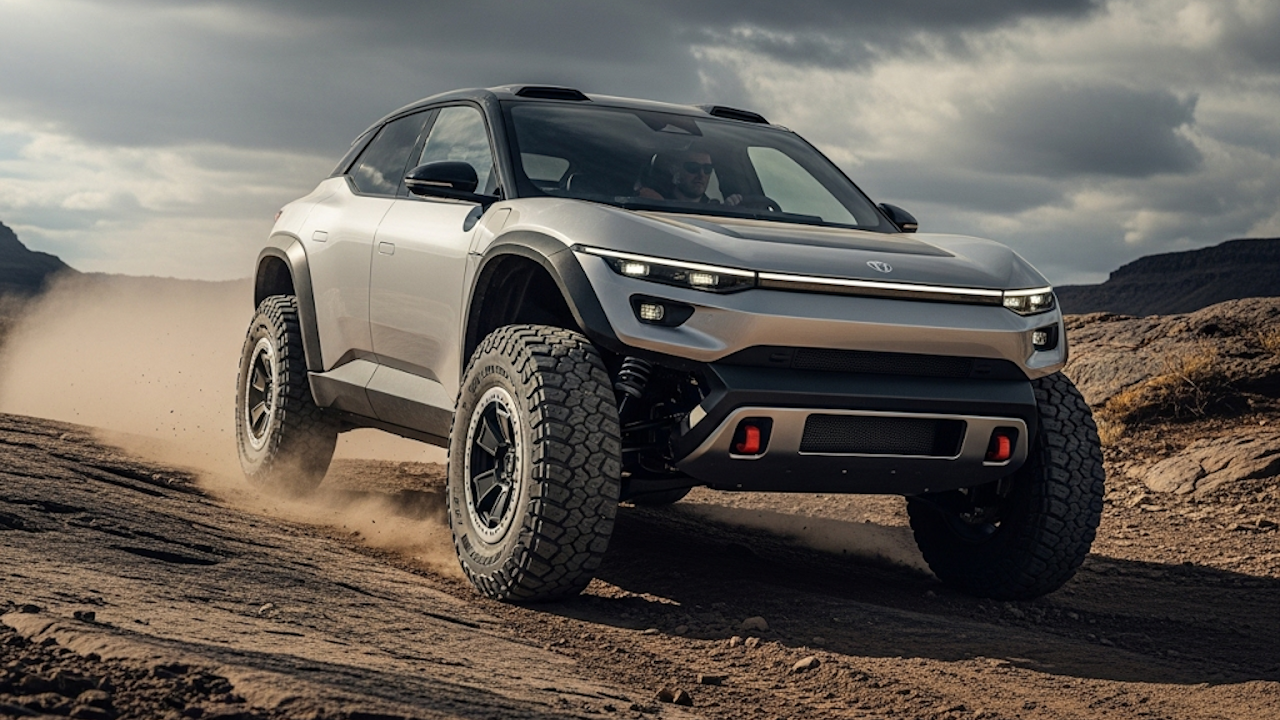
Electric vehicles have transformed everyday driving with their silent operation, instant acceleration, and lower operating costs. Yet when it comes to venturing beyond paved roads into the wilderness, skepticism persists. Can off-road electric vehicles truly conquer extreme terrains such as jagged rock formations, deep mud pits, shifting sand dunes, rushing water crossings, or icy mountain passes? The answer, based on extensive real-world testing and engineering advancements as of 2026, is a qualified yes. Purpose-built off-road EVs from manufacturers like Rivian, Tesla, GMC, Mercedes-Benz, and Ford demonstrate impressive capabilities that often match or surpass traditional internal combustion engine rivals in specific scenarios. However, challenges related to weight, range, and remote infrastructure remain significant hurdles. This article explores the technology, performance data, limitations, and future prospects of off-road EVs in demanding conditions.
The rise of off-road EVs reflects broader industry trends toward electrification combined with growing consumer interest in adventure travel. By 2026, models such as the Rivian R1T and R1S, Tesla Cybertruck, GMC Hummer EV, Mercedes-Benz G 580 with EQ Technology, and Ford F-150 Lightning have established themselves as legitimate trail contenders. Upcoming entries like the Jeep Recon, expected in late 2026, and the electric Range Rover further expand options. These vehicles leverage multiple electric motors, advanced software for terrain-specific modes, and robust battery protection to tackle obstacles that once required noisy, emissions-spewing engines. Unlike conventional off-roaders that rely on mechanical differentials and transfer cases, EVs distribute power instantaneously and independently to each wheel through torque vectoring. This precision enables feats such as virtual locking differentials or even CrabWalk modes that allow diagonal movement around obstacles.
Several inherent advantages position off-road EVs well for extreme terrains. First, electric motors deliver maximum torque from zero RPM, providing immediate traction without the lag of gear shifts or clutch engagement. In slippery mud or loose sand, this means wheels can grip and pull without spinning excessively. Quad-motor setups, as found in the Rivian R1T or GMC Hummer EV, allow independent control of each wheel, mimicking or exceeding the effect of mechanical lockers. Second, the heavy battery pack sits low in the chassis, lowering the center of gravity and enhancing stability on steep side slopes or during rock crawling. Third, regenerative braking offers precise speed control on descents, reducing brake fade and wear. Many models also include underbody armor, high ground clearance adjustable via air suspension, and specialized drive modes like Rock Crawl or Extract that optimize throttle response, suspension damping, and traction control. Quiet operation preserves the natural soundscape and allows drivers to hear approaching hazards, while features such as 360-degree cameras, including transparent hood views in the Mercedes G 580, aid navigation over unseen obstacles.
Real-world testing confirms these strengths across diverse extreme conditions. Consider the Rivian R1T and R1S, which have earned praise for rock crawling and water fording. In high ride-height modes, the R1T achieves up to 15 inches of ground clearance, with strong approach, departure, and breakover angles that enable it to scale steep ledges and navigate boulder fields without scraping. Testers have driven it through meter-deep water crossings and thick mud, where the instant torque and all-wheel-drive system kept momentum without bogging down. One review highlighted its performance on slippery rock piles near Lake Tahoe, where the quad-motor configuration and software-managed traction prevented wheel spin even on loose surfaces. Similarly, the vehicle maintained composure in sand dunes and snow, with energy consumption rising but remaining manageable thanks to efficient power delivery.
The Tesla Cybertruck demonstrates capability in sand and mud despite its angular stainless-steel exoskeleton. Tests in Qatar’s dunes showed it gliding through soft sand with ease, aided by off-road mode that raises suspension, firms damping, and engages virtual locking differentials. In mud puddles and shallow water, the vehicle forded depths up to tire-top level without issue, thanks to sealed battery packs and wade-mode features that protect electronics. Approach angles around 39 to 40 degrees in raised settings allow it to climb steep inclines, though its weight demands careful momentum management. Early skepticism about its off-road prowess faded as owners and reviewers documented successful runs on moderate trails, including rocky inclines and sandy hills.
The GMC Hummer EV stands out for sheer extremity. With up to 15.9 inches of ground clearance in Extract mode, 35-inch mud-terrain tires, full underbody armor, and CrabWalk capability, it tackles boulder-strewn paths that challenge even modified Jeeps. The Extreme Off-Road package adds locking differentials and undercarriage cameras for delicate rock crawling. Testers note its single-pedal driving excels on slickrock, providing fine control without abrupt inputs. Water fording reaches 32 inches, and the vehicle’s power allows it to extract itself from deep ruts where lighter trucks might stall.
Mercedes-Benz’s G 580 with EQ Technology brings luxury to the extreme. Equipped with four motors and independent suspension, it achieves 45-degree climb and descent angles, 35-degree lateral tilt, and 33.5 inches of fording depth. Real-world trials from Arctic Circle cold to Middle Eastern heat confirmed its durability, with a low-mounted, protected battery enabling confident water crossings and rock ascents. Transparent Hood camera technology gives drivers a virtual view beneath the front wheels, crucial for cresting blind obstacles. Its tank-turn function, rotating in place via counter-rotating wheels, proves useful in tight rocky confines.
Even the more mainstream Ford F-150 Lightning handles moderate off-road duties effectively. In off-road mode with rear differential lock, it climbs rocky inclines and packed-dirt hills with minimal wheel spin thanks to abundant low-end torque. However, its lower 8.9-inch ground clearance and highway-oriented tires limit it compared to dedicated rivals. It performs adequately in snow or light mud but struggles more in deep sand or extreme rock crawling due to weight and breakover angles. Still, its overland potential shines on fire roads and gentle trails, where regenerative braking aids controlled descents.
These successes stem from thoughtful engineering, yet off-road EVs face notable limitations in extreme terrains. Battery weight remains the primary concern. Many off-road EVs tip the scales at 7,000 to 9,000 pounds or more, roughly 30 percent heavier than equivalent gasoline trucks. This mass improves planted feel on pavement but causes sinking in soft mud or sand, increases stress on suspension components during drops, and complicates recovery if stuck. A bogged-down EV requires more effort to extract than a lighter internal combustion counterpart, and winch points or recovery gear must account for the added load. Heavier vehicles also demand stronger tires and wheels, which can further reduce efficiency.
Range anxiety intensifies off-road. Highway ratings promise 300-plus miles, but low-speed crawling, steep climbs, and accessory use like winches or climate control can cut real-world range by 14 to 20 percent or more. Sand dunes and mud exacerbate energy draw as the vehicle fights for traction. Remote trails lack charging stations, forcing reliance on portable generators, solar setups, or home base planning. Cold weather thickens battery electrolytes and reduces capacity, while extreme heat triggers thermal throttling to protect cells. Manufacturers mitigate this with advanced cooling systems, but prolonged exposure in deserts or high altitudes still shortens usable distance.
Durability and repairability pose additional risks. Sealed battery packs resist water and debris, yet field repairs remain complex without specialized tools or dealer support. Electronics and high-voltage systems require waterproofing ratings that most models meet for fording, but submersion beyond specified depths risks damage. Tire selection matters critically: swapping to aggressive all-terrain or mud-terrain rubber boosts grip but accelerates range loss due to higher rolling resistance. Ground clearance and angles vary widely; while Rivian and Hummer excel here, others like the Lightning require aftermarket lifts that further impact efficiency and warranty coverage.
Compared to traditional off-roaders such as the Jeep Wrangler or Toyota Land Cruiser, EVs offer superior low-speed torque and traction control but lag in long-distance self-sufficiency. Gasoline or diesel vehicles refuel quickly anywhere, carry spare fuel, and benefit from lighter curb weights for flotation in soft terrain. Hybrids and plug-in hybrids bridge some gaps by combining electric torque with range extenders. Nevertheless, EVs shine in controlled, high-torque scenarios like rock crawling or snow traversal, where their silent power and precise modulation reduce driver fatigue and environmental disturbance.
Looking ahead, innovations promise to address current shortcomings. As of 2026, solid-state and semi-solid batteries edge closer to production, offering higher energy density, faster charging, improved safety, and potentially lighter packs for the same range. Prototypes from companies like Toyota, CATL, and others target 400-plus watt-hours per kilogram, which could extend off-road range while reducing weight. Faster DC charging at rates exceeding 200 kilowatts shortens stops at trailhead stations. Software over-the-air updates continuously refine drive modes, traction algorithms, and energy management. Future models may incorporate swappable battery packs or integrated solar panels for emergency top-ups. Expanded charging networks, including off-grid solar or hydrogen hybrids in select concepts, will ease infrastructure woes.
In conclusion, off-road EVs can and do handle extreme terrains effectively, often delivering capabilities that surprise even seasoned enthusiasts. Models like the Rivian R1T, GMC Hummer EV, and Mercedes G 580 prove that electric powertrains excel in torque delivery, stability, and specialized features tailored for rocks, mud, sand, water, and snow. Their performance in documented tests across varied environments underscores rapid technological progress. Yet weight-induced traction loss, range constraints in remote areas, and repair complexities mean they are not universally superior to internal combustion alternatives for every expedition. Drivers must plan meticulously, select appropriate tires and accessories, and respect environmental limits. As battery technology advances and more rugged models enter the market through 2026 and beyond, off-road EVs will likely become the default choice for many adventurers seeking powerful, efficient, and exhilarating trail experiences. The future of off-roading is electric, provided infrastructure and engineering keep pace with ambition.