

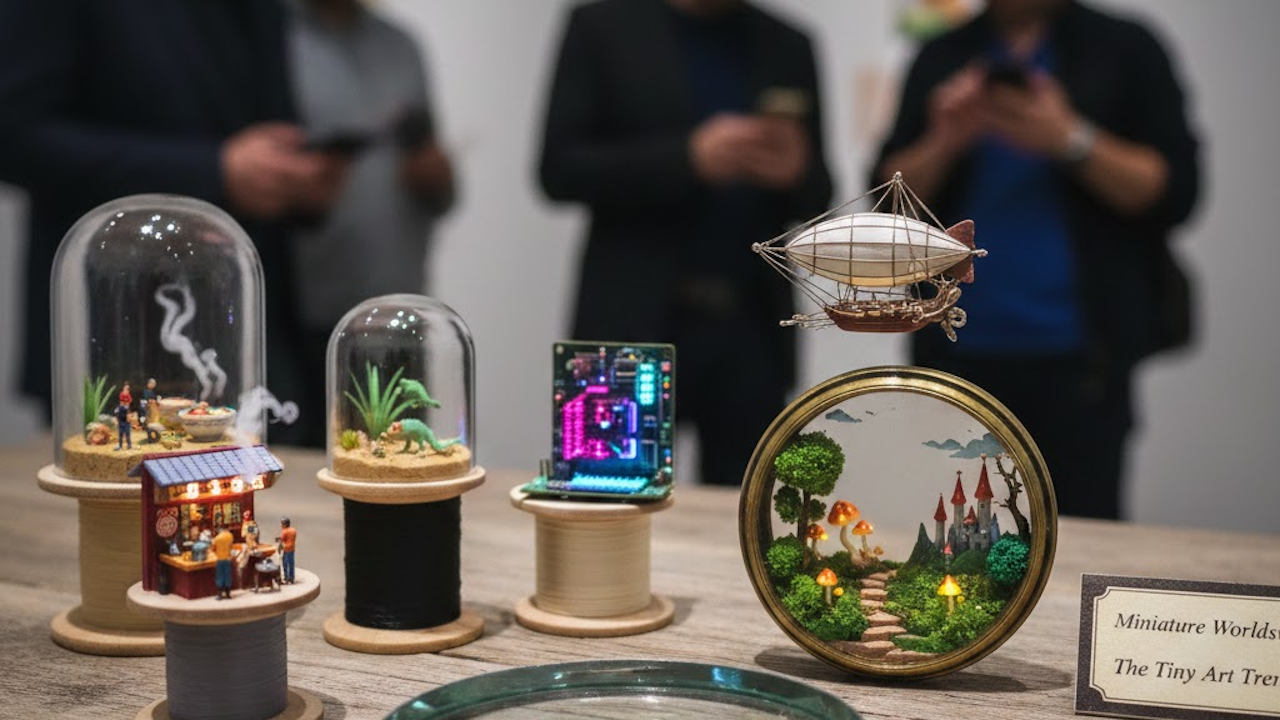
In a world often dominated by grand gestures and oversized spectacles, a quiet revolution is taking place in the realm of art. Miniature worlds, those intricately crafted tiny scenes and diminutive creations, have captured the imagination of artists, collectors, and enthusiasts alike. This trend, sometimes called tiny art or miniature dioramas, invites viewers to peer into self-contained universes where everyday objects transform into landscapes, stories unfold on a scale small enough to fit in the palm of a hand, and imagination reigns supreme. Far from being mere novelties, these small-scale artworks offer profound experiences of wonder, escapism, and meticulous craftsmanship.
The appeal lies in the contrast. While much of contemporary culture celebrates the monumental, miniature art whispers its stories. A tiny beach scene inside a jewelry box or a bustling city made from household items can evoke emotions as powerful as any large canvas. These works encourage close observation, fostering a sense of intimacy and discovery that larger pieces sometimes lack. As people seek balance in fast-paced lives, the patience required to create and appreciate these tiny worlds provides a meditative counterpoint.
A Rich Historical Tradition
The fascination with small-scale art is not new. Miniature painting has roots stretching back centuries. In Europe during the 16th century, portrait miniatures gained popularity as portable keepsakes, often painted on vellum or ivory. Artists like Nicholas Hilliard served royal courts, creating detailed likenesses that fit into lockets or small cases. These works served practical purposes as personal mementos in an era before photography.
By the 1700s, the demand for miniatures boomed across Europe and the American colonies. Wealthy patrons commissioned them as affordable alternatives to full-size portraits or as tokens of affection. The introduction of photography in the 19th century challenged this tradition, leading to a decline in commercial portrait miniatures. Yet the form persisted through revivals in the late 19th and early 20th centuries, influencing dollhouses, model trains, and other hobbies.
Contemporary miniature art builds on this legacy but expands it into new territories. Today, it encompasses not just paintings but three-dimensional dioramas, sculpted scenes, and mixed-media installations. Artists draw from historical techniques while incorporating modern materials and themes, ranging from whimsical daily life to commentary on society and environment.
The Modern Surge: From Galleries to Social Media
The current tiny art trend has accelerated in recent years, fueled by social media platforms like Instagram and TikTok. Creators share time-lapse videos of building intricate worlds, turning the process itself into engaging content. Everyday items such as food, office supplies, and craft materials become the building blocks for fantastical scenes.
One standout example is Japanese artist Tatsuya Tanaka, whose Miniature Calendar project has run daily since 2011. Tanaka repurposes common objects like bread slices as mountains, broccoli as forests, or circuit boards as urban landscapes, populating them with tiny figurines. His photographs capture playful recreations of everyday life, seasonal events, and cultural moments. Exhibitions of his work have drawn large crowds, proving that small can command big attention.
Other artists push boundaries in different ways. Thomas Doyle creates sealed dioramas depicting suburban scenes disrupted by disasters, inviting viewers to contemplate fragility from a god-like perspective. Sculptors like Joe Fig build precise miniature replicas of famous artists’ studios, offering insights into creative processes. Emerging creators experiment with walnut shells, matchboxes, or even digital tools to fabricate impossible tiny realms.
Tiny paintings have also gained traction. Postcard-sized or smaller canvases allow collectors to amass diverse collections without needing vast wall space. Galleries and art fairs report increased interest in small works, partly due to practical considerations like affordability and ease of display in modern homes.
Why Tiny Art Resonates Today
Several factors explain the popularity of miniature worlds in the 2020s. First, there is the therapeutic aspect. Building or viewing these scenes promotes mindfulness. The focus on minute details slows down the mind, providing relief from digital overload. Many describe the hobby as relaxing and addictive, with TikTok videos of miniature crafting amassing millions of views.
Sustainability plays a role too. Using recycled or everyday materials aligns with eco-conscious values. Instead of consuming large resources for massive installations, artists create impactful work with minimal footprints. This resonates in an age concerned with environmental impact.
Accessibility broadens the appeal. Professional tools are not always necessary; beginners can start with basic supplies like polymer clay, glue, and found objects. Online communities share tutorials, fostering a democratic creative space. For collectors, tiny art offers entry points into the art world without prohibitive costs.
Psychologically, miniatures tap into universal experiences. Childhood play with dollhouses or model kits echoes in adult appreciation. They evoke nostalgia while allowing exploration of complex themes in a contained, manageable format. Viewing a miniature world can inspire awe at human ingenuity and the beauty of scale.
The art market has taken notice. Small works challenge traditional notions of value tied to size. Some argue that the intimacy of miniatures creates stronger emotional connections. Exhibitions like “Small Worlds” at museums explore how artists use scale to evoke whimsy, dread, or reflection.
Techniques and Innovations in Miniature Creation
Creating miniature worlds demands precision and creativity. Artists employ various methods. Sculpting with polymer clay or resin allows for custom figures and landscapes. Photography plays a crucial role, with macro lenses and careful lighting enhancing realism. Some incorporate stop-motion animation for dynamic storytelling.
Innovations include hybrid approaches. Digital artists generate miniature-style images using AI, blending them with physical crafts. Others build immersive installations where viewers look through peepholes into hidden scenes. Materials range from traditional woods and metals to modern 3D-printed elements.
Challenges abound. Working at small scales requires steady hands, magnification tools, and patience for trial and error. Dust, breakage, and lighting inconsistencies complicate the process. Yet overcoming these yields satisfying results, as each detail contributes to the overall illusion.
Cultural Impact and Future Directions
Miniature art influences broader culture beyond galleries. It appears in film set design, video games, and interior decor. Tiny art walls in homes add personality to small spaces. Educational programs use miniatures to teach history, architecture, or ecology through tangible models.
The trend encourages cross-disciplinary collaboration. Scientists partner with artists to visualize microscopic worlds, while urban planners create scaled city models. In literature and illustration, books showcase fantasy miniature realms.
Looking ahead, the movement may evolve with technology. Virtual reality could let users enter digital tiny worlds. Sustainable and upcycled materials will likely gain prominence. As interest grows, more museums and festivals may dedicate space to small-scale exhibitions.
Getting Involved in the Tiny Art Movement
For those inspired to explore, starting is straightforward. Gather basic supplies: figurines, paints, glue, and a base like a shadow box. Begin with simple scenes, such as a tiny garden or room interior. Online resources, workshops, and communities provide guidance.
Collectors can seek out emerging artists at craft fairs, Etsy shops, or social media. Supporting the trend means valuing skill over size. Hosting miniature art swaps or creating group dioramas can build community.
Ultimately, miniature worlds remind us that profound beauty and meaning can exist in the smallest packages. In embracing the tiny, we rediscover the joy of looking closely, imagining freely, and finding universes within the ordinary. This trend, though small in scale, carries expansive potential to enrich lives and redefine artistic expression for years to come.