

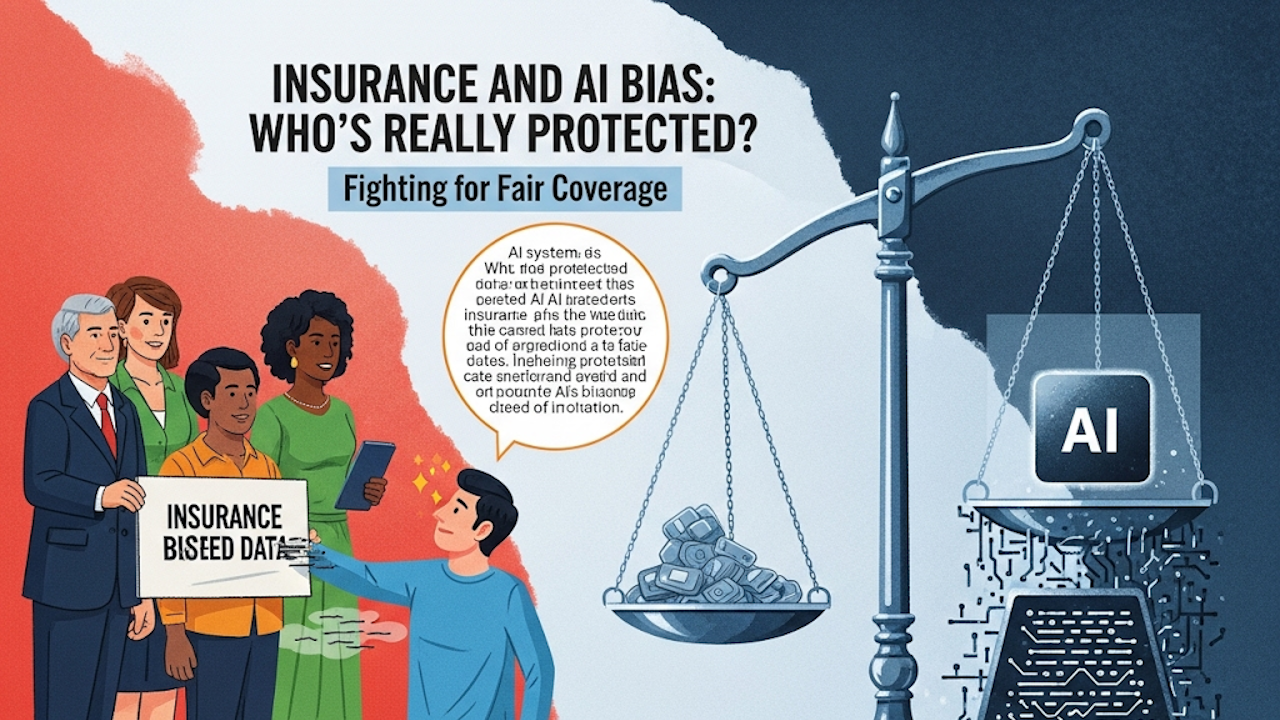
The insurance industry stands at a crossroads powered by artificial intelligence. Insurers now deploy AI systems to evaluate risks, set premiums, process claims, and detect fraud with unprecedented speed and scale. These tools promise greater efficiency, lower costs, and more personalized coverage for policyholders. Yet beneath the surface of this technological leap lies a persistent problem: AI bias. When algorithms trained on imperfect historical data make decisions about who gets coverage and at what price, they risk amplifying old inequalities rather than erasing them. The central question emerges clearly. In this new era of data-driven insurance, who is truly protected, the companies wielding the algorithms or the people who rely on them for financial security?
To understand the stakes, consider how deeply AI has embedded itself across insurance lines. In auto insurance, machine learning models analyze telematics data from connected vehicles, including speed, braking patterns, and even the time of day a driver travels. Health insurers use AI to scan medical records and prior authorization requests, flagging claims for review or outright denial in seconds. Life insurance underwriters feed vast datasets into predictive models that assess mortality risk based on everything from credit scores to social media activity and wearable health metrics. Property insurers rely on satellite imagery and property sensors to price homeowners policies down to the neighborhood block. Claims processing, once a labor-intensive manual task, now runs through automated systems that read documents, assess damage from photos, and recommend settlements. These applications deliver measurable gains. Fraud detection improves, underwriting cycles shrink from weeks to hours, and some low-risk customers enjoy lower premiums tailored to their actual behavior rather than broad demographic averages.
Yet the very data that fuels these advances often carries forward societal biases. AI does not invent prejudice; it learns from patterns in the information it receives. Historical insurance records reflect decades of unequal access to healthcare, employment, and safe housing. Credit scores, frequently used as a risk proxy, correlate strongly with income, race, and geography because of systemic economic disparities. Zip codes serve as shorthand for neighborhood risk, yet they frequently overlap with racial or ethnic concentrations shaped by past redlining practices. Even seemingly neutral variables such as driving habits or shopping preferences can act as indirect proxies for protected characteristics like gender or age. For instance, late-night driving patterns might signal higher risk in one model, but they could also reflect shift-work schedules more common among certain low-income or minority groups. When these correlations slip into algorithms unchecked, the result is not neutral efficiency but discriminatory outcomes dressed up as objective math.
Real-world cases illustrate how bias materializes in practice. In health insurance, automated systems have come under fire for denying claims at rates that appear to disadvantage certain patient groups. One prominent investigation revealed an insurer using an algorithm to reject a high volume of claims without human review, prompting a class-action lawsuit alleging the tool systematically undervalued medical necessity for chronic conditions prevalent in lower-income populations. In life insurance, models trained on past mortality data have shown tendencies to assign higher premiums or stricter underwriting to applicants from minority communities, even when controlling for traditional factors such as age and health history. The models sometimes interpret zip-code data or financial instability indicators as elevated mortality signals, leading to coverage denials or inflated rates that hit rural and low-income families hardest. Auto insurers have faced similar scrutiny. Algorithms analyzing vehicle color or commuting distance have occasionally functioned as stand-ins for gender or socioeconomic status, resulting in women or urban drivers paying more despite comparable safety records. One study of homeowners claims found discrepancies in handling times and settlement offers between Black and white policyholders, with AI-driven triage cited as a contributing factor in delayed processing for certain demographics.
These examples are not anomalies. They stem from fundamental limitations in how AI learns. Training datasets often underrepresent certain groups or embed past discriminatory practices. Proxy variables creep in because models optimize relentlessly for predictive accuracy without regard for fairness. Once deployed, the systems operate as black boxes, making it difficult for consumers to understand or challenge adverse decisions. Opacity compounds the harm. A policyholder denied coverage rarely receives a clear explanation beyond a generic risk score. Even regulators struggle to audit outcomes when the underlying logic remains proprietary. The result is a quiet erosion of trust: people feel priced out or shut out not because of their actual risk profile but because of statistical patterns that unfairly lump them with historical averages.
Insurers, by contrast, reap clear protections from AI adoption. The technology helps them reduce loss ratios by spotting fraudulent claims early and pricing policies with granular precision. Competitive pressures reward those who adopt AI fastest, as they can offer lower rates to the safest customers while charging higher premiums to those the models flag as riskier. Regulatory compliance becomes more manageable when automated systems log every decision for audit trails. Shareholders benefit from improved profitability and lower reserve requirements. In short, the companies gain tools that sharpen their competitive edge and shield them from some financial uncertainties. Policyholders, however, occupy a more precarious position. While some individuals with pristine data profiles enjoy cheaper premiums, others face higher costs or outright exclusion. Vulnerable populations, including racial minorities, women in certain occupations, low-income households, and residents of historically under-served areas, bear the brunt. They are the least likely to have the resources to shop around, appeal decisions, or provide supplemental data that might override algorithmic flags.
The regulatory environment attempts to restore balance, but progress remains uneven. In the European Union, the AI Act classifies insurance risk assessment and pricing systems for life and health coverage as high-risk applications. Providers must conduct rigorous data governance checks, test for bias, maintain technical documentation, and ensure human oversight. Fundamental rights impact assessments are mandatory, forcing companies to evaluate potential discriminatory effects before deployment. Transparency obligations require clear explanations to consumers affected by automated decisions. Across the Atlantic, the United States relies on a patchwork of state-level rules and existing anti-discrimination statutes. Colorado’s legislation requires insurers to test big-data systems, including algorithms, for unfair discrimination against protected classes. The National Association of Insurance Commissioners has issued guidance emphasizing fairness, accountability, and ongoing monitoring. Federal agencies such as the Consumer Financial Protection Bureau have signaled increased scrutiny of algorithmic bias in financial services, including insurance. Yet enforcement varies widely by jurisdiction, and many insurers still operate under voluntary frameworks or self-reported audits. Lawsuits serve as a blunt corrective force, as seen in cases targeting major carriers for alleged racial bias in claims handling or automated claim denials. These legal actions highlight gaps in oversight but also underscore how reactive rather than preventive most protections remain.
Mitigating bias demands deliberate effort throughout the AI lifecycle. Actuarial professionals recommend starting with diverse and representative training data, supplemented by techniques such as re-sampling to balance underrepresented groups. During model development, fairness constraints can be added to the objective function, penalizing outcomes that disproportionately harm protected classes. Post-deployment monitoring tracks performance drift and disparate impact across demographic segments. Explainable AI tools help surface which variables drive decisions, allowing human reviewers to intervene when proxies for sensitive attributes appear. Some carriers have begun conducting regular equity audits, simulating outcomes across hypothetical populations to surface hidden disparities. Third-party validation and collaboration with regulators further strengthen these safeguards. Behavioral data, such as telematics or wellness app information, offers one promising path forward because it focuses on individual actions rather than group averages, though even these inputs require careful scrubbing to avoid new proxies.
Despite these tools, challenges persist. Bias can re-emerge as societal conditions evolve or as models encounter fresh data. Complete elimination of statistical correlations between risk factors and protected characteristics is often impossible without sacrificing predictive power. Insurers face a tension between regulatory compliance and commercial incentives: overly cautious fairness adjustments might raise premiums across the board or reduce market competitiveness. Consumers, meanwhile, lack standardized rights to access their algorithmic profiles or demand corrections. The burden of proof frequently falls on the individual to demonstrate harm rather than on the company to prove fairness upfront.
Looking ahead, the trajectory depends on whether the industry treats bias mitigation as a core design principle or merely a compliance checkbox. If regulators tighten standards, mandate independent audits, and require plain-language explanations for all adverse decisions, AI could deliver genuinely fairer insurance by rewarding actual behavior over demographic stereotypes. Personalized policies might become more accessible, fraud reduced without punishing honest claimants, and overall market efficiency improved for everyone. Yet if oversight lags, the technology will continue to protect insurers’ bottom lines while leaving certain policyholders exposed to invisible discrimination. Low-income families, minority communities, and those in rural or high-risk areas may find themselves priced out or forced into residual markets with limited options. In that scenario, the promise of AI becomes a tool of exclusion rather than inclusion.
The question of who is really protected ultimately reveals a deeper truth about power in the insurance ecosystem. Companies control the data, the algorithms, and the narrative around risk. Consumers provide the personal information but rarely influence how it is interpreted or weighted. Regulators and courts offer important backstops, yet they respond after harm occurs rather than preventing it. True protection requires shifting the balance toward transparency, accountability, and shared governance. Insurers must embrace explainability and continuous fairness testing as competitive advantages rather than costs. Policymakers must harmonize rules across borders and lines of business to close loopholes. Consumers need education and easy mechanisms to review and contest AI-driven decisions. Only then can the industry claim that its AI systems protect everyone equally rather than entrenching the advantages of those already favored by the data. The technology is here. The choice now is whether insurance will use it to build a more equitable safety net or simply to reinforce the old one in faster, more opaque ways.