

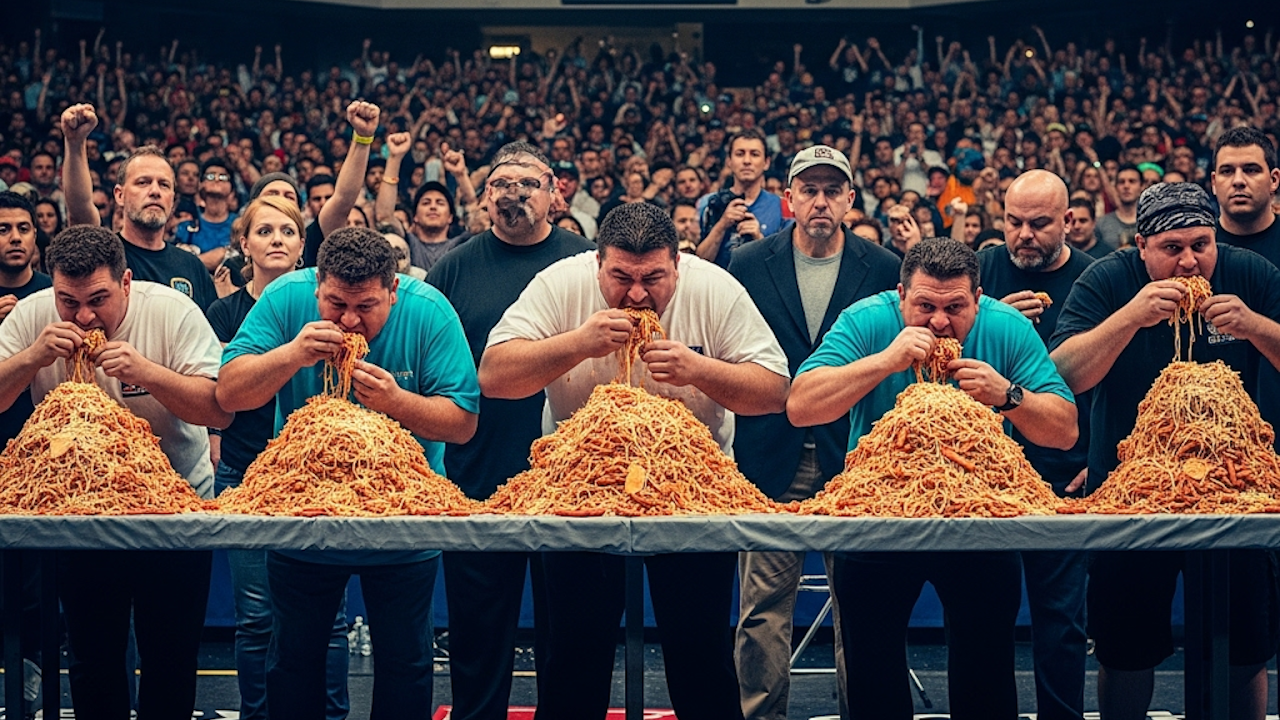
On a sweltering July afternoon in Coney Island, thousands pack the boardwalk as competitors line up behind long tables stacked with Nathan’s Famous hot dogs and buns. The air fills with the scent of grilled meat, mustard, and anticipation. A master of ceremonies in a loud suit hypes the crowd while timers tick down from ten minutes. What unfolds next is not a meal but a spectacle of human endurance pushed to grotesque extremes. Men and women, jaws working like industrial pistons, cram frankfurters into their mouths at a pace that defies biology. By the end, one champion will have devoured more than seventy hot dogs and buns, an amount that would feed a small family for days. This is the Nathan’s Famous International Hot Dog Eating Contest, the crown jewel of competitive eating, a sport that blends athleticism, showmanship, and sheer bodily defiance in ways few other activities can match.
Competitive eating, also known as speed eating, involves contestants racing to consume the largest quantity of a specific food within a fixed time, usually ten or twelve minutes. It is not casual overindulgence at a backyard barbecue. It is a regulated professional circuit governed by Major League Eating, the dominant sanctioning body in North America. Events span everything from hot dogs and chicken wings to pizza slices, tacos, and even moon pies. Prizes range from a few thousand dollars to the prestige of the mustard yellow belt awarded at Nathan’s. Yet beneath the carnival atmosphere lies a world that is equal parts disciplined training regimen, psychological warfare, and unsettling physiological experiment. Participants train their bodies to expand their stomachs far beyond normal capacity, suppress gag reflexes, and ignore signals of fullness that would stop most people cold. The result is a subculture that fascinates millions while raising eyebrows among doctors, ethicists, and casual observers who wonder why anyone would voluntarily subject themselves to such extremes.
The roots of competitive eating stretch back further than many realize, though the modern professional version is relatively young. Informal eating contests have appeared at county fairs and festivals for centuries, often as side attractions to test brute appetite. One oft repeated tale claims the Nathan’s contest began in 1916 when four immigrants on Coney Island held a hot dog eating duel to settle an argument about American patriotism. Historians have largely debunked the precise details as promotional myth crafted in the 1970s by publicists hoping to drum up interest. The event did gain traction around that time, however, when Nathan’s began hosting an annual Fourth of July showdown. Attendance grew steadily through the 1980s and 1990s, but it was the arrival of brothers George and Richard Shea that transformed the pastime into a structured sport. In 1997 they founded the International Federation of Competitive Eating, later rebranded as Major League Eating. The organization standardized rules, tracked records, secured television deals with networks like ESPN, and expanded the calendar to include dozens of events each year across the United States and Canada. What had been quirky local fun became a year round professional league complete with rankings, sponsorships, and global stars.
Today Major League Eating sanctions roughly seventy to eighty contests annually. The Nathan’s event remains the undisputed flagship, drawing live crowds of tens of thousands and millions more via broadcast. Other highlights include the Wing Bowl for chicken wings, the Taco Bell Taco Eating Championship, and specialized bouts featuring bratwurst, dumplings, or even entire pies. Each discipline demands its own technique. Hot dogs require rapid dunking in water to soften the buns, a practice known as “dunking” that aids swallowing speed. Wings involve meticulous stripping of meat from bone while minimizing waste. Pizza slices must be folded and gulped in ways that prevent choking. The league maintains detailed records for nearly every food type imaginable, from 47 slices of sixteen inch pizza in ten minutes to 53 soft beef tacos. These numbers are not abstract statistics. They represent hours of preparation, strategic pacing, and a willingness to push the human digestive system into uncharted territory.
At the pinnacle of this world stands Joey Chestnut, widely regarded as the greatest competitive eater of all time. The 42 year old from Westfield, Indiana, has claimed the Nathan’s title seventeen times, including a triumphant return in 2025 when he consumed 70.5 hot dogs and buns in ten minutes to reclaim the mustard yellow belt after missing the previous year due to a contract dispute. His all time record at the event stands at 76 hot dogs set in 2021, though he once downed an unofficial 83 in a separate Netflix special. Chestnut holds more than fifty world records across dozens of foods, a feat that underscores his versatility. He is not a hulking giant but a focused athlete who approaches contests with military precision. His dominance has defined the sport for nearly two decades, turning him into a household name and a symbol of American excess wrapped in competitive spirit.
Chestnut’s reign was not inevitable. For six straight years from 2001 to 2006, the throne belonged to Takeru Kobayashi, the Japanese phenomenon known as “The Tsunami.” Kobayashi revolutionized the sport with his innovative techniques and seemingly bottomless capacity. At just 160 pounds, he introduced the “Solomon method,” named after the biblical king who proposed splitting a baby in half, which involved breaking hot dogs in two before eating them separately from the buns. His six consecutive Nathan’s victories elevated competitive eating to international prominence and sparked a fierce trans Pacific rivalry. When Chestnut finally dethroned him in 2007, the contest went into overtime for the first time in history. Kobayashi later clashed with Major League Eating over exclusive contracts that restricted his ability to compete elsewhere. The resulting standoff kept him out of some marquee events, but his legacy as the godfather of modern speed eating remains intact.
Women have carved out their own formidable place in the sport, none more impressively than Sonya Thomas, nicknamed “The Black Widow.” Weighing around 100 pounds at the height of her career, Thomas defied expectations by out eating much larger male competitors. She claimed the first official women’s title at Nathan’s in 2011 with 40 hot dogs and buns and amassed dozens of records in other categories, including 57 Krystal burgers in one sitting. Her success highlighted a key insight in competitive eating: body size is not always the deciding factor. Smaller frames can sometimes process food more efficiently when trained properly, and Thomas’s speed and strategy made her a legend. Current women’s champion Miki Sudo has continued that tradition, winning multiple Nathan’s titles and proving the sport’s inclusivity across genders.
Other top ranked eaters round out the field. Patrick Bertoletti, currently ranked second overall, captured the 2024 Nathan’s contest with 58 hot dogs after Chestnut’s absence and consistently challenges for supremacy in wings, pizza, and more. Geoffrey Esper, James Webb, and Matt Stonie also feature prominently in league standings, each bringing unique strengths to different disciplines. These athletes are not weekend hobbyists. They maintain rigorous schedules, travel constantly, and treat eating contests as full time professions. Prize money, sponsorship deals, and appearance fees sustain them, though the financial rewards rarely approach those of mainstream sports. The real payoff is fame within a niche but passionate community.
Preparation separates the elite from the amateurs. Competitive eaters do not simply show up and gorge themselves. They follow structured training programs that stretch the stomach like a balloon. A common method involves consuming massive volumes of water, sometimes a gallon in under a minute, to expand gastric capacity without adding calories. Others practice with low density foods such as cabbage, watermelon, or oatmeal to simulate volume. Jaw exercises, including chewing on silicone tubing or multiple sticks of gum, build the endurance needed to chew at superhuman speeds. Mental conditioning is equally vital. Eaters learn to override the brain’s satiety signals and push through discomfort that would fell most people after the first few bites. Some visualize contests as battles against an invisible opponent, maintaining focus amid crowds and cameras. Diet between events is carefully managed to avoid permanent weight gain, though the caloric swings can be extreme. One contest might involve twenty thousand calories in ten minutes, followed by days of light eating and recovery.
The physiological toll is impossible to ignore. During a contest, the esophagus becomes a high speed conveyor belt shuttling barely chewed masses downward. The stomach balloons to several times its normal size, pressing against other organs and creating intense pressure. Choking remains the most immediate danger, with paramedics always on standby. Longer term risks include gastroparesis, a condition where the stomach loses its ability to empty properly, leading to chronic nausea and vomiting. Esophageal tears, acid reflux, and even potential ruptures have been documented in medical literature. Some former eaters report lifelong digestive issues or difficulty feeling full during regular meals. Despite these hazards, professional competitors insist they train responsibly and monitor their health. Major League Eating emphasizes safety protocols, yet critics argue the sport glorifies behavior that could prove disastrous for imitators. Amateur contests, especially those held at colleges or local fairs, have seen tragic outcomes including fatal choking incidents, underscoring the gap between trained athletes and casual participants.
What makes the entire enterprise so weird is the collision of celebration and revulsion. Crowds cheer wildly as eaters turn into human vacuum cleaners, yet the sight of half chewed food and bulging bellies can provoke equal parts awe and disgust. Nicknames add theatrical flair: “Jaws” for Chestnut, “The Tsunami” for Kobayashi, “Badlands” for Eric Booker. Commentators narrate the action like a boxing match, complete with blow by blow updates on bites per minute and strategic dunking. The events double as charity fundraisers, with Major League Eating partnering with organizations like Feeding America to highlight the paradox of excess alongside hunger relief. Fans debate technique online, analyze training videos, and attend live shows with the fervor of sports loyalists. It is performance art as much as competition, a celebration of American abundance that also invites uncomfortable questions about waste, gluttony, and bodily limits.
Controversies have shadowed the sport from its earliest days. Contract disputes, such as the one that sidelined Chestnut in 2024 over his sponsorship with Impossible Foods, reveal the business tensions beneath the fun. Animal rights groups occasionally protest events involving meat heavy foods. Health advocates warn that promoting speed eating normalizes dangerous habits for younger audiences. The league has faced accusations of exploiting athletes while downplaying long term medical consequences. Yet supporters counter that participants are consenting adults who understand the risks and that the sport provides entertainment, community, and even a strange form of empowerment. Kobayashi’s legal battles with the league highlighted issues of athlete autonomy versus organizational control. Similar debates arise whenever a new food challenge goes viral on social media, blurring the line between professional sport and reckless internet stunt.
Beyond North America, competitive eating enjoys pockets of popularity worldwide. Japan has a long tradition of food challenges, and Kobayashi’s success helped export the concept. Europe and Australia host occasional events, though none match the scale of Major League Eating’s circuit. Different cultures adapt the format to local favorites, from Korean noodle eating marathons to European sausage contests. The universal appeal seems rooted in primal fascination with appetite and human potential. Psychologists note that watching others consume vast quantities triggers a mix of schadenfreude and vicarious thrill. It taps into evolutionary wiring about scarcity and survival while subverting it in an age of plenty. For some observers, the sport mirrors broader societal obsessions with extremes, whether in athletics, entertainment, or consumption itself.
Looking ahead, competitive eating shows no signs of slowing. Major League Eating continues to expand its calendar with new disciplines and international qualifiers. Streaming platforms have broadened access, allowing fans worldwide to tune in live. Innovations in training science, nutrition, and even medical monitoring may help athletes mitigate risks while chasing higher records. The next generation of eaters is already emerging, studying footage of Chestnut and Bertoletti, experimenting with water loading techniques, and dreaming of their own mustard belts. Whether the sport evolves into a more mainstream athletic pursuit or remains a quirky niche depends on balancing spectacle with safety and ethics. One thing is certain: as long as humans possess both hunger and hubris, there will be those willing to test the outer edges of what a stomach can hold.
In the end, competitive eating is more than a sideshow of swallowed calories and stretched bellies. It is a mirror reflecting our complicated relationship with food, ambition, and the body. It celebrates excess while warning against it, entertains crowds while challenging medical norms, and turns the mundane act of eating into high drama. Step behind the mustard stained tables and you find not just athletes but performers, scientists of the self, and explorers of human limits. The weird world of competitive eating endures because it reminds us that sometimes the most ordinary things, like taking a bite, can become extraordinary when pushed to their furthest extremes.