

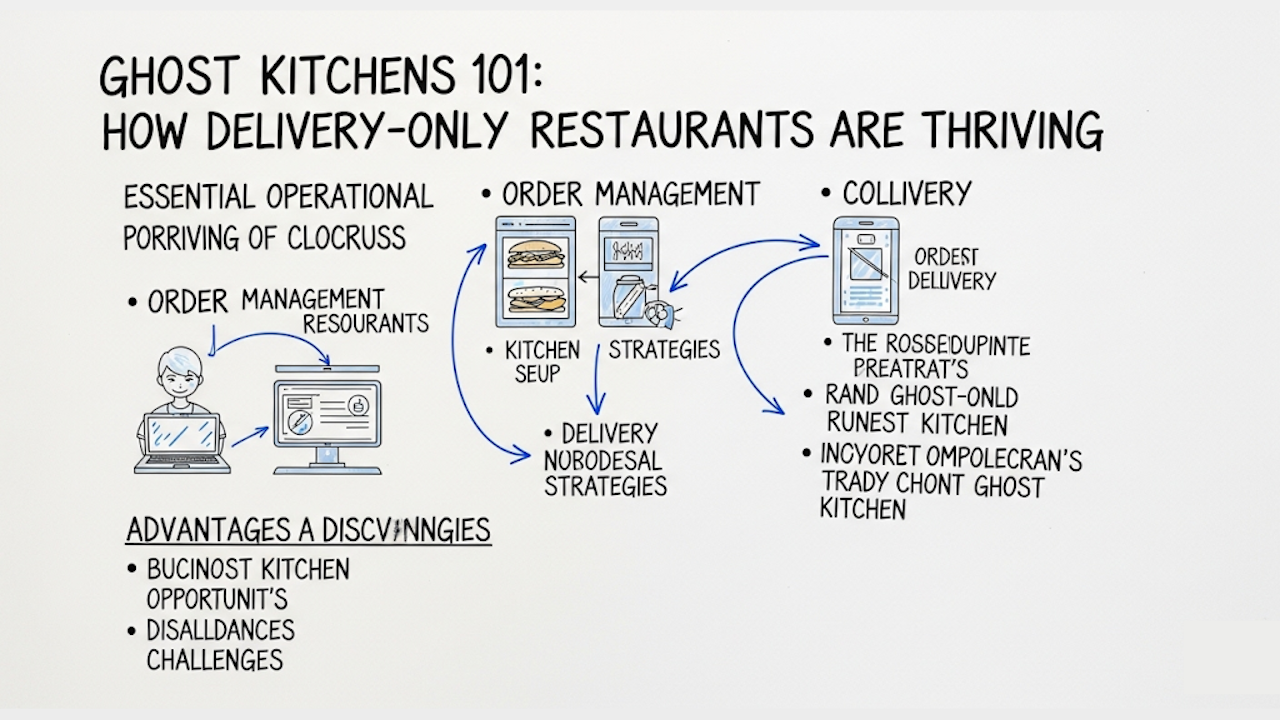
The restaurant industry has undergone a quiet revolution over the past decade. While traditional brick-and-mortar eateries continue to welcome guests for sit-down meals, a new breed of food business operates entirely behind the scenes. These are ghost kitchens, also known as cloud kitchens or dark kitchens. They produce meals solely for delivery and takeout, with no dining rooms, no waitstaff, and often no visible storefront. Customers order through apps like DoorDash, Uber Eats, or Grubhub, and the food arrives packaged and ready to eat. What began as a niche experiment has exploded into a global phenomenon. Industry estimates place the worldwide ghost kitchen market at around 97 billion dollars in 2025, with projections reaching over 200 billion dollars by 2030. This growth reflects more than just convenience. It signals a fundamental shift in how people eat, how operators run businesses, and how technology reshapes food service.
Ghost kitchens thrive because they strip away the costly elements of conventional dining. No prime real estate leases. No elaborate interiors. No front-of-house payroll. Instead, operators channel every resource into efficient food preparation and rapid fulfillment. The model delivers speed, scalability, and profitability potential that many full-service restaurants envy. Yet success demands precision. Operators must master logistics, menu design, and platform partnerships while navigating fierce competition and thin margins. This article breaks down the essentials of ghost kitchens, from their origins to their current momentum and the strategies keeping them viable in 2026.
Understanding the Ghost Kitchen Model
At its core, a ghost kitchen is a commercial cooking facility optimized exclusively for off-premise orders. Multiple independent brands or concepts can share the same physical space, each with its own menu, packaging, and online identity. A single warehouse might house a virtual burger joint, a salad concept, and an Asian fusion brand simultaneously. Orders stream in digitally, kitchen staff prepare them in dedicated zones, and drivers pick up the completed meals within minutes.
The concept predates the pandemic but gained explosive traction during COVID-19 lockdowns. When dine-in service halted, many restaurants pivoted to delivery by renting shared kitchen space. Delivery platforms actively courted these operations, offering visibility to millions of users. What started as survival quickly evolved into opportunity. Today, established chains like Wendy’s and Chick-fil-A experiment with ghost locations alongside independent entrepreneurs and celebrity-backed virtual brands such as MrBeast Burger.
Unlike traditional restaurants, ghost kitchens eliminate several layers of overhead. Startup costs can dip as low as 20,000 to 30,000 dollars for basic equipment and a lease in a shared facility. Traditional openings often exceed 100,000 dollars before the first customer arrives. Rent focuses on industrial or suburban locations rather than high-traffic retail strips. Staffing stays lean because there is no need for hosts, servers, or bussers. The entire operation centers on a handful of cooks, packers, and managers trained for high-volume, high-speed production.
The Economics Driving Profitability
The business model rests on three pillars: low fixed costs, high order volume, and data-driven optimization. Delivery commissions typically range from 20 to 30 percent per order, a significant slice that eats into revenue. Yet the savings elsewhere more than compensate for many operators. Real estate expenses drop dramatically without the need for customer-facing space. Utilities and maintenance remain lower because facilities stay compact and functional. Inventory management becomes tighter since menus can adjust in real time based on demand forecasts from platform analytics.
Many ghost kitchens operate multiple virtual brands from one location. This strategy maximizes kitchen utilization throughout the day. A breakfast concept might dominate mornings, followed by lunch burgers and dinner pastas. Each brand maintains its own branding on the apps, creating the illusion of separate restaurants. Customers rarely realize the meals originate from the same facility. This multi-brand approach spreads risk and boosts overall throughput.
Revenue streams extend beyond individual orders. Some operators partner directly with aggregators for preferential placement or launch subscription meal plans targeting busy professionals. Others focus on niche diets such as keto, vegan, or gluten-free options that command premium pricing. In markets like India, companies such as Rebel Foods run hundreds of cloud kitchens across multiple countries, scaling brands like Faasos and Behrouz Biryani to capture regional tastes while keeping operations centralized.
Break-even timelines shorten considerably. Where a full-service restaurant might need 12 to 18 months to turn profitable, a well-run ghost kitchen can achieve it in six months or less. The model rewards efficiency. Operators who invest in kitchen display systems, automated order routing, and predictive inventory tools gain a competitive edge. Artificial intelligence now forecasts peak hours, suggests menu tweaks, and minimizes waste, further protecting margins.
Key Factors Fueling the Boom
Several converging trends explain why delivery-only restaurants continue to expand despite post-pandemic normalization of dining. First, consumer habits have permanently shifted. Busy urban professionals and families prioritize convenience. Surveys consistently show that speed and reliability trump ambiance for many meals. Delivery volumes remain elevated even as indoor dining rebounds, particularly for lunch and late-night orders.
Second, technology lowers barriers. Food delivery platforms provide instant access to vast customer bases without expensive marketing campaigns. Integrated software handles order aggregation, routing, and customer communication seamlessly. Real-time analytics reveal which items sell best, at what times, and in which neighborhoods. Operators use this data to refine menus weekly rather than annually.
Third, real estate dynamics play a role. Many cities contain underutilized industrial spaces or former retail warehouses ripe for conversion. Providers like CloudKitchens, founded with involvement from former Uber leadership, transform these properties into turnkey facilities complete with equipment, utilities, and compliance support. Tenants simply plug in their recipes and branding. This plug-and-play infrastructure appeals to chefs, existing restaurant groups testing new concepts, and first-time entrepreneurs alike.
Fourth, scalability favors the model. A successful concept can expand to new cities by leasing additional kitchen slots rather than building from scratch. National chains use ghost kitchens to enter markets without committing to full build-outs. Independent operators launch in one location and replicate the formula once data proves demand. The flexibility also allows quick pivots. If a menu item underperforms, it disappears overnight without sunk costs in printed menus or signage.
Market projections reflect this momentum. Global estimates forecast sustained double-digit compound annual growth rates through the early 2030s, with particular acceleration in Asia and emerging urban centers. In India, the cloud kitchen segment alone is expected to triple in size by 2030, driven by rising smartphone penetration and changing lifestyles.
Real-World Success Stories
Several operators illustrate how the model delivers results when executed well. CloudKitchens operates facilities across dozens of cities, emphasizing operational discipline and technology integration. Their spaces support both independent brands and partnerships with established names. Rebel Foods in India stands out for its portfolio approach, managing thousands of kitchens under multiple labels while maintaining quality through centralized supply chains and training programs.
Virtual brands created specifically for delivery have also succeeded. Concepts like virtual fried chicken or specialized dessert lines thrive by focusing on items that travel well and photograph appealingly on apps. Celebrity involvement, such as high-profile burger launches, generates initial buzz that converts to repeat orders when the product meets expectations. Even traditional chains benefit. Quick-service giants deploy ghost kitchens to supplement drive-thru capacity during peaks or to test limited-time offerings without disrupting core operations.
Smaller operators succeed by niching down. A ghost kitchen specializing in healthy bowls might target fitness enthusiasts with subscription bundles. Another focusing on late-night comfort food capitalizes on evening surges. Success hinges on understanding local demographics through platform data and delivering consistent quality despite the invisible nature of the brand.
Navigating the Challenges
No business model is without hurdles, and ghost kitchens face distinct pressures. Delivery fees can erode profits unless volumes stay high. Food quality risks suffering during transit; packaging must maintain temperature and presentation. Customers expect the same standards as dine-in experiences even though the kitchen remains unseen. Negative reviews spread quickly on apps, damaging visibility.
Competition has intensified. Early movers enjoyed first-mover advantages, but saturation in major cities forces differentiation. Labor shortages affect kitchens just as they do traditional restaurants. Operators must train staff for speed, accuracy, and proper packaging under time constraints. Regulatory scrutiny is rising in some areas, with calls for clearer labeling of virtual brands and food safety oversight.
Some high-profile ventures stumbled after over-expansion. Projections once hailed ghost kitchens as inevitable disruptors, yet reality revealed limits. Delivery demand proved more price-sensitive than anticipated once lockdowns ended. Several large players closed locations or pivoted to software and licensing models. A reported 58 percent failure rate in certain cohorts underscores the need for operational excellence over hype.
Survivors adapt by emphasizing reliability. They invest in better packaging, real-time tracking, and direct ordering channels to bypass some commissions. Many build hybrid strategies, pairing ghost kitchens with limited physical pickup points or catering arms. Automation tools for cooking and packing are gaining traction, reducing labor costs while improving consistency.
Emerging Trends Shaping the Future
Looking ahead, ghost kitchens are evolving beyond basic delivery. Sustainability practices such as compostable packaging and waste-reduction systems appeal to eco-conscious customers. Kitchen automation promises faster throughput and lower error rates. Subscription services and meal kits represent new revenue avenues.
Integration with quick-commerce platforms, which promise 15-minute deliveries, pushes operators to locate even closer to dense neighborhoods. Artificial intelligence will refine demand prediction, personalized recommendations, and dynamic pricing. In smaller cities, lower real estate costs and growing delivery infrastructure create expansion opportunities previously overlooked.
The line between ghost and traditional models may blur. Some operators maintain a small storefront for pickup while running the bulk of volume through shared kitchens. Others use ghost facilities as testing grounds before committing to full restaurants. The model increasingly serves as a growth accelerator rather than a replacement for every concept.
Why Ghost Kitchens Represent Lasting Change
Ghost kitchens are not a fad. They embody a broader transformation in food service toward efficiency, convenience, and adaptability. By removing unnecessary costs and leveraging digital platforms, they make high-quality meals accessible to more people at more times. For operators, they lower risk and accelerate iteration. For consumers, they deliver variety and speed without compromise.
Thriving in this space requires more than cheap rent. It demands excellence in execution: precise operations, compelling menus that travel well, strong digital marketing, and relentless focus on customer feedback. Those who master these elements capture loyal followings and healthy margins. As the industry matures, the most successful ghost kitchens will blend technology, creativity, and operational rigor.
The delivery-only restaurant revolution is far from over. It is simply entering a more disciplined, sustainable phase. Whether you are an aspiring entrepreneur, an established restaurateur, or simply a curious diner, understanding ghost kitchens reveals the future of how we source, prepare, and enjoy food. The kitchens may remain unseen, but their impact on the culinary landscape is impossible to ignore.