

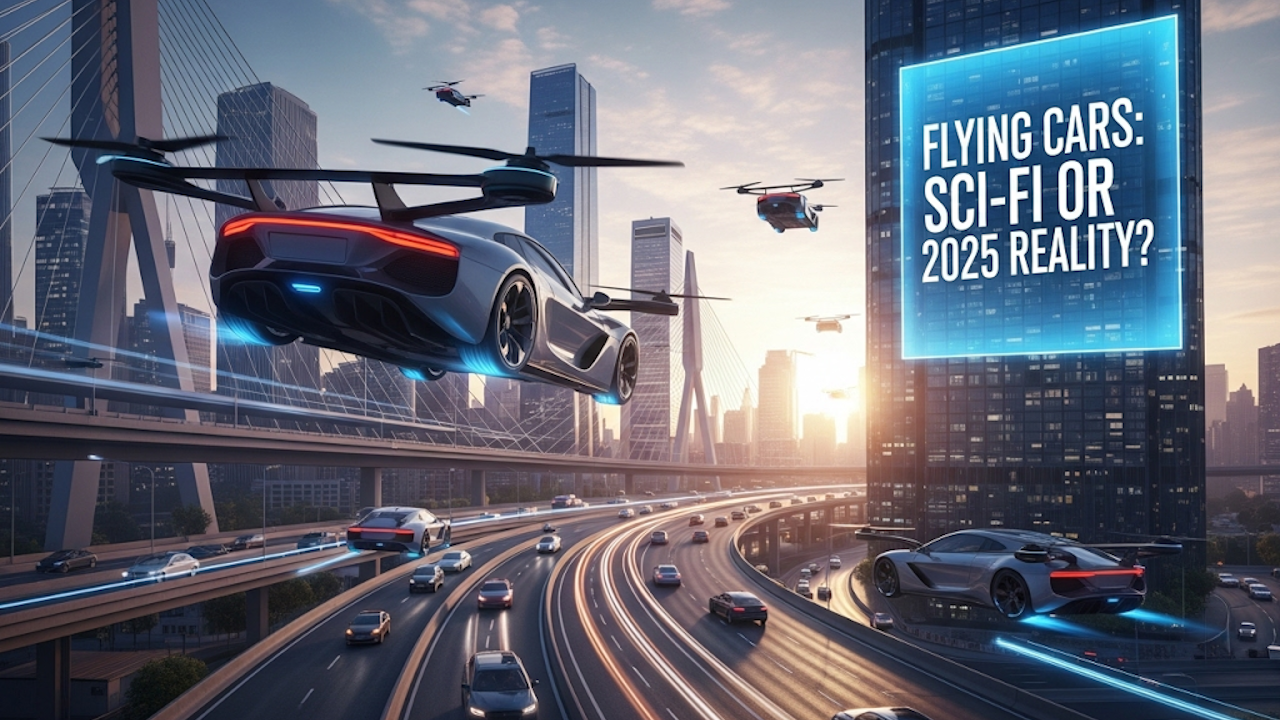
For generations, the dream of flying cars has fueled countless works of science fiction. Writers and filmmakers imagined sleek vehicles zipping between skyscrapers, bypassing gridlocked highways and turning commutes into effortless aerial adventures. Titles like “The Jetsons” and more recent blockbusters painted a world where personal flight was as ordinary as owning a sedan. Yet for most of the 20th century, the concept stayed locked in the pages of novels and on movie screens. Prototypes existed, but they were expensive, unreliable, and often more novelty than practical transport. Fast forward to the mid-2020s, and the question arises with fresh urgency: have flying cars crossed from sci-fi into everyday reality by 2025, or are they still years away from widespread adoption?
The answer, as of mid-2026, leans toward cautious optimism. Pure personal flying cars that double as road vehicles and require no special training remain rare and limited. However, a new class of electric aircraft known as eVTOLs, or electric vertical takeoff and landing vehicles, has moved from drawing boards to test flights and even early commercial trials. These are not quite the door-to-door personal flyers of fiction. Instead, they function more like sky-based taxis or shuttles, designed for short urban hops. Major companies have secured regulatory milestones, governments have launched pilot programs, and limited passenger services have begun in select markets. What was once dismissed as futuristic fantasy now appears poised for incremental rollout in 2026, though full-scale transformation of transportation systems will take longer.
To understand this shift, it helps to trace the evolution of the idea. The concept of flying automobiles dates back to the early 20th century. In the 1920s and 1930s, inventors experimented with roadable aircraft, vehicles that could drive on streets and then unfold wings for flight. One notable example was the Curtiss Autoplane from 1917, though it never entered production. Post-World War II enthusiasm surged with designs like the Convair Model 118 ConvAirCar in 1946 and the Taylor Aerocar in the 1950s. These hybrids promised freedom from roads, but practical hurdles proved insurmountable. Fuel inefficiency, complex mechanics, and safety concerns kept them from the masses. By the late 20th century, the dream had largely faded into hobbyist projects and occasional demonstrations.
The modern resurgence began in the 2010s, driven by advances in battery technology, electric motors, and autonomous systems. Companies realized that full roadability added unnecessary complexity and weight. Instead, they focused on dedicated eVTOL designs that take off and land vertically like helicopters but operate on battery power for quieter, cleaner flights. Pioneers such as Joby Aviation, Archer Aviation, and EHang drew inspiration from drone technology and electric vehicle breakthroughs. Uber’s now-defunct Elevate program in 2016 helped popularize the air-taxi vision, envisioning on-demand aerial rides within cities. Investment poured in from automakers, airlines, and venture capital. Suddenly, the industry had momentum, with prototypes flying at airshows and test sites worldwide.
Today, the leading players illustrate how far the sector has progressed. Joby Aviation stands out as one of the most advanced. In early 2026, the California-based company completed key Federal Aviation Administration milestones, including the first flight of its FAA-conforming aircraft and passage of a major design audit. Joby aims for limited commercial operations in 2026, with plans centered on Dubai and select U.S. locations. Its aircraft, a piloted four-passenger model, emphasizes safety through redundant systems and quiet operation. Archer Aviation follows a similar trajectory. The company has confirmed progress toward 2026 passenger flights, including participation in U.S. pilot programs and a launch in the United Arab Emirates. Archer’s Midnight model features 12 electric motors for redundancy and targets short hops between city centers and airports.
In China, EHang has taken an even bolder step by achieving commercial operations ahead of Western counterparts. Its EH216-S autonomous two-seater received certification for pilotless passenger flights, enabling paid services in select cities. While regulatory environments differ, EHang’s progress demonstrates that fully autonomous eVTOLs can carry people today under controlled conditions. European contender Lilium has reaffirmed targets for first customer deliveries in 2026, focusing on a jet-like eVTOL for regional routes. Meanwhile, smaller players like Pivotal offer a glimpse of personal ownership. Its Helix single-seat eVTOL went on sale for around 190,000 dollars, with deliveries possible within nine to 12 months for early reservers. These light aircraft target enthusiasts rather than daily commuters, but they represent a tangible product buyers can order now.
Technologically, these vehicles rely on several breakthroughs that make 2026 viability possible. Electric propulsion eliminates the noise and emissions of traditional helicopters. Distributed electric motors provide redundancy; if one fails, others compensate. Advanced batteries deliver sufficient energy density for 20- to 50-mile ranges, ideal for urban routes. Autonomous flight software, supported by sensors and artificial intelligence, promises safer navigation in crowded skies. Materials science has produced lighter composite structures, improving efficiency. Noise reduction remains a priority, with designs engineered to produce levels comparable to everyday traffic rather than the roar of rotorcraft.
Yet technology alone does not guarantee success. Regulatory approval forms the true gateway. In the United States, the FAA has moved deliberately. Full type certification for passenger-carrying eVTOLs requires exhaustive testing of structures, systems, and performance. Progress has accelerated through the eVTOL Integration Pilot Program, or eIPP, introduced in 2025. This initiative allows selected companies to conduct real-world operations in controlled settings across 26 states, even before final certification. Flights could begin as early as summer 2026 in places like New York, Florida, and Texas. The program tests integration with existing airspace, vertiport usage, and emergency procedures. Internationally, the European Union Aviation Safety Agency coordinates closely with the FAA on harmonized standards. In the UAE and China, streamlined processes have enabled faster timelines for demonstrations and launches.
Infrastructure presents another critical piece. Traditional airports cannot handle the volume of short-hop flights envisioned. Vertiports, compact facilities with charging stations and passenger terminals, are under construction. Dubai has completed the world’s first commercial vertiport adjacent to its main airport, ready for Joby operations in 2026. Cities such as Los Angeles have issued proposals for similar sites near major hubs. These facilities must support rapid charging, passenger screening, and seamless ground connections. Without a network of vertiports spaced 10 to 20 miles apart, eVTOL services cannot scale beyond niche routes.
Safety remains paramount and non-negotiable. Regulators demand multiple layers of redundancy and fail-safe mechanisms. Early test programs emphasize data collection on battery performance in extreme conditions, collision avoidance, and pilot or autonomous system reliability. Public acceptance hinges on proving that these vehicles are safer than ground alternatives for equivalent trips. Privacy concerns also arise: low-altitude flights over residential areas could raise questions about noise and surveillance.
Economic factors will shape adoption. Initial rides may cost 200 dollars or more for short trips, comparable to premium ground services. As fleets grow and manufacturing scales, prices could drop below 100 dollars. Job creation in aerospace, maintenance, and vertiport operations offers upside, but job displacement in traditional taxi and delivery sectors is possible. Broader societal benefits include reduced road congestion, lower emissions in urban cores, and faster emergency response. Medical transport and cargo delivery could benefit first, paving the way for passenger services.
Despite these advances, flying cars in the classic sci-fi sense, personal vehicles that drive on roads and fly at will, face steeper barriers. Hybrid designs add weight, cost, and regulatory complexity. Most experts agree that air taxis will arrive before true roadable flying cars reach consumers. Ownership models may evolve toward subscription or on-demand services rather than garage-kept personal flyers. Even optimistic projections place mass-market personal eVTOLs a decade or more away.
Looking ahead, 2026 marks a transitional year rather than a complete revolution. Pilot programs will generate real passenger data, refine operations, and build public trust. Success in Dubai or select U.S. cities could accelerate global rollout. Challenges such as airspace management, equitable access, and environmental impact will require ongoing collaboration among governments, industry, and communities. If these early efforts demonstrate safety and reliability, the trajectory toward broader integration becomes clearer.
In the end, flying cars are no longer pure science fiction. Elements of the vision have materialized through eVTOL innovation, regulatory creativity, and engineering persistence. By late 2026, riders in certain locales may experience their first aerial taxi rides, shaving minutes or hours off congested commutes. Yet the full promise of ubiquitous personal flight awaits further maturation. The journey from concept to reality has taken longer than futurists predicted, but steady progress suggests the sky is no longer the limit; it is the next frontier for practical transportation. Whether 2025 felt like arrival or merely the beginning depends on perspective. For those watching closely, it feels like the dawn of a new era in mobility, one careful flight at a time.