

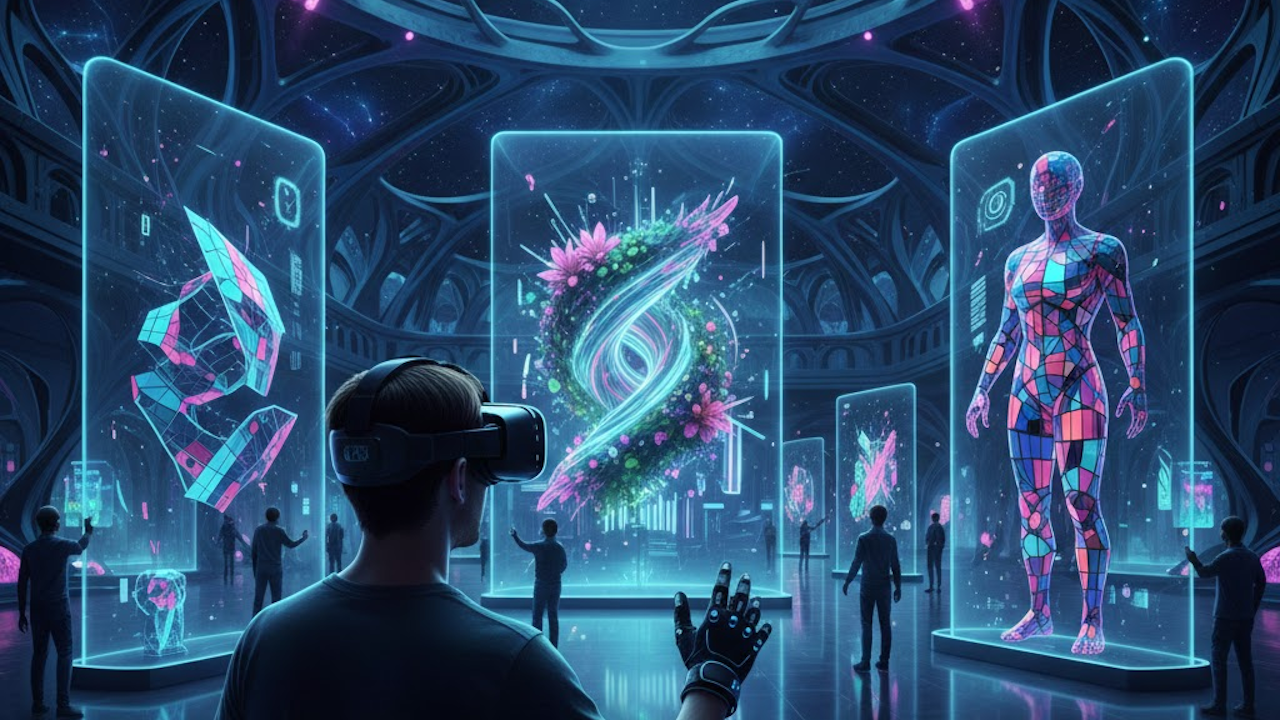
The metaverse has transformed how people gather, create, and experience culture. Among its most compelling applications is the rise of 3D art exhibits. These virtual spaces allow visitors to walk through digital galleries, circle sculptures that float or rotate freely, and interact with installations that respond to movement or sound. Unlike traditional museums bound by physical walls and fixed hours, metaverse exhibits exist in persistent shared worlds accessible from anywhere with an internet connection. They blend advanced 3D modeling, virtual reality or browser-based navigation, and often blockchain elements to create experiences that feel alive and participatory.
This shift represents more than technological novelty. It expands who can make art visible, who can encounter it, and what forms art can take. Artists no longer need physical gallery approval or shipping logistics. Viewers no longer face travel costs or mobility limits. The result is a vibrant ecosystem of platforms, exhibitions, and communities that push the boundaries of perception, ownership, and social connection through art.
The Evolution from Physical Galleries to Virtual Realms
For centuries, art exhibitions relied on physical presence. Viewers traveled to museums or galleries to stand before paintings and sculptures under controlled lighting. Conservation needs, security, and real estate costs restricted what could be shown and for how long. Early digital experiments, such as online catalogs and virtual tours during the pandemic, offered glimpses of broader access but remained largely two-dimensional and passive.
The metaverse changed the equation. Persistent 3D environments let users navigate as avatars, often alongside others in real time. Three-dimensional artworks can be examined from every angle, scaled dramatically, or even manipulated. Sound, animation, and interactivity become integral rather than supplementary. Blockchain technology introduced verifiable ownership through non-fungible tokens, enabling artists to sell digital pieces with built-in royalties and provenance.
Major institutions quickly took notice. Auction houses and museums began experimenting with virtual outposts. Independent creators built entire districts filled with experimental installations. What started as hype around 2021 has matured into sustained platforms where art thrives alongside social events, live performances, and educational programs. The metaverse does not replace physical spaces. It complements them by removing barriers and inviting new kinds of creative expression.
Key Platforms Powering 3D Art Exhibits
Several platforms have become central to this movement, each with distinct strengths.
Decentraland stands out as a decentralized, blockchain-powered virtual world. Users own land as NFTs and build upon it using accessible tools. Artists and curators construct galleries with custom lighting, music, and interactive elements. The platform has hosted major events such as Art Week, featuring dozens of new immersive works and live creator sessions. In 2021, Sotheby’s opened a virtual gallery there, replicating its historic London headquarters in the Voltaire Art District at coordinates 52,83. The space included multiple rooms for displaying NFTs and a digital greeter avatar.
The Sandbox offers similar land-ownership mechanics with strong emphasis on user-generated content and gaming integration. Its voxel-friendly tools appeal to creators focused on playful or architectural 3D environments.
VRChat provides a more social, free-to-enter experience. Thousands of user-created worlds function as galleries where avatars gather, chat, and explore elaborate installations together. Many spaces feature dynamic lighting, particle effects, and synchronized audio that enhance the sense of presence.
New Art City takes a different approach by prioritizing accessibility. This browser-based platform requires no headset or download. Artists use its toolkit to build custom 3D rooms and environments, upload GLB or GLTF models, integrate video and spatial audio, and design interactive narratives. Visitors navigate with keyboard or mouse controls, orbit objects, and move through interconnected spaces. The platform has hosted numerous experimental exhibitions exploring ecology, identity, technology, and climate themes, such as immersive worlds with digital dioramas or glitch-processed 3D forms.
Other notable options include OnCyber for polished, quick-setup NFT displays, Artsteps for straightforward VR exhibition building with uploaded 3D models, and Spatial for collaborative virtual rooms. Some platforms lean heavily on blockchain for ownership and transactions. Others focus on open creativity and lower technical barriers. Together they create a diverse landscape where different artistic visions find suitable homes.
Iconic Examples and Immersive Experiences
Concrete projects illustrate the medium’s potential. The Metropolitan Museum of Art partnered with Atopia to create two VR experiences. Dendur Decoded lets users explore a detailed 3D reconstruction of the Temple of Dendur, tracing its journey from ancient Nubia to the museum while examining carvings up close through interactive elements. Oceania: A New Horizon of Space and Time places fifteen objects from the Arts of Oceania collection inside a lush virtual environment evoking Pacific Islands. Visitors encounter contextual stories, sound, and imaginative future settings. Both experiences run in web browsers or on Meta Quest headsets, demonstrating how institutions can extend reach without requiring physical visits.
The Museum of Crypto Art operates as a decentralized institution dedicated to blockchain-native works. It maintains collections viewable across metaverse platforms, including immersive 3D rooms and community-driven exhibitions. Its Genesis Collection serves as a time capsule of early crypto art, featuring hundreds of pieces by pioneering digital artists. Visitors can walk through virtual spaces that highlight the intersection of technology, identity, and new forms of cultural production.
In Decentraland and similar worlds, independent artists have constructed districts filled with floating sculptures, responsive environments, and narrative-driven installations. VRChat hosts elaborate user-built galleries ranging from intimate rooms to vast conceptual spaces where multiple people explore simultaneously. New Art City continues to feature timely shows, such as ecological dioramas or interactive pieces addressing consumer culture through photogrammetry and LiDAR-scanned 3D objects.
These examples share a common thread. They treat space itself as part of the artwork. Lighting, scale, movement, and social presence become compositional elements unavailable in traditional settings.
The Distinct Advantages of 3D Metaverse Exhibits
Immersion stands as the primary draw. In a well-designed virtual gallery, viewers feel present. They can circle a sculpture, peer inside its structure, or watch it transform based on proximity or time of day. This level of engagement turns passive observation into active exploration.
Accessibility expands dramatically. Browser-based platforms eliminate the need for expensive headsets. Global audiences participate without flights, visas, or physical mobility. People with disabilities often find customizable interfaces and voice navigation more accommodating than crowded museum halls.
Interactivity and social connection flourish. Multiple avatars can occupy the same space, discuss works in real time, attend live artist talks, or collaborate on new pieces. Events blend exhibition viewing with performances and workshops.
Democratization lowers barriers for creators. Emerging artists bypass traditional gatekeepers by minting NFTs or simply uploading models to open platforms. Curators experiment with novel flows and juxtapositions impossible in physical rooms constrained by square footage.
Economic models evolve as well. Blockchain enables direct sales, ongoing royalties, and verifiable scarcity. Institutions explore new revenue through virtual tickets, digital memberships, and hybrid physical-digital offerings.
Artistic innovation accelerates. Creators develop works that change over time, respond to visitors, or exist only in virtual physics. Generative systems and real-time rendering open entirely new aesthetic territories.
Challenges That Remain
Technical hurdles persist. High-quality VR still demands capable hardware and stable connections. Some users experience motion discomfort. Building complex scenes requires learning curves even with improved tools.
Digital equity concerns are real. Reliable internet and devices are not universal. Platforms risk creating new exclusions even as they remove old ones.
Questions of authenticity arise. Can a digital replica convey the same emotional weight or historical aura as an original physical object? Many argue the virtual offers different but equally valid experiences centered on interaction and context rather than material presence.
Intellectual property issues grow complex in shared, editable spaces. Easy copying raises questions about attribution and control. Moderation of social behavior in anonymous environments demands ongoing attention.
Environmental considerations around blockchain energy use have prompted shifts toward more efficient consensus mechanisms, yet sustainability remains a topic of discussion.
Finally, commercialization can overshadow artistic intent. The excitement around NFTs sometimes prioritizes speculation over substance. Platforms and communities continue working to balance economic opportunity with meaningful cultural contribution.
How Artists and Curators Work in These Spaces
Creation typically begins with 3D modeling software such as Blender or Maya. Artists export optimized models in formats like GLB or GLTF for platform compatibility. Textures, animations, and interactivity are added through game engines or platform-specific builders. Lighting design becomes crucial for mood and focus in virtual environments.
Curators shape visitor journeys through spatial storytelling. They consider pacing, sightlines, audio cues, and opportunities for social encounter. Some exhibitions feature guided tours or embedded narratives that unfold as users explore. Community governance in decentralized platforms allows collective decision-making about land use and event programming.
Many creators operate across multiple platforms, adapting works or building parallel presences. Residencies and festivals provide structured support for experimentation and visibility.
Looking Ahead: Trends Shaping the Future
Artificial intelligence is accelerating content creation. Generative tools help produce 3D assets, environments, and even personalized exhibition paths. AI-driven guides or responsive artworks add layers of dynamism.
Hardware improvements continue. Lighter headsets, better haptics, and wider field-of-view displays will deepen immersion. Hybrid AR experiences may overlay digital art onto physical locations.
Interoperability efforts aim to let avatars and assets move more freely between worlds, reducing platform lock-in.
Educational applications are expanding. Virtual museums serve as interactive classrooms for art history, allowing students to examine artifacts in reconstructed contexts. Therapeutic and wellness uses of calming or meditative virtual spaces are also emerging.
Major institutions will likely deepen involvement, creating hybrid programs that link physical collections with metaverse extensions. Brands and independent creators will continue pushing aesthetic boundaries.
Regulation and standards will evolve around digital ownership, data privacy, and cross-platform compatibility. The most successful spaces will prioritize inclusive design and sustainable practices.
Conclusion
Three-dimensional art exhibits in the metaverse are not a fleeting trend. They embody a fundamental expansion of what art can be and who it can reach. By combining spatial immersion, real-time social interaction, and new economic models, these environments invite fresh ways of seeing, making, and connecting.
Physical museums and galleries retain irreplaceable value through material presence, historical weight, and communal ritual. The metaverse adds infinite canvas, global simultaneity, and participatory depth. Together they form a richer cultural ecosystem.
The invitation stands open. Step into a browser or headset. Wander through floating architectures. Circle a sculpture that exists only in code yet feels profoundly present. Engage with creators and fellow visitors from every corner of the world. The art of the metaverse is still young, still forming its conventions, and still full of possibility. Those willing to explore will help shape its next chapters.