

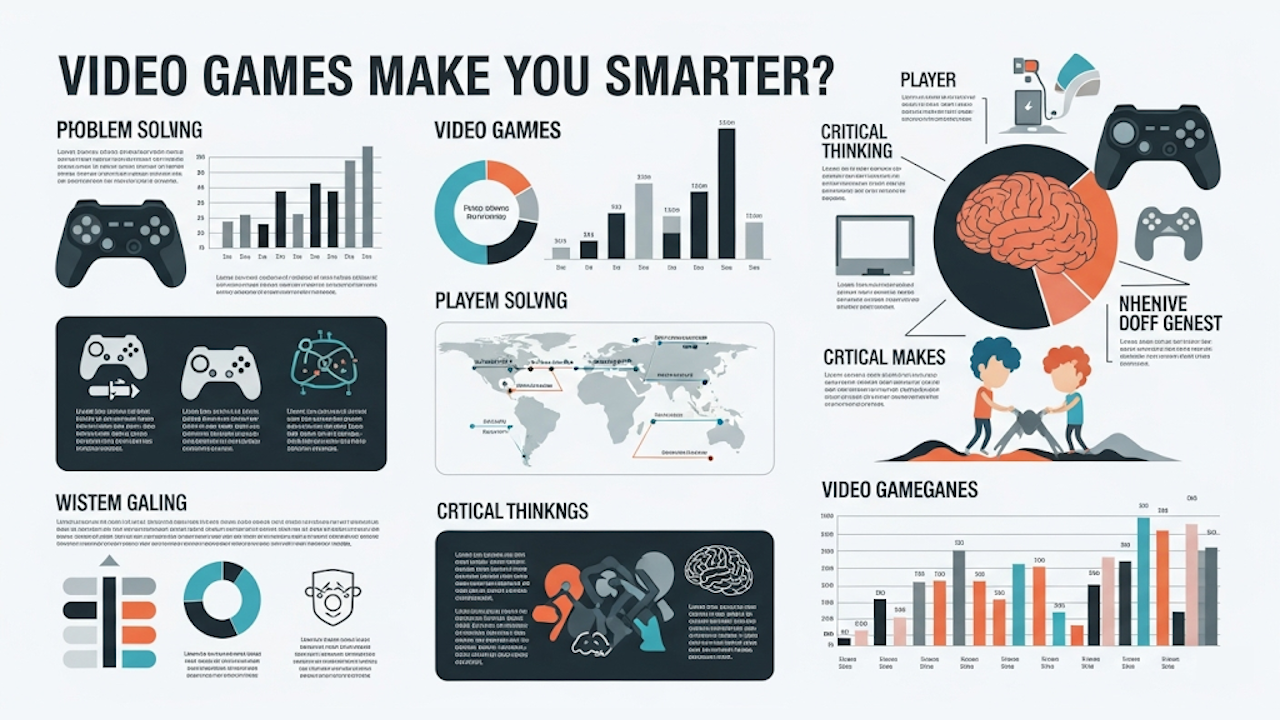
The question of whether video games make you smarter has sparked debate for decades. Parents, educators, and gamers themselves often wonder if hours spent in virtual worlds enhance cognitive abilities or simply waste time. Science provides a nuanced answer: video games, particularly certain genres played in moderation, can improve specific cognitive skills such as attention, spatial reasoning, processing speed, and problem-solving. However, they do not broadly increase general intelligence or IQ in a dramatic way, and excessive play carries potential downsides. Here is what the research actually shows.
Cognitive Benefits Supported by Evidence
Action video games, which include fast-paced titles with high demands on visual processing, quick decision-making, and multitasking, show the most consistent positive effects. Meta-analyses of cross-sectional studies reveal that habitual action game players outperform non-players on lab tests of cognitive skills by a large average effect size (Hedges’ g around 0.64). These advantages appear in areas like top-down attention, perceptual processing, spatial cognition, and multitasking.
Intervention studies, where non-gamers are randomly assigned to play action games for 8 to 50 hours, demonstrate smaller but causal improvements, with an average effect size of about 0.30 compared to control groups playing other games. This suggests that the act of playing can train and transfer skills to tasks outside the game, though the gains are modest and vary across individuals.
Specific enhancements include:
- Attention and visual processing: Action games improve the ability to distribute attention across space, track multiple moving objects, filter distractions, and process rapid visual streams. Players often show better selective, divided, and sustained attention. Early work established that gamers can localize peripheral targets amid distractors more accurately and exhibit reduced attentional blink (the temporary inability to notice a second target right after the first).
- Spatial reasoning and mental rotation: Games involving navigation, shooting, or building consistently boost performance on spatial tasks. A 2025 study from CU Boulder found small but significant benefits to spatial reasoning even after adjusting for baseline IQ, with effects on processing speed as well.
- Decision-making and sensorimotor skills: Frequent players display superior sensorimotor decision-making and enhanced brain activity in relevant regions, as shown in fMRI studies. They react faster in tasks measuring response inhibition and working memory.
- Working memory and executive functions: Some evidence links gaming to better performance on tasks involving temporary information holding and cognitive control, though results here are more mixed than for attention or spatial skills.
These benefits arise because action games create demanding environments that require constant adaptation, rapid learning of new mechanics, and efficient resource allocation. They train the brain in ways that simple “brain-training” apps often fail to match, as commercial brain games show negligible transfer to real-world cognition.
Intelligence and IQ: Small Gains in Children, Mixed in Adults
A prominent 2022 longitudinal study followed thousands of U.S. children from the Adolescent Brain Cognitive Development project. Kids who played video games above average amounts at ages 9-10 showed greater gains in intelligence measures two years later, equating to roughly 2.5 additional IQ points compared to peers. This held after controlling for genetics, socioeconomic status, and other screen activities like watching videos or social media, which showed no or minimal positive effects.
The NIH highlighted related findings: children playing three or more hours daily performed better on cognitive tests involving impulse control and memory. Other work ties skill in complex strategy games like League of Legends or Dota 2 to higher intelligence indicators.
In adults, a large-scale study found that frequent players (five or more hours per week on a single game type) performed cognitively like people 13.7 years younger on average, while infrequent players performed like those 5.2 years younger. Video gaming correlated with better cognition but not directly with mental health improvements (unlike physical exercise).
However, not all research agrees on broad intelligence boosts. Some meta-analyses report only weak or negligible correlations between video game experience and overall cognitive ability, with no strong evidence of far transfer to untrained domains like general fluid intelligence. One comprehensive review concluded that video game training does not enhance broad cognitive ability beyond the specific skills practiced. Gains often remain task-specific or modest.
Brain Changes and Mechanisms
Neuroimaging supports some structural and functional adaptations. Systematic reviews indicate that video gaming can alter brain regions involved in sensory perception, attention, memory, and reward processing. Action games may increase efficiency in visual and attentional networks, sometimes attenuating unnecessary prefrontal activity for more automatic processing.
fMRI studies show gamers with differences in cortical pathways for visual, attention, and memory tasks. Enhanced activity appears in areas handling decision-making. Yet excessive violent game play has been linked in some studies to reduced gray matter in certain regions or altered connectivity tied to aggression or self-esteem, though causality and replication vary.
Benefits seem driven by neuroplasticity: repeated challenge in rich, unpredictable environments strengthens neural pathways for learning, much like physical exercise builds muscle. Games provide immediate feedback, escalating difficulty, and high engagement, elements known to promote skill acquisition.
Potential Downsides and Moderation Matters
Not all effects are positive. Excessive gaming, especially addiction-like patterns, correlates with attention problems, higher depression and ADHD symptom scores in some studies, despite small cognitive gains. Overstimulation of the reward system via dopamine can lead to tolerance, reduced enjoyment of non-game activities, procrastination, or social withdrawal.
Violent games may temporarily reduce activity in prefrontal areas linked to emotion regulation and impulse control. Heavy play can disrupt sleep or displace physical activity and real-world social interaction, indirectly harming cognition and mental health.
A University of Houston study of fifth graders found no meaningful link between play duration or genre and cognitive test scores, challenging blanket assumptions of harm or benefit in preteens. Heterogeneity in research is high: effects depend on game type (action and strategy games fare better than others), dosage, player age, and individual differences.
Publication bias appears in some cross-sectional data, inflating apparent benefits, while intervention effects are smaller and more robust to bias checks.
21st-Century Skills and Broader Applications
Beyond narrow cognition, digital games show medium overall effects on skills like critical thinking (large effect), communication, collaboration, and creativity (smaller effects), according to a 2025 meta-analysis of 37 studies. Strategy and puzzle games may particularly support planning, flexibility, and problem-solving.
Educational or “serious” games leverage these mechanics for targeted training, with benefits for older adults’ memory and cognition as well.
What Science Says Overall
Video games do not turn players into geniuses or reliably raise general IQ across the board. Claims of massive intelligence gains lack strong support. Yet the evidence clearly indicates that certain games, especially action-oriented ones, can enhance specific cognitive functions: faster processing, better attentional control, improved spatial abilities, and modest boosts in learning efficiency. These improvements can transfer modestly to real-world tasks and may accumulate over time, particularly in developing brains.
A 2023 meta-analysis concluded that action video game play is causally related to cognitive skill improvements, encouraging further work on game design for training. Longitudinal data in children suggest gaming can contribute positively to intelligence trajectories when it displaces less stimulating screen time.
The key variables are moderation, game choice, and balance with other activities. Playing 1-3 hours daily of engaging titles appears more beneficial than none or excessive amounts. Action and complex strategy games offer more cognitive bang than passive or hyper-casual ones. Combining gaming with exercise, sleep, and social interaction maximizes upsides while minimizing risks.
In short, video games train the brain like a simulator trains pilots: targeted skills improve through deliberate practice in dynamic settings. They are not a magic bullet for smarts, but neither do they “rot” the brain when approached thoughtfully. Science supports viewing quality gaming as one tool among many for cognitive maintenance and enhancement across the lifespan. Future research will likely refine which mechanics drive benefits and how to optimize games for broader transfer. Until then, the data favor a balanced perspective: games can make aspects of your thinking sharper, but real-world application and variety remain essential.