

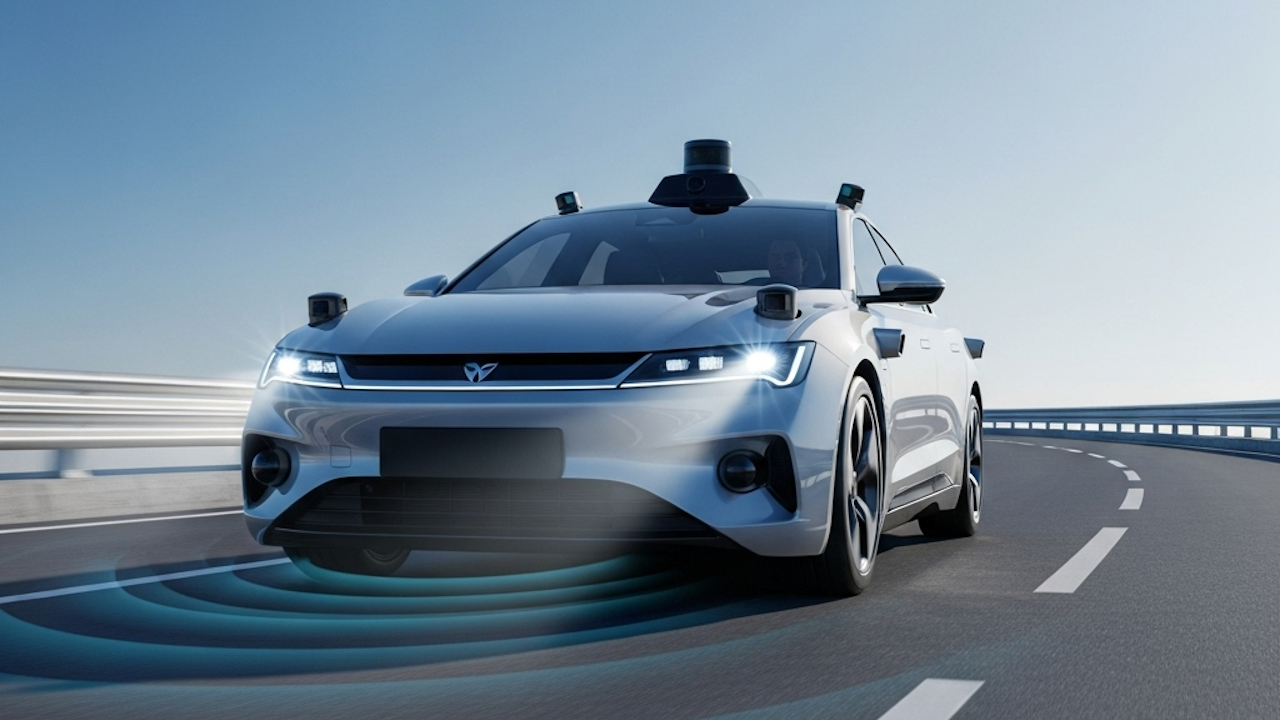
Autonomous driving has moved from science fiction to everyday reality in select corners of the world. By May 2026 robotaxis without human drivers ferry passengers through major cities in the United States and China. Consumer vehicles equipped with advanced driver assistance systems handle complex maneuvers on highways and city streets with minimal input. Yet true full self-driving, often called Level 5 autonomy, remains elusive. Vehicles can operate independently only under tightly controlled conditions or with constant human supervision. This article examines the current state of autonomous driving technology, the gap to complete self-driving capability, the obstacles that persist, and what the next few years may bring.
To understand progress it helps to start with the standard framework used by the industry. The Society of Automotive Engineers defines six levels of driving automation. Level 0 means no automation at all; the driver performs every task. Level 1 adds basic assistance such as adaptive cruise control or lane-keeping. Level 2 combines these into partial automation where the system can steer, accelerate, and brake simultaneously but the driver must remain fully attentive and ready to intervene at any moment. Most advanced consumer systems today, including Tesla’s Full Self-Driving (Supervised), fall into this category even if marketing language sometimes suggests otherwise.
Level 3 allows the driver to take eyes off the road in specific situations such as highway traffic jams, but the human must stay alert and resume control within seconds when prompted. Level 4 represents high automation where the vehicle handles all driving tasks within a defined operational design domain such as a mapped city or highway corridor and no human driver is required inside the vehicle. Level 5 is full automation with no restrictions on geography, weather, or time of day; the vehicle performs every task in every condition without any human fallback. Reaching Level 5 would mean cars could drive themselves anywhere a human could, any time, without steering wheels or pedals in some designs.
The journey toward these higher levels began decades ago. Early experiments in the 1980s and 1990s demonstrated basic lane following and obstacle avoidance. The DARPA Grand Challenges in the mid-2000s accelerated development by pitting university and industry teams against desert and urban courses. Google (now Alphabet) launched its self-driving car project in 2009, which evolved into Waymo. Tesla introduced Autopilot in 2014 and later rebranded its more advanced suite as Full Self-Driving. Traditional automakers such as Mercedes-Benz, General Motors, and Ford invested billions in their own programs. Chinese companies like Baidu entered the field aggressively, leveraging dense urban environments and supportive government policies. By the early 2020s pilot programs had begun, but widespread commercial deployment remained years away. The pace quickened dramatically between 2024 and 2026 as data from millions of miles of real-world driving fed ever more capable artificial intelligence models.
In 2026 the landscape shows clear leaders in two distinct categories: robotaxis operating at Level 4 and advanced driver assistance systems at Level 2 or limited Level 3. Waymo stands out as the most mature robotaxi operator in the United States. The company now provides service in ten cities including San Francisco, Los Angeles, Phoenix, Atlanta, Austin, Miami, Dallas, Houston, San Antonio, and Orlando. It delivers hundreds of thousands of paid rides each week and aims to reach one million weekly rides by the end of the year. Vehicles operate without a safety driver in geofenced areas, using a combination of cameras, radar, and lidar sensors. Waymo has accumulated more than one hundred million miles of autonomous driving experience. Expansion continues into colder climates such as Denver and Indianapolis, and international testing has started in Tokyo and London with commercial launches targeted for late 2026.
In China Baidu’s Apollo Go service matches or exceeds Waymo’s scale in some metrics. It provides roughly two hundred fifty thousand weekly rides across multiple cities and has logged more than one hundred forty million driverless miles. However, a significant outage in Wuhan in late March 2026, when dozens of robotaxis suddenly stopped mid-traffic and caused minor collisions, prompted authorities to suspend new autonomous vehicle permits nationwide while investigations continue. This event highlights the fragility of large-scale deployments even in a regulatory environment that has generally favored rapid rollout.
Tesla pursues a different strategy. Rather than building dedicated robotaxi fleets from scratch, the company relies on its existing customer vehicles equipped with cameras and neural network software. Full Self-Driving (Supervised) version 14 has reached impressive maturity. Owners report using it for more than ninety-nine percent of their driving in many cases, and the fleet has collectively driven more than ten billion miles under the system. The latest updates improve handling of low-light conditions, emergency vehicles, unprotected turns, and pedestrian interactions. Tesla has begun limited unsupervised testing in Texas and plans to expand robotaxi operations to additional cities throughout 2026. Production of the steering-wheel-free Cybercab has started, and the company expects fully autonomous vehicles to operate across twenty-five to fifty percent of the United States by the end of the year, subject to regulatory approval. Elon Musk has predicted millions of Teslas operating fully autonomously in the second half of 2026.
Other players occupy supporting roles. General Motors shifted away from its Cruise robotaxi unit after setbacks in 2024 and now focuses on integrating the technology into personal vehicles through Super Cruise, a hands-free Level 2 system available on more than twenty models. Mercedes-Benz offers the only approved Level 3 system in the United States with DRIVE PILOT, which allows eyes-off driving in low-speed highway traffic under strict conditions. Ford, BMW, and several Chinese manufacturers provide competitive Level 2-plus features, but none have scaled unsupervised robotaxis to the extent of Waymo or Baidu.
Technological progress rests on several pillars. Vision-only systems like Tesla’s use cameras and end-to-end neural networks trained on vast real-world data. Multi-sensor approaches like Waymo’s combine lidar for precise distance measurement, radar for velocity in poor weather, and high-definition maps. Compute power has improved dramatically with specialized chips that deliver the massive parallel processing required for real-time decision making. Simulation environments allow companies to test billions of edge-case scenarios without risking real vehicles. Over-the-air updates mean improvements deploy instantly to thousands of cars rather than requiring physical recalls.
Despite these advances several stubborn challenges keep Level 5 out of reach. The long tail of rare events remains the biggest technical hurdle. Systems perform flawlessly in ordinary conditions but struggle with unusual combinations such as construction zones at night during heavy rain combined with erratic pedestrian behavior. Achieving the nine-nines reliability (99.9999999 percent) needed for public roads without human backup demands orders of magnitude more data and validation than current fleets have collected. Artificial intelligence still lacks robust common sense; it can recognize patterns but may fail to infer intent or predict novel situations the way humans do intuitively.
Hardware costs present another barrier. Lidar units and high-end sensors remain expensive, limiting widespread consumer adoption. Energy consumption for onboard computers is high, which affects range in electric vehicles. Infrastructure readiness varies wildly; many roads lack clear markings, smart traffic signals, or vehicle-to-infrastructure communication that could ease decision making. Weather extremes, from blizzards to sandstorms, continue to degrade sensor performance.
Regulatory and liability issues complicate deployment further. Different countries and even states within the United States maintain inconsistent rules. Some jurisdictions require safety drivers, others allow fully driverless operations only in approved zones. Questions of responsibility loom large: when an accident occurs, is the manufacturer, the software developer, the vehicle owner, or the remote operator at fault? Insurance models are evolving, but courts have yet to establish clear precedents for Level 4 and Level 5 systems. Public trust also lags. Surveys indicate persistent concern about hacking, software glitches, and the loss of personal control. High-profile incidents, even if statistically rare, receive outsized attention and can slow regulatory momentum.
Safety statistics offer a mixed picture. Human drivers cause roughly ninety-four percent of crashes through error or inattention. Autonomous systems already demonstrate lower collision rates per mile in supervised testing, sometimes by factors of seven or more. Yet proving superiority across every possible scenario requires billions more miles of data. Critics argue that the final one percent of improvement may prove exponentially harder than the first ninety-nine percent.
Economically the stakes are enormous. Robotaxis could transform urban mobility by reducing congestion, lowering ownership costs, and providing accessible transport to those who cannot drive. Trucking companies eye driverless freight for long-haul routes, potentially cutting labor costs dramatically. On the downside, millions of jobs in driving-related fields could disappear. Automakers face pressure to justify huge research and development investments while competing with software-first companies like Tesla and Waymo. Consumer pricing for full autonomy features remains high, restricting access to premium vehicles for now.
Looking ahead to the remainder of 2026 and beyond, several trends appear likely. Robotaxi services will expand geographically and in volume, particularly in the United States and China. Waymo’s push toward one million weekly rides and Tesla’s rollout of unsupervised capability in approved regions could mark a tipping point where autonomous rides become commonplace in daily life rather than novelties. Level 3 systems will proliferate in luxury consumer cars, allowing limited eyes-off driving on highways. By 2027 or 2028 broader Level 4 corridors may open for personal vehicles on major interstates.
True Level 5 autonomy, however, will probably arrive later. Most analysts project widespread unrestricted self-driving capability in the early to mid-2030s at the earliest. Achieving it will require continued breakthroughs in artificial intelligence generalization, cheaper and more reliable sensors, harmonized global regulations, and extensive real-world validation. Optimists point to the exponential growth of training data and compute power. Skeptics emphasize the inherent unpredictability of the physical world and the difficulty of certifying systems for every conceivable edge case.
In summary, autonomous driving has progressed farther and faster than many predicted even five years ago. Level 4 robotaxis already serve real customers in multiple cities, and advanced Level 2 systems feel nearly magical to many drivers. Yet the dream of full self-driving cars that require no human attention anywhere remains several years distant. The technology is close enough to excite and transform parts of transportation today, but the final miles to complete autonomy will demand patience, rigorous safety standards, and careful navigation of technical, regulatory, and societal obstacles. The coming decade will reveal whether autonomous vehicles become a seamless extension of modern life or remain a promising but imperfect tool confined to specific domains. The road ahead is long, but the destination appears increasingly within sight.