

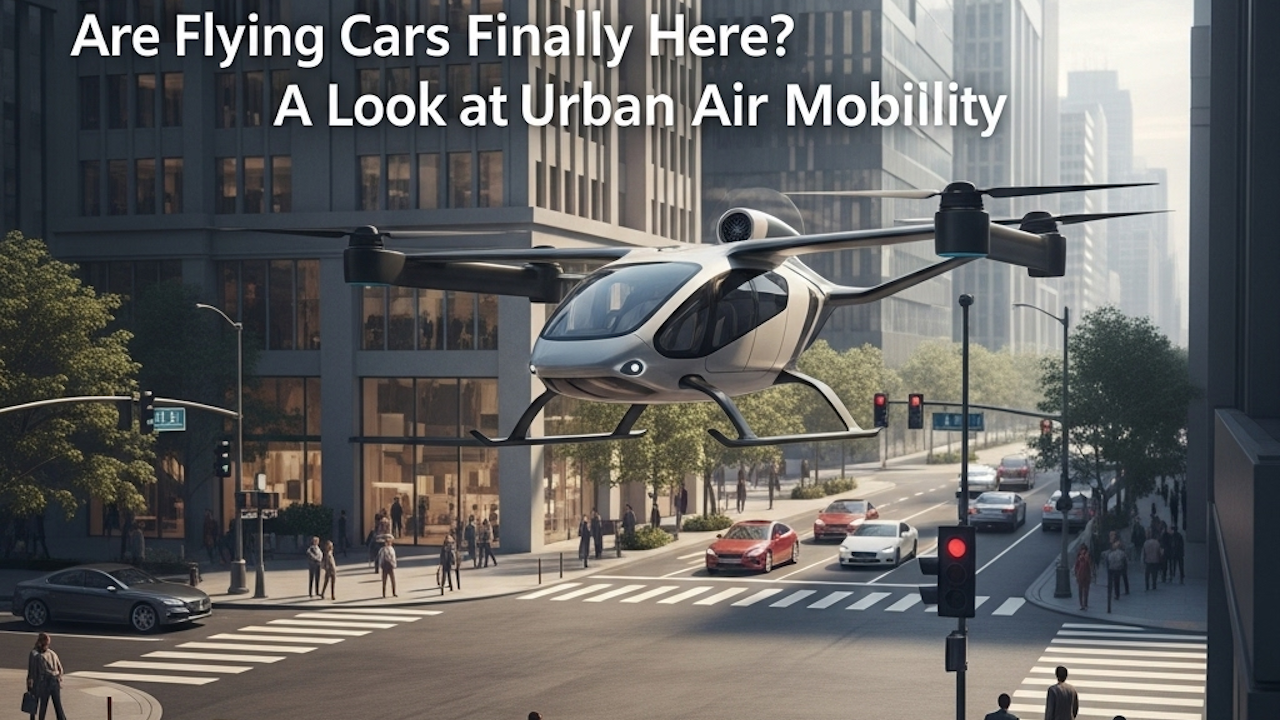
Urban Air Mobility represents one of the most ambitious shifts in transportation since the advent of commercial aviation. For decades, the idea of flying cars has captured public imagination through science fiction and concept art, promising relief from congested roads by lifting passengers above traffic in compact, electric aircraft. Today, that vision has evolved into a practical field known as Urban Air Mobility, or UAM, centered on electric vertical takeoff and landing vehicles, commonly called eVTOLs. These aircraft combine helicopter-like vertical capabilities with airplane-style forward flight, powered by quiet electric motors and advanced batteries. As of early 2026, the question is no longer purely speculative: Are flying cars finally here? The answer is a qualified yes, with initial commercial services poised to begin this year in select locations, though widespread adoption remains years away.
The concept of UAM emerged from efforts to address urban congestion, pollution, and inefficient short-distance travel. Traditional ground transport in major cities often crawls at speeds below 20 miles per hour during peak times, while air travel bypasses this entirely for trips of 10 to 50 miles. eVTOLs aim to serve point-to-point routes between dedicated landing sites called vertiports, which could sit on rooftops, existing heliports, or repurposed parking structures. Unlike conventional airplanes, these vehicles do not require long runways. Unlike helicopters, they promise lower noise, zero direct emissions during flight, and potentially lower operating costs once scaled.
How eVTOL Technology Works
eVTOL aircraft typically feature multiple rotors or propellers mounted on wings or tilting mechanisms. In takeoff and landing mode, the rotors provide lift like a multirotor drone. Once airborne, many designs transition to forward flight, where wings generate lift and rear propellers provide thrust, improving efficiency and range. Battery technology is central: high-energy-density lithium-ion packs power the motors, with rapid charging or battery swapping envisioned for quick turnarounds. Autonomy plays a growing role, with some companies developing fully self-flying systems guided by artificial intelligence, sensors, and digital air traffic management.
Safety features include redundant motors and batteries, parachute systems for the entire aircraft in some designs, and fly-by-wire controls that prevent pilot error. Noise reduction comes from optimized propeller shapes and distributed electric propulsion, which spreads thrust across many smaller units rather than a few loud engines. Ranges for early models target 20 to 100 miles per charge, sufficient for intra-city or airport-to-city hops, with speeds around 120 to 200 miles per hour in cruise.
Leading Companies and Their Progress
Several firms lead the push toward commercialization. Joby Aviation has advanced furthest in the United States, with its piloted S4 eVTOL undergoing Type Inspection Authorization testing as of late 2025. The company has completed key certification stages with the Federal Aviation Administration and conducted extensive flight tests, including operations between public airports. Joby partners with Delta Air Lines and Uber, targeting launch markets such as Los Angeles and New York once full certification arrives, likely in 2027 or later. It also plans early services in Dubai.
Archer Aviation focuses on its Midnight model, a piloted four-passenger aircraft designed for urban routes. Archer has made strides in piloted test flights and holds partnerships with major airlines. Like Joby, it eyes Dubai for 2026 operations and aims for broader U.S. deployment aligned with events such as the 2028 Los Angeles Olympics. Both companies emphasize quiet operation suitable for dense neighborhoods.
In China, EHang has pursued a different path with its autonomous two-passenger EH216-S. The company claims progress toward commercial sightseeing flights as early as March 2026 in locations such as Guangzhou, potentially marking some of the world’s first ticketed eVTOL passenger services. Other players include Vertical Aerospace in the UK, targeting certification around 2028 for its VX4, and Lilium, which focuses on longer-range regional jets with a distinctive ducted-fan design. Beta Technologies has emphasized cargo and medical applications with its Alia aircraft, achieving production milestones for both vertical and conventional takeoff variants. Boeing’s Wisk Aero advances autonomous flight with its Generation 6 model.
Smaller or specialized efforts, such as Israel’s AIR with production-standard cargo eVTOLs delivered in late 2025, highlight dual-use potential for logistics before passenger scaling. Japan’s SkyDrive and others in Asia add regional diversity to development.
Regulatory Developments and Timelines
Certification remains the primary gatekeeper. The FAA in the United States has adapted existing rules for powered-lift aircraft, creating special conditions for eVTOLs that do not fit neatly into traditional Part 23 or Part 27 categories for small airplanes or helicopters. In March 2026, the FAA and Department of Transportation launched the eVTOL Integration Pilot Program, selecting eight proposals to test advanced air mobility operations, including urban air taxis, across 26 states. Operations under this program could begin as early as summer 2026, focusing initially on piloted flights, cargo, and emergency response in controlled settings. This initiative gathers real-world data on integration with existing airspace without requiring full type certification upfront.
In Europe, the European Union Aviation Safety Agency has issued dedicated technical specifications for vertical takeoff and landing aircraft. The UAE’s General Civil Aviation Authority targets commercial operations by the third quarter of 2026, with Joby and Archer advancing plans there. China appears positioned for some of the earliest passenger-carrying flights via EHang’s autonomous models.
Full FAA type certification for leading U.S. designs is not expected in 2026, with realistic targets for Joby around mid-2027 and Archer later. Delays stem from rigorous testing of novel systems, including batteries, software, and human factors. Past ambitious timelines, such as services for the 2024 Paris Olympics, were postponed due to engine certification issues, underscoring the gap between prototypes and airworthy production aircraft.
Infrastructure Needs: Vertiports and Beyond
Flying vehicles require more than aircraft. Vertiports serve as the ground infrastructure equivalent of small airports or bus stops in the sky. These facilities include landing pads, charging stations, passenger terminals, and maintenance areas. Many will retrofit existing heliports or integrate with rooftops near transit hubs, airports, or business districts. The FAA has released design guidelines covering safety zones, obstacle clearance, and electric infrastructure.
Challenges include securing urban real estate, ensuring sufficient electrical capacity for simultaneous charging of multiple aircraft, and managing noise and visual impacts on communities. Early networks will likely connect airports to city centers or link suburbs to downtowns, with gradual expansion. Air traffic management must evolve too, incorporating low-altitude digital systems to handle dense eVTOL traffic safely alongside drones and traditional aircraft. Concepts such as UAS Traffic Management aim to automate routing and separation.
Potential Benefits and Use Cases
If scaled successfully, UAM could transform daily commutes, emergency medical transport, and cargo delivery. A 30-mile trip that takes an hour by car might shrink to 15 minutes in the air, saving time and reducing road congestion. Electric propulsion cuts local emissions, supporting climate goals when paired with renewable energy for charging. Medical applications, such as rapid organ or patient transport, could improve outcomes in time-critical scenarios. Tourism and premium business travel offer early revenue streams, as seen in planned sightseeing flights.
Market projections reflect optimism. Estimates for the UAM sector vary widely but generally forecast growth from several billion dollars in 2025-2026 to tens or even hundreds of billions by 2030-2040, with compound annual growth rates exceeding 20 percent in many forecasts. Revenue potential includes passenger fares, cargo services, and infrastructure development.
Challenges and Realistic Outlook
Significant hurdles persist. Safety certification demands levels comparable to commercial airliners, requiring thousands of test flight hours and exhaustive failure-mode analysis. Battery energy density limits range and payload, though incremental improvements continue. Affordability is another concern: early rides may cost as much as helicopter charters, limiting access to premium users until economies of scale reduce prices.
Public acceptance hinges on demonstrated safety, minimal noise, and equitable access. Cybersecurity for autonomous systems and integration with existing airspace raise complex operational questions. Infrastructure rollout faces zoning, permitting, and funding barriers at local levels, even as federal regulators focus on aviation safety. Economic viability depends on high utilization rates and supportive business models, often involving partnerships with airlines or ride-sharing platforms.
Environmental impacts extend beyond tailpipe emissions to include battery production, manufacturing, and end-of-life recycling. Noise, while lower than helicopters, must still meet strict urban standards. Equity issues arise if services primarily benefit wealthier areas or users.
As of April 2026, flying cars in the popular sense, meaning personal vehicles that anyone can pilot from driveway to sky, are not imminent. Instead, the near-term reality is shared air taxi services operated by professional pilots or autonomous systems on fixed or on-demand routes. Limited commercial flights could launch in Dubai or Chinese cities this year, with U.S. testing expanding in parallel. Full integration into daily life may take until the 2030s, contingent on successful certification, infrastructure buildout, and proven economics.
The progress in 2025 and early 2026, including conforming aircraft testing, pilot programs, and international momentum, marks a genuine inflection point. Decades of research and investment are converging with regulatory openness and technological maturity. Urban Air Mobility will not replace cars or subways but could complement them, offering a faster layer for select trips. Whether it delivers on its transformative promise depends on navigating the remaining technical, regulatory, and societal barriers with transparency and measurable safety gains.
In summary, flying cars as envisioned in popular culture are not yet commonplace, but the foundational elements of Urban Air Mobility are advancing from prototypes to early operations. The coming years will determine if this new mode of transport becomes a practical reality for millions or remains a niche innovation for specific routes and users. The trajectory points toward gradual adoption rather than overnight revolution, grounded in rigorous engineering and oversight.