

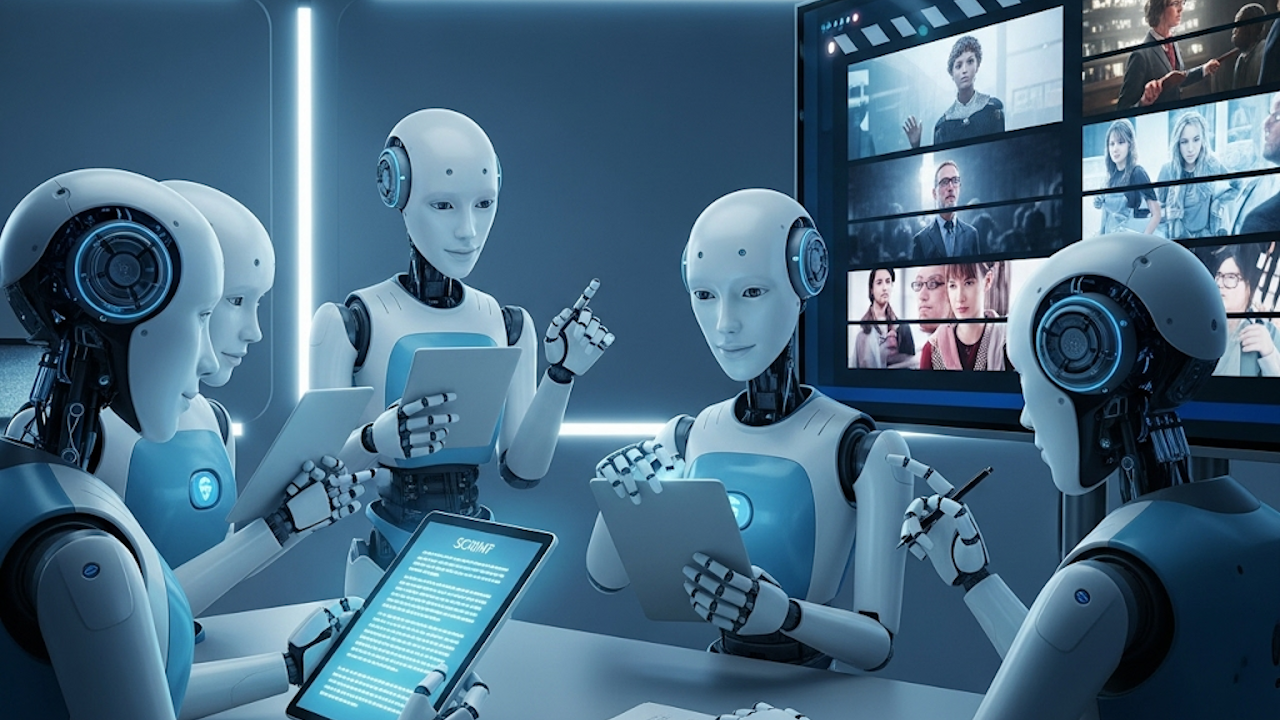
The notion of machines crafting stories for the silver screen once belonged firmly in the realm of speculative fiction. Screenwriters toiled in isolation or in collaborative rooms, drawing on personal experiences, cultural observations, and years of craft to birth characters that audiences could love, hate, or relate to on a visceral level. Yet by 2026, artificial intelligence has infiltrated nearly every stage of filmmaking, from ideation to final cut. Tools powered by large language models can now produce full scripts in minutes, complete with scene headings, action lines, and dialogue. The provocative question echoes through Hollywood boardrooms and indie production houses alike: Are robots writing movies?
This article explores the evolution of AI in screenwriting, examines real-world applications and experiments, weighs the benefits against the drawbacks, and considers what the future holds for human creativity in an era when algorithms can mimic narrative structure with startling proficiency. Far from a simple yes or no proposition, the reality is nuanced. AI is transforming how stories are born, but it has yet to eclipse the irreplaceable spark of human authorship.
The dawn of AI screenwriting traces back to the rapid advancements in generative language models around 2022. When OpenAI released ChatGPT in late November of that year, creative professionals immediately began testing its limits. Just seventeen days later, filmmaker Richard Juan used the tool to create “The Safe Zone,” widely recognized as the world’s first AI-scripted and AI-directed short film. ChatGPT not only generated the screenplay but also provided detailed instructions for camera movements, lighting setups, and even wardrobe choices. Storyboards came courtesy of DALL-E, another OpenAI product. The result was a polished short that demonstrated the technology’s potential while exposing its early flaws, such as occasionally clunky dialogue that felt forced rather than organic.
This early experiment set off a wave of similar projects. By the mid-2020s, filmmakers were blending AI with traditional techniques to produce shorts and even features. One standout example is “Check Point,” a documentary-style short created by New York-based Hungarian director Áron Filkey in collaboration with Vox’s Joss Fong. The team credited multiple image generators alongside GPT-based tools for assets and elements of the script. The film stands out as arguably the most successful AI-influenced production to date, praised for its thoughtful exploration of machine learning concepts and its ability to blur the lines between human and artificial contributions. Its script, while partly shaped by AI, delivered clear, informative explanations that resonated with viewers.
Other projects pushed boundaries further. In 2024, artist Kevin Abosch released screengrabs from “Am I?,” described as the first AI-generated feature film. By 2025 and into 2026, entire pipelines emerged that took a text prompt and outputted scripts, storyboards, visuals, and even audio. Independent creators shared workflows on platforms like YouTube and Reddit, demonstrating how a single prompt could yield a professional-grade short film in under ten minutes. These experiments highlighted AI’s speed and accessibility, particularly for resource-limited indie filmmakers who previously faced steep barriers in pre-production.
Hollywood, however, did not embrace these developments without resistance. In 2023, the Writers Guild of America (WGA) launched a historic 148-day strike, one of the longest in the industry’s history. At the heart of the dispute was the role of generative AI in the writing process. Writers demanded strict guardrails: AI could not be credited as a writer, could not write or rewrite literary material, and could not serve as source material for scripts. Studios initially pushed back, offering only annual discussions on technological advancements. The writers prevailed. The eventual contract required disclosure when AI-generated material was provided to writers and prohibited AI from receiving writing credits. It also barred the use of AI to replace human labor in core creative tasks.
This victory bought screenwriters time, but it did not halt progress. By 2026, AI tools had matured into sophisticated assistants rather than outright replacements. Specialized platforms now cater directly to the demands of feature films, pilots, and television series. Sudowrite, for instance, features a proprietary Muse model trained specifically on creative storytelling, including screenplays. Its Story Bible system tracks characters, plot points, and world details across long-form projects, ensuring consistency that generic chatbots often lack. Writers can generate beat-by-beat outlines based on a logline, expand scenes with visual action lines that adhere to “show, don’t tell” principles, and polish dialogue to reflect distinct character voices. Emmy-winning writer Bernie Su and author Hugh Howey have publicly endorsed its capabilities for overcoming structural hurdles like the notorious second-act sag.
Other leading tools in 2026 include Boords, which excels at turning ideas into storyboard-ready scripts in multiple languages and seamlessly transitions to visual planning. Veed.io offers a free, browser-based option that generates scripts from simple prompts and integrates directly with video editing and text-to-speech features. Taskade provides dynamic builders for on-the-go customization, while Synthesia.io focuses on scripts that convert quickly into narrated videos. Kapwing rounds out the list by transforming AI scripts into social-media-ready content with stock footage, subtitles, and soundtracks. These platforms emphasize efficiency, helping users overcome writer’s block and iterate rapidly without sacrificing core formatting standards.
The practical benefits are undeniable. AI accelerates the early stages of development, where writers traditionally spend weeks brainstorming or staring at blank pages. A logline can yield a full treatment in minutes. Dialogue passes can be generated and refined for subtext or pacing. For television writers juggling multiple episodes, AI maintains continuity across seasons far more reliably than manual note-taking. Indie filmmakers, in particular, report completing pre-production drafts 40 percent faster, freeing resources for shooting and post-production. One independent screenwriter documented using AI software to produce a 60-page feature script in roughly the time it took to drink a cup of tea and smoke a cigarette. While the third act needed work and the dialogue felt generic, the structural bones were solid enough to serve as a starting point.
Yet these successes come with significant caveats. AI-generated scripts often suffer from a lack of originality. Because models are trained on vast corpora of existing screenplays, they tend to recombine familiar tropes, archetypes, and plot beats. The result can feel derivative, lacking the unpredictable spark that arises from lived human experience. In the example above, the protagonist modeled after a gritty action hero like Snake Plissken emerged as competent but not cool or memorable on the page. Emotional depth proves elusive; interior monologues translate poorly into visual action, and nuanced subtext frequently flattens into on-the-nose exchanges.
Legal and ethical questions compound the technical limitations. Training data for these models often includes copyrighted scripts without explicit permission from writers, raising concerns about fair use and compensation. The 2023 strike agreement addressed some issues around credit and replacement, but it did not resolve broader questions of authorship. If an AI generates 80 percent of a script and a human polishes the rest, who owns the work? Studios have begun requiring disclosures, yet enforcement varies. Meanwhile, some executives quietly use AI for coverage reports or initial evaluations, further marginalizing entry-level writers who once relied on spec scripts to break in.
Critics within the industry argue that AI cannot replicate the collaborative tension of a writers’ room or the cultural specificity that comes from diverse lived experiences. A machine might analyze thousands of romantic comedies to produce meet-cute dialogue, but it lacks the ability to draw from personal heartbreak or cultural nuance in a way that feels authentic. Surveys from 2026 indicate that while 67 percent of professional screenwriters now incorporate AI into their workflow, the majority view it strictly as a tool rather than a co-author. They use it for brainstorming, research, or mechanical tasks like formatting, then apply human judgment to infuse soul.
Despite these shortcomings, hybrid approaches are gaining traction. Many filmmakers now describe a workflow where AI handles first drafts or scene expansions, and humans provide the emotional core, revisions, and final polish. Directors use AI-generated scripts as mood boards to visualize tone before committing to expensive shoots. In low-budget productions, the technology democratizes access, allowing solo creators to produce proof-of-concept shorts that attract funding. As one 2025 analysis noted, AI is reshaping the pipeline from script to screen, integrating with video generation models to create entire sequences from text prompts. Yet experts consistently emphasize that the final product resonates with audiences only when human oversight ensures thematic coherence and emotional truth.
Looking ahead to the late 2020s and beyond, predictions vary. Optimists foresee AI evolving into an indispensable creative partner capable of handling increasingly complex narrative tasks, such as generating alternate endings based on test-audience feedback or adapting scripts for different cultural markets in real time. Pessimists warn of further job displacement, especially for mid-level writers whose roles involve routine rewrites. Some studios may experiment with fully AI-generated features for streaming platforms, testing whether audiences notice or care about the absence of human authorship.
The most likely outcome is a balanced coexistence. Screenwriting will remain a fundamentally human endeavor because storytelling is, at its root, an act of empathy and connection. AI can simulate patterns, but it cannot originate the messy, contradictory insights that define great cinema. Tools will continue to improve, perhaps incorporating multimodal inputs that analyze actor performances or real-world locations to suggest revisions. Writers who master these technologies will gain a competitive edge, much as early adopters of word processors outpaced those who clung to typewriters.
In the end, robots are not writing movies in any complete sense. They are assisting, accelerating, and occasionally inspiring the process. The scripts that move audiences, win awards, and endure in cultural memory will still bear the indelible imprint of human hands and hearts. AI may generate the scaffolding, but the architecture of compelling storytelling demands the architect’s vision. As the industry navigates this technological shift, the enduring truth remains: machines can mimic craft, but only people can create art that truly matters. The robots may propose lines, but the movies will always belong to us.