

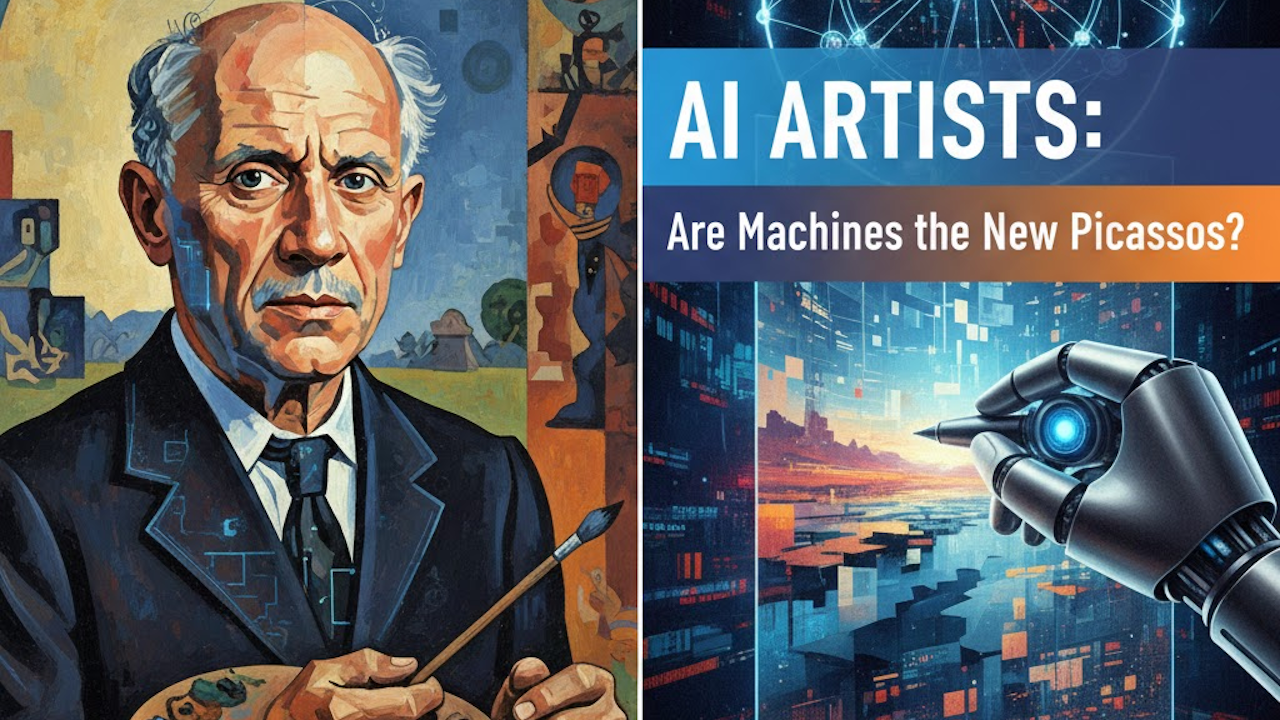
In the autumn of 2018, the art world witnessed something unprecedented. At Christie’s auction house in New York, a painting titled Portrait of Edmond Belamy sold for $432,500. The work depicted a blurred, aristocratic figure in the style of old masters, yet no human hand had touched a brush. It emerged from a generative adversarial network trained on 15,000 historical portraits by the French collective Obvious. The sale sent shockwaves through galleries, museums, and artist studios. Was this the beginning of a new era, or merely a clever gimmick?
By 2026 the landscape has transformed beyond recognition. Text-to-image systems such as DALL-E, Midjourney, and the open-source Stable Diffusion allow anyone to conjure detailed, stylistically coherent images from a few lines of text in seconds. More advanced multimodal models now handle video, 3D, and interactive installations. Conferences like AIART 2026 explore “multimodal agents for AI art,” while artists such as Refik Anadol create vast data-driven environments acquired by institutions including the Museum of Modern Art.
The central question persists with greater urgency: Are machines the new Picassos? Pablo Picasso did not merely paint; he detonated centuries of representational tradition. Through Cubism he fractured form, incorporated influences from African sculpture and Iberian art, and produced thousands of works across decades marked by personal turmoil, political fury, and relentless reinvention. His genius lay in lived experience transmuted into visual language. Can algorithms, trained on billions of existing images and lacking any inner life, achieve comparable rupture and originality?
To answer honestly requires examining the history, the technology, the philosophical stakes, the legal battles, the economic tremors, and the human responses that together define this moment.
From Mechanical Drawing Machines to Diffusion Models
The dream of machine-made art is older than computers. In the 1970s, British artist Harold Cohen created AARON, a program that generated drawings according to evolving rules. AARON produced recognizable figures and landscapes yet remained tethered to Cohen’s hand-coded aesthetic decisions. Early experiments in the 1960s, such as the “Cybernetic Serendipity” exhibition in London, featured kinetic machines and light-sensitive sculptures that reacted to viewers. These were reactive systems rather than generative intelligences.
The decisive leap arrived with generative adversarial networks in 2014. Ian Goodfellow’s GAN framework pitted two neural networks against each other: one generating images, the other discriminating real from fake. Artists quickly adopted the technology. Helena Sarin trained models on her own drawings; Anna Ridler used photographs of tulips. In 2018 the Obvious collective’s sale proved the commercial world would pay serious money for purely algorithmic output.
The consumer explosion began in 2021 when OpenAI released DALL-E, followed in 2022 by Midjourney’s Discord-based interface and Stability AI’s open-source Stable Diffusion. Suddenly, high-quality image generation required no coding expertise and ran on consumer hardware or affordable cloud credits. Prompt engineering became a new craft. Users discovered that weighting words, chaining concepts, and iterating through dozens of variations could yield surprisingly coherent and often beautiful results.
By 2025 and into 2026, models incorporated better text understanding, stylistic control, and consistency across multiple generations. Refik Anadol’s studio pushed further, treating massive datasets of museum archives, nature imagery, and urban sensors as raw material. His “Unsupervised” installation at MoMA transformed the museum’s collection into an ever-shifting dreamscape. In 2026 his team prepared to open Dataland, described as the world’s first museum dedicated to AI arts, in downtown Los Angeles.
These developments represent more than incremental improvement. Diffusion models do not copy pixels; they learn statistical distributions of visual features across enormous corpora. When prompted with “a cubist portrait in the style of Picasso but set on Mars,” the system recombines learned patterns in ways that can feel inventive. The question is whether such recombination constitutes creativity or sophisticated collage.
The Creativity Debate: Pattern Matching or Genuine Novelty?
Critics argue that AI possesses no intention, no emotional stake, and no lived experience. It cannot suffer a broken heart, witness war, or feel the weight of cultural displacement the way Picasso did during his Blue and Rose periods or while painting Guernica. Without consciousness, the argument runs, there can be no authentic artistic expression. Studies consistently show that viewers rate identical images lower in creativity, emotional depth, and monetary value when told they were AI-generated, revealing a persistent bias even when objective quality matches human work.
Defenders counter that human artists have always borrowed and transformed existing visual languages. Picasso himself drew heavily from non-European sources and from contemporaries. Creativity, according to this view, lies in novel combinations rather than ex nihilo invention. Mathematician and author Marcus du Sautoy has suggested that machine-learning code, once exposed to vast data, can “learn, mutate and evolve” beyond its original programming, producing outputs that deserve to be called creative in their own right. He compares the process to Picasso’s own development: shaped by DNA and experience yet capable of surprising leaps.
AI art also forces a reevaluation of what we value. If a work moves viewers, provokes thought, or reveals unseen patterns in data, does its origin matter? Philosophers note that definitions of art have expanded before: Duchamp’s readymades, conceptual art, performance. Generative systems may represent another expansion rather than an endpoint.
Yet a crucial distinction remains. Human artists usually create because they must; the drive emerges from within. AI generates only when prompted. Even sophisticated agentic systems in 2026 still require human goals, curation, and often post-processing. The spark of why remains human.
Prominent Practitioners and Hybrid Practices
Not all AI art is simple prompting. Refik Anadol exemplifies a sophisticated approach: he and his studio collect or access enormous datasets, train custom models, and shape the resulting “hallucinations” into immersive architectural experiences. His Large Nature Model draws ethically from hundreds of millions of open-source nature images to generate coral formations, forests, and atmospheric phenomena that feel simultaneously familiar and alien.
Other artists treat AI as one instrument in a larger orchestra. They generate base images, then paint over them, composite elements in editing software, or project outputs onto physical sculptures. Prompt engineering itself has evolved into a skilled practice involving precise language, negative prompts, seed control, and iterative refinement. Many commercial illustrators now use AI for rapid concepting while reserving final execution for their own hand or distinctive voice.
Activist and critical projects also thrive. Artists expose biases in training data, highlight missing representations of marginalized communities, or use AI to visualize alternative futures. These works often critique the very systems that enable them.
The most interesting territory lies in sustained human-AI collaboration. An artist might spend weeks refining a single series, developing a personal visual vocabulary through thousands of generations. In such cases the machine functions less as autonomous creator and more as tireless studio assistant capable of exploring combinatorial spaces no individual could traverse alone.
Legal and Economic Fault Lines
The rapid rise of generative tools triggered immediate legal conflict. In January 2023, artists Sarah Andersen, Kelly McKernan, and Karla Ortiz filed a class-action lawsuit against Stability AI, Midjourney, and DeviantArt, alleging that training on billions of scraped images constituted copyright infringement. Getty Images launched parallel suits.
Courts have moved cautiously. The U.S. Copyright Office has maintained that purely AI-generated works lack the human authorship required for protection. In its 2025 Part 2 report on copyrightability, the Office clarified that prompts alone do not supply sufficient creative control; the AI system determines expressive elements. However, works combining substantial human authorship with AI output, or featuring creative selection and arrangement of AI elements, can qualify for registration. The Supreme Court declined to hear a related case in March 2026, leaving the human-authorship requirement intact.
These rulings create practical uncertainty. A purely prompt-generated image may be freely usable by others under Midjourney’s or similar terms, yet lack enforceable copyright. Hybrid works require careful documentation of human contributions. Meanwhile, living artists whose distinctive styles are easily mimicked by models have seen their livelihoods threatened, especially in illustration, concept art, and stock imagery.
Economically, the picture is mixed. Commercial artists report lost commissions as clients turn to faster, cheaper AI generation. Yet new roles have emerged: AI art directors, prompt specialists, dataset curators, and fine-tuners of open-source models. Galleries remain divided; a 2026 Artsy survey of hundreds of gallery professionals found widespread use of AI for administrative tasks but skepticism about AI-generated works as primary artistic output.
The broader effect resembles earlier technological disruptions. Photography did not eliminate painting; it liberated painters from strict realism and helped birth modernism. AI may similarly push human artists toward qualities machines currently struggle to replicate: raw emotional authenticity, cultural specificity rooted in lived identity, and the irreplaceable trace of physical struggle visible in brushwork or chisel marks.
The Picasso Comparison Revisited
Picasso was not merely technically brilliant; he was a cultural force whose personal mythology amplified his work. His fractured forms reflected a world coming apart. His Blue Period channeled grief. His later ceramics and sculptures demonstrated restless curiosity across media. No algorithm possesses a biography, a libido, a political conscience, or the capacity for self-mythologizing.
AI systems can simulate any style because they have ingested the entire history of visual culture. They can produce credible Cubist compositions, Surrealist dreamscapes, or photorealistic scenes with equal facility. This omnivorous capacity is both strength and limitation. Picasso’s power derived partly from what he chose to reject and distort. AI has difficulty rejecting; it tends toward plausible averages unless heavily guided.
Still, the analogy contains a grain of truth at the level of cultural impact rather than individual genius. Just as Cubism changed how subsequent generations saw space and form, generative AI is changing how images are produced, valued, and understood. It collapses the time between conception and realization. It makes sophisticated visual creation accessible to people without traditional training. It forces institutions to confront new questions of authorship, authenticity, and conservation (how does one preserve a model-dependent artwork?).
If Picasso represented the apotheosis of the heroic individual artist, AI art points toward distributed, iterative, and sometimes anonymous creation. The new “Picassos” may not be single machines or even single human operators but communities of artists, engineers, and datasets evolving together. Or they may be human creators who use AI to achieve expressive range previously impossible within one lifetime.
Where We Stand in 2026 and Beyond
The technology continues to advance. Multimodal agents that maintain memory across sessions, accept iterative feedback in natural language, and generate coherent long-form visual narratives are already emerging. Integration with robotics and augmented reality will soon allow AI-generated imagery to appear in physical space. Ethical questions around training data consent, energy consumption, and cultural appropriation remain unresolved and urgent.
Yet the fundamental human questions endure. Why do we make images? What do we seek when we look at art? Connection to another consciousness? Evidence of struggle and triumph? Revelation of unseen patterns in the world or in ourselves?
Machines excel at the latter. They can reveal statistical relationships across millions of images that no human eye could perceive. They can generate variations at a speed that supports genuine experimentation. They lack, for now, the former qualities that make art matter to most people: the sense that another being has poured intention, vulnerability, and hard-won insight into the work.
The honest answer to the title question is therefore no and yes. Machines are not the new Picassos. They possess neither the interiority nor the cultural agency that defined Picasso’s singular contribution. At the same time, the technology represents a rupture comparable in scale to the inventions and movements Picasso himself helped shape. It expands the field of possible images and challenges settled definitions of artist and artwork.
The most fruitful path forward lies in neither rejection nor uncritical embrace. Human artists who master these tools while preserving their own voice will likely produce the most compelling work of the coming decade. Collectors and institutions that develop sophisticated criteria for evaluating AI-assisted and AI-generated art will help shape a healthy ecosystem. Policymakers who update copyright and labor frameworks without stifling innovation will matter enormously.
Art has always evolved with its tools. Oil paint, photography, video, and digital editing each provoked anxiety before becoming integral to practice. Generative AI is the latest chapter in that long story. Whether it ultimately produces new Picassos or simply new ways for humans to be creative remains to be seen. What is already clear is that the canvas has grown vastly larger, the palette more infinite, and the conversation more urgent than ever before.
The machines are here. The question is what we, as humans, will choose to make with them and of them.