

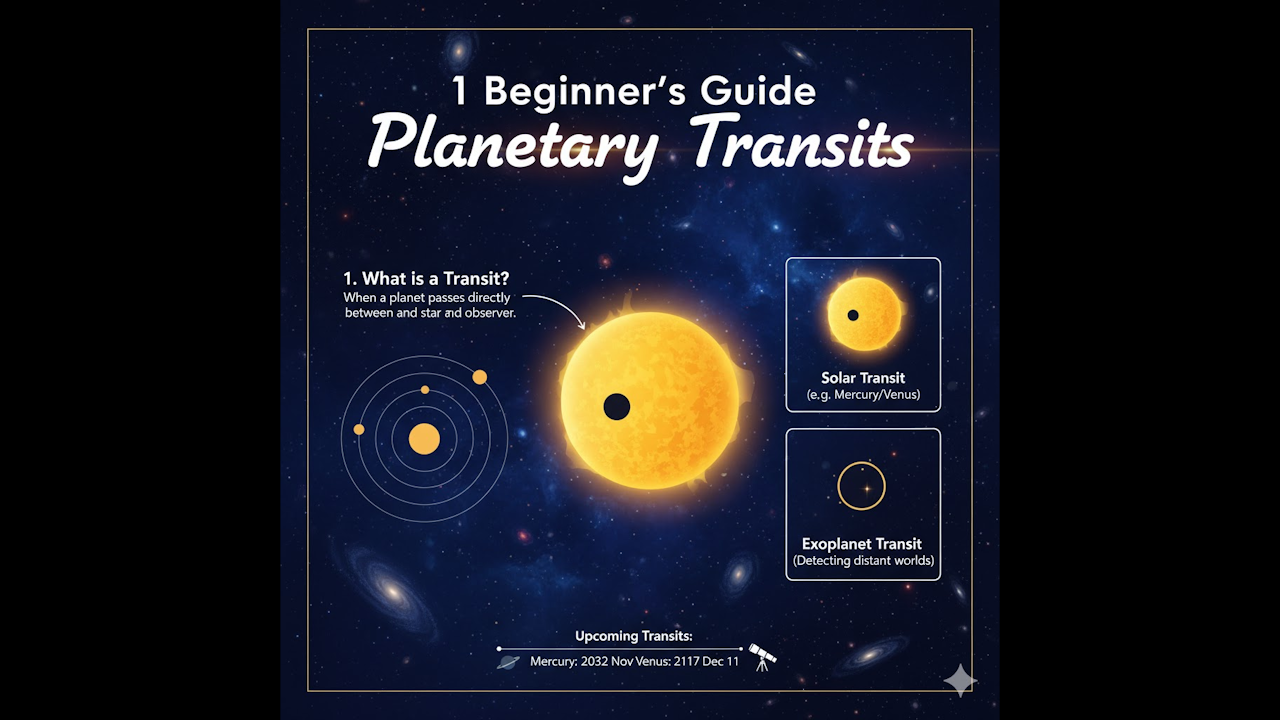
Have you ever gazed at the sky and marveled at the intricate movements of the planets? Astronomy offers countless wonders, and one of the most captivating events is a planetary transit. For beginners, understanding planetary transits can open a window into the mechanics of our solar system and beyond. In simple terms, a planetary transit happens when one planet passes in front of another celestial body from our viewpoint on Earth. Most commonly, this refers to the inner planets Mercury and Venus crossing the face of the Sun, appearing as tiny dark dots against its brilliant glow. These events are rare, predictable, and scientifically valuable. They have helped astronomers measure distances in space, study planetary atmospheres, and even discover worlds beyond our solar system.
This guide is designed for newcomers to astronomy. We will explore what planetary transits are, their historical significance, the science that makes them possible, how to observe them safely, notable past events, upcoming opportunities, and their role in modern exoplanet research. By the end, you will have a solid foundation to appreciate these cosmic alignments and perhaps even plan to witness one yourself. Let us dive in.
What Is a Planetary Transit?
At its core, a planetary transit is an alignment where a smaller or closer planet moves directly between Earth and a larger celestial object, typically the Sun in our discussions here. From Earth’s perspective, only Mercury and Venus can transit the Sun because they orbit inside Earth’s path around the Sun. Outer planets like Mars or Jupiter cannot appear to cross the Sun’s disk from our vantage point; instead, they would be seen against the stars.
Imagine the solar system as a vast clockwork mechanism. The planets orbit the Sun in nearly the same plane, called the ecliptic. However, their orbits are slightly tilted relative to each other. For a transit to occur, the inner planet must reach inferior conjunction, the point where it is directly between Earth and the Sun, precisely when its orbit aligns with the line of sight from Earth. If the alignment is off by even a small degree, the planet will pass above or below the Sun’s disk, and no transit happens.
For Mercury, transits last several hours, up to about 7 hours and 50 minutes at most. The planet appears as a small black dot, about 10 to 12 arcseconds in diameter, which is roughly 1/150th the size of the Sun’s apparent width. Venus transits are longer and more dramatic, with the planet appearing larger, about 58 arcseconds across, because it is closer to Earth during the event.
Transits are not just visual spectacles; they provide data on planetary sizes, orbits, and atmospheres. When a planet transits, it blocks a tiny fraction of the Sun’s light, which astronomers can measure. This dimming effect is key to detecting exoplanets around distant stars, but we will cover that later.
The Historical Significance of Planetary Transits
Humanity’s fascination with planetary transits dates back centuries, blending curiosity, science, and exploration. The first recorded observation of a transit was not of Venus but of Mercury, on November 7, 1631, by the French astronomer Pierre Gassendi. Gassendi used a telescope to project the Sun’s image onto a screen, noting Mercury as a small spot much tinier than expected. This confirmed predictions by Johannes Kepler, who had forecasted transits in his astronomical tables but did not live to see one.
Just a month later, in December 1631, a Venus transit occurred, but it was not visible from most of Europe. The first successful Venus transit observation came on December 4, 1639, by English astronomers Jeremiah Horrocks and William Crabtree. Horrocks, working from his home in Much Hoole, England, corrected Kepler’s calculations and predicted the event accurately. He projected the Sun’s image through a telescope onto paper, marking a milestone in observational astronomy.
The 18th century brought global expeditions. Edmond Halley, after observing a Mercury transit in 1677 from Saint Helena, proposed using Venus transits to calculate the distance from Earth to the Sun, known as the astronomical unit (AU). This method relied on parallax: observers at different latitudes would time the transit differently, allowing triangulation of the distance.
The 1761 and 1769 Venus transits sparked international efforts. In 1761, expeditions went to places like Siberia and India, with Russian astronomer Mikhail Lomonosov suggesting Venus had an atmosphere based on a hazy ring he observed. The 1769 transit featured Captain James Cook’s voyage to Tahiti, where he and astronomer Charles Green recorded the event. These observations yielded an AU estimate of about 153 million kilometers, close to the modern value of 149.6 million kilometers.
The 19th century transits of 1874 and 1882 involved photography and refined measurements, with expeditions to remote locations like New Zealand and Hawaii. The 20th and 21st centuries saw transits like Mercury’s in 2003, 2006, 2016, and 2019, and Venus’s in 2004 and 2012, broadcast live worldwide via satellites and the internet. These events not only advanced science but also inspired public interest in astronomy.
The Science Behind Planetary Transits
To grasp why transits happen, consider orbital mechanics. The planets follow elliptical paths around the Sun, governed by gravity as described by Kepler’s laws. Mercury orbits every 88 days, Venus every 225 days, and Earth every 365 days. Transits require precise alignment at the nodes, where the planet’s orbit crosses the ecliptic plane.
For Mercury, its 7-degree orbital tilt means transits occur around May 8 or November 10, when Earth is aligned with those nodes. November transits happen more often because Mercury is closer to the Sun (at perihelion), moving faster. Venus’s 3.4-degree tilt leads to transits in June or December, in pairs separated by 8 years, with long gaps of 105.5 or 121.5 years between pairs. This pattern arises from the 8:13 ratio of Earth to Venus years; after 8 Earth years, Venus has completed about 13 orbits, bringing the planets back into near-alignment.
During a transit, astronomers observe four contact points: first contact (planet touches Sun’s edge), second (fully enters), third (begins to exit), and fourth (fully exits). A phenomenon called the black drop effect, where the planet appears to “stick” to the Sun’s edge due to atmospheric turbulence or optical illusions, has historically complicated timings.
Transits also reveal atmospheric details. As Venus crosses the Sun, light refracts through its thick carbon dioxide atmosphere, creating a luminous arc that confirms its composition. For Mercury, with its thin exosphere, transits help study solar wind interactions.
How to Observe Planetary Transits Safely
Observing a transit can be thrilling, but safety is paramount since you are looking toward the Sun. Never stare directly at the Sun without protection; it can cause permanent eye damage.
The best method for beginners is projection. Use a telescope or binoculars to project the Sun’s image onto a white screen or paper, several feet away. This indirect view shows the transit without risking your eyes. Adjust the focus until the Sun’s disk is sharp, and you might even spot sunspots alongside the transiting planet.
For direct viewing, use a telescope with a certified solar filter attached to the front objective lens. These filters block 99.999% of sunlight. Avoid eyepiece filters, as they can crack from heat. Solar viewing glasses, rated for eclipses, work for naked-eye views, but transits require magnification since Mercury and Venus appear tiny.
Join a local astronomy club or planetarium event for guided observations. Many offer safe telescopes. If photographing, use a camera with a solar filter and a telephoto lens. Start with wide shots to capture the Sun’s context, then zoom in. Practice on non-transit days to perfect your setup.
Weather matters; clear skies are essential. Check forecasts and have a backup location. Transits are global but visibility varies by region, so use online tools to confirm if the event is fully or partially visible from your area.
Famous Planetary Transits
Several transits stand out in history. The 1639 Venus transit, observed by Horrocks, was a triumph of prediction over observation challenges. The 1769 event tied into Cook’s Pacific explorations, blending astronomy with geography.
The 1882 Venus transit was the last of the 19th century, photographed extensively and used to refine the AU. In modern times, the 2004 Venus transit was the first in over a century, viewed by millions online. The 2012 event, captured from space by the International Space Station, provided data on Venus’s atmosphere and exoplanet analogies.
Mercury’s 2016 and 2019 transits were popular among amateurs, with the 2019 event visible from much of the Americas and Europe. These helped study Mercury’s sparse atmosphere and the Sun’s variability.
Upcoming Planetary Transits
As of October 2025, the next Mercury transit is on November 13, 2032, lasting from about 06:41 UTC to 11:07 UTC. It will be visible from parts of Europe, Africa, and Asia. Following that, November 7, 2039; May 7, 2049; and others through the century.
Venus transits are farther out. The next pair begins on December 10-11, 2117, visible from Asia and Australia, followed by December 8, 2125, from the Americas. These long intervals make Venus transits generational events.
Plan ahead using NASA resources or apps to track visibility.
Planetary Transits and Exoplanet Discovery
Beyond our solar system, the transit method has revolutionized exoplanet hunting. Space telescopes like Kepler and TESS detect dips in starlight when planets cross their host stars. This reveals planet sizes, orbital periods, and sometimes atmospheres through spectroscopy.
Solar system transits serve as analogs, helping calibrate instruments for distant worlds. The 2012 Venus transit, for instance, simulated exoplanet signals. Over 5,000 exoplanets have been found this way, including Earth-like candidates.
Conclusion
Planetary transits remind us of our place in the cosmos: a delicate alignment in a vast universe. From ancient predictions to modern space missions, they have driven scientific progress and inspired wonder. As a beginner, start with safe observation techniques, join communities, and explore further through books or online simulations. The next transit could be your gateway to a lifelong passion for astronomy. Keep looking up; the sky has more stories to tell.