

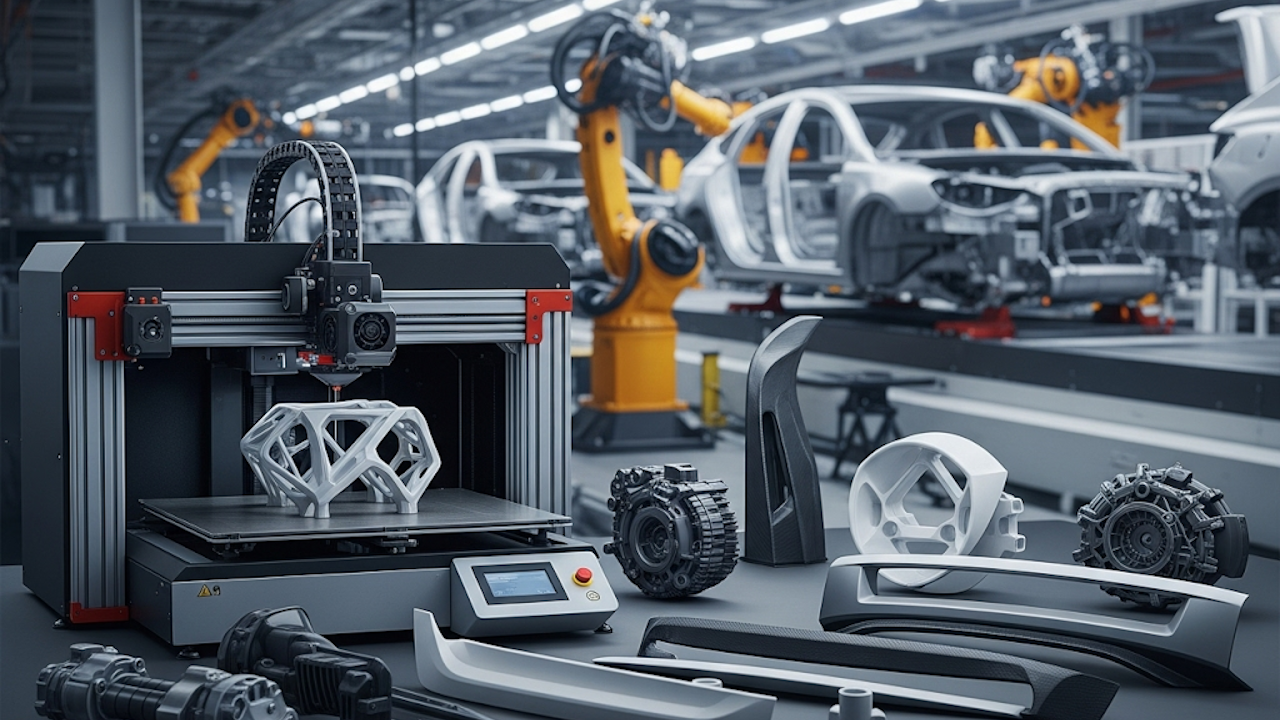
The automotive industry stands at a pivotal moment of technological reinvention. For decades, car manufacturing relied on traditional methods such as stamping, casting, and machining, which demanded massive tooling investments, long lead times, and rigid production schedules. Today, 3D printing, also known as additive manufacturing, has emerged as a powerful complement and, in select cases, a replacement for these conventional approaches. By building parts layer by layer from digital designs, 3D printing enables automakers to create complex geometries, reduce material waste, accelerate development cycles, and respond to customer demands for customization with unprecedented agility. As of 2026, the technology has evolved from a niche tool for prototyping into a strategic asset integrated across prototyping, tooling, low-volume production, and even high-end vehicle assembly. This shift supports the broader goals of sustainability, efficiency, and innovation in an era dominated by electric vehicles and supply-chain volatility.
The roots of 3D printing in automotive manufacturing trace back to the late 1980s and early 1990s. Chuck Hull invented stereolithography in 1984, and by the early 1990s, companies like BMW began experimenting with early additive systems to produce concept car components and race car parts. Ford followed suit, using 3D printing as far back as the 1990s for rapid prototyping of engine components such as intake manifolds. These early applications focused primarily on speeding up design validation rather than replacing metal or plastic parts on the assembly line. Prototypes that once took weeks or months to machine or mold could now be produced in days or even hours, allowing engineers to iterate designs rapidly without incurring the high costs of traditional tooling. Over the subsequent decades, advancements in materials, printer precision, and software integration pushed the technology beyond the workshop and into mainstream production environments. By the 2010s, automakers had expanded usage to include functional prototypes, assembly aids, and limited end-use parts, setting the stage for the broader adoption seen today.
At its core, 3D printing in car manufacturing employs several distinct technologies tailored to the demands of automotive components. Fused deposition modeling (FDM) remains popular for cost-effective prototyping and non-structural parts, extruding thermoplastic filaments layer by layer. Selective laser sintering (SLS) and multi-jet fusion (MJF) excel at producing durable nylon or polymer components suitable for interior trim or functional testing. For metal parts, techniques such as selective laser melting (SLM), direct metal laser sintering (DMLS), and emerging wire arc additive manufacturing (WAAM) allow the creation of high-strength aluminum, titanium, or steel components with intricate internal lattices that traditional forging or casting cannot achieve. Large-format printers have also gained traction, enabling the production of bigger subassemblies or even full-scale vehicle elements in experimental settings. Hybrid systems that combine additive and subtractive processes further enhance accuracy and surface finish, making printed parts ready for immediate use in vehicles. Materials have advanced in parallel, with high-performance polymers, carbon-fiber-reinforced composites, and lightweight metal alloys now meeting stringent automotive standards for heat resistance, impact strength, and fatigue life.
One of the most transformative applications of 3D printing lies in rapid prototyping. Traditional prototyping required expensive molds or CNC machining setups that could cost hundreds of thousands of dollars and take months to prepare. With additive manufacturing, designers can generate multiple iterations of a dashboard component, suspension bracket, or aerodynamic element overnight. This capability shortens the product development timeline dramatically, from concept to validation. Automakers report reductions in prototyping costs by up to 90 percent in some cases and time savings measured in weeks rather than months. Functional prototypes made from production-grade materials allow real-world testing under vibration, temperature extremes, and mechanical stress, providing data that feeds directly back into digital simulations. The result is fewer design flaws reaching the production stage and a faster path to market for new models.
Beyond prototyping, 3D printing has revolutionized tooling and manufacturing aids. Jigs, fixtures, and assembly tools printed on-site eliminate the need for outsourced machining and reduce downtime on the factory floor. Custom grippers for robotic arms, for instance, can be optimized for specific part geometries and replaced quickly if damaged. Sand molds for casting engine blocks or transmission housings can be printed directly, bypassing the lengthy pattern-making process. These applications deliver immediate returns on investment by minimizing inventory of spare tools and enabling on-demand adjustments to production lines. In high-mix, low-volume scenarios, such as luxury or motorsport vehicles, printed tooling proves particularly valuable because it supports frequent design changes without prohibitive retooling expenses.
The transition to end-use production parts marks the most significant evolution in recent years. Automakers now incorporate 3D-printed components directly into customer vehicles, especially where complexity, weight savings, or low production volumes justify the approach. Lightweight lattice structures reduce part mass while maintaining or improving structural integrity, which is critical for electric vehicles striving to offset heavy battery packs and extend range. Interior elements, brackets, ducts, and even structural supports appear in production models. On-demand spare parts production addresses another longstanding pain point: legacy vehicle support. Classic car owners or owners of discontinued models can receive replacement components printed from archived digital files, eliminating the need for warehouses full of slow-moving inventory. This digital inventory model enhances supply-chain resilience, particularly during disruptions such as the semiconductor shortages or raw-material delays experienced in the early 2020s.
Leading manufacturers have embraced these opportunities with dedicated facilities and ambitious programs. BMW Group stands out as a pioneer, having commissioned its first additive manufacturing equipment in 1990. The company opened its Additive Manufacturing Campus in Oberschleissheim, Germany, in 2020 as a central hub for production, research, and training. By 2023, the campus had produced more than 300,000 printed components, with an additional 100,000 generated annually across global plants. BMW integrates additive parts into series production vehicles across its brands, including Mini and Rolls-Royce. Examples include roof brackets, water pump wheels, and structural interior components. The group has also achieved notable sustainability gains, reporting a 27 percent emissions reduction in certain components through wire-arc additive manufacturing. Looking ahead, BMW plans to introduce WAAM-produced large metal structures into production vehicles starting in 2027, enabling single-piece components that replace multi-part assemblies and further reduce weight and assembly complexity.
Ford Motor Company has similarly scaled its efforts through a dedicated 3D printing center that has generated hundreds of thousands of components. Early successes included nylon prototypes for engine air intake manifolds and oil pans tested in working vehicles over tens of thousands of miles. More recently, Ford has moved into end-use production with polymer parts created via digital light synthesis technology. Notable examples include auxiliary plugs for the F-150 Raptor, HVAC lever arms for the Focus, and electric parking brake brackets for the Mustang Shelby GT500. These parts demonstrate the technology’s maturity for functional, safety-related applications in higher-volume models. Ford’s investment in advanced manufacturing centers underscores a commitment to using 3D printing not only for prototyping but also for flexible, on-demand production that supports just-in-time assembly strategies.
General Motors has pushed boundaries in luxury and electric vehicle segments with the Cadillac Celestiq. This hand-built ultra-luxury electric sedan incorporates more than 130 3D-printed components, the highest number in any GM production vehicle to date. Among them is the largest additively manufactured aluminum structural component ever produced by the company, created at GM’s Additive Industrialization Center. These parts enable intricate designs, weight optimization, and customization options that align with the vehicle’s bespoke commissioning process. The Celestiq exemplifies how additive manufacturing supports low-volume, high-value production where traditional methods would be uneconomical. Plastic and metal printed elements appear throughout the interior and chassis, contributing to both performance and aesthetic differentiation.
Porsche and Audi have focused on legacy support and motorsport applications. Porsche uses 3D printing to recreate rare parts for classic models, ensuring owners can maintain vehicles that might otherwise become obsolete due to unavailable spares. In racing, teams leverage printed components for rapid iteration of aerodynamic elements and lightweight brackets. Volkswagen Group, which includes these brands, has accumulated more than 25 years of experience with the technology, applying it across development and limited production runs.
The advantages of 3D printing in car manufacturing extend far beyond speed and cost in the prototype phase. Material efficiency stands out as a major benefit. Traditional subtractive methods can waste up to 90 percent of raw stock, whereas additive processes deposit only what is needed. This reduction in scrap aligns with global sustainability mandates and helps automakers lower their carbon footprints. Lightweighting delivers direct performance gains: every kilogram saved improves fuel efficiency in internal-combustion vehicles and extends range in electric models. Complex internal channels for cooling or fluid flow become possible without multi-piece welding or assembly, enhancing thermal management in batteries and powertrains. Supply-chain flexibility improves dramatically. Instead of relying on distant suppliers for specialized parts, manufacturers can print components locally or even at dealerships, cutting lead times from months to days and reducing transportation emissions. Customization reaches new heights. Buyers of premium vehicles can request personalized interior accents, ergonomic adjustments, or performance upgrades printed to exact specifications. Finally, the technology fosters innovation in design. Engineers can explore organic shapes, topology-optimized structures, and multi-material gradients that were previously impossible, opening avenues for safer, quieter, and more efficient vehicles.
Despite these benefits, challenges remain that prevent 3D printing from fully displacing traditional high-volume manufacturing. Production speed continues to lag behind stamping or injection molding for millions of identical parts per year. While printer throughput has improved, scaling to mass-market volumes still requires significant time and energy. Material properties can vary between builds if process parameters are not tightly controlled, raising concerns about consistency for safety-critical components such as suspension arms or brake calipers. Certification processes for regulatory compliance add time and cost, as printed parts must undergo rigorous testing to meet crash, fatigue, and durability standards. Build volume limitations mean very large components require segmentation and joining, potentially introducing weak points. Initial capital investment in industrial-grade printers, post-processing equipment, and skilled operators can be substantial, although the long-term return on investment often justifies the outlay for low-volume or high-complexity applications. Post-processing steps such as support removal, heat treatment, and surface finishing remain labor-intensive, though automation efforts are addressing this gap.
Looking to the future, several trends point toward deeper integration of 3D printing into automotive workflows. Market projections indicate robust growth, with the automotive 3D printing sector expanding from approximately 5.93 billion USD in 2025 to over 23 billion USD by 2035 at a compound annual growth rate of 14.8 percent. This expansion will be driven by electric vehicle platforms that demand lightweight, thermally efficient components and by the rise of software-defined vehicles where hardware updates can be paired with printed upgrades. Multi-material printers capable of combining metals, polymers, and ceramics in a single build will enable multifunctional parts that integrate electronics or sensors directly. Artificial intelligence and digital twins will optimize designs in real time, predicting performance before a single layer is printed. Large-format and hybrid systems may eventually allow the printing of entire vehicle subframes or body panels, reducing assembly steps and enabling on-site vehicle customization. Sustainable feedstocks, including recycled plastics and bio-based resins, will further align additive manufacturing with circular economy principles. Onshoring and resilient supply chains will favor localized printing hubs that can pivot quickly to regional demands or emergency needs. By 2030 and beyond, experts anticipate that additive manufacturing will handle a meaningful share of spare parts, tooling, and specialized low-volume vehicles, complementing rather than competing with conventional lines.
In conclusion, 3D printing has moved from an experimental curiosity to an indispensable element of modern car manufacturing. It empowers engineers to design without traditional constraints, streamlines production for greater efficiency, and delivers tangible benefits in cost, speed, weight, and sustainability. As leading companies like BMW, Ford, and General Motors continue to scale their capabilities and share best practices, the technology will play an even larger role in shaping the vehicles of tomorrow. The automotive industry, long defined by economies of scale and standardization, is now embracing flexibility, personalization, and innovation through additive manufacturing. This evolution promises not only better cars but also a more responsive, resilient, and environmentally conscious manufacturing ecosystem. The road ahead is printed layer by layer, and the destination looks remarkably advanced.